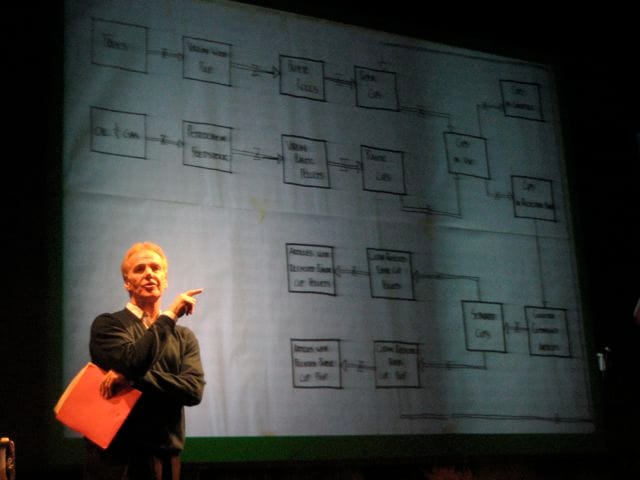
Starbucks consultant Peter Senge explains what's so complicated about a new cup.
In the world of sustainable marketing, few tales have grown as epic in scope as the redesign of the Starbucks cup. The coffee company seems to pursue its objective with the fervor of a moonshot; an effort that started in 2008 isn’t supposed to wrap up until 2015, and the company says it’s behind schedule. What could be so complicated about refashioning a paper cylinder with a plastic lid?
At the Sustainable Brands conference in Monterey on Tuesday, attendees learned just how far-reaching and complicated the effort has become. Starbucks wants to have 100 percent of its cups recyclable or reusable by 2015, with three sub-goals: complete a recyclable cup strategy by 2012, serve 25 percent of drinks in tumblers or permanent cups, and have front-of-store recycling in all stores owned by the company.
That’s ambitious enough, but a couple of presentations by Ben Packard, the head of corporate responsibility, and consultant Peter Senge of the MIT Sloan School of Management, made clear that along the way the project has turned into something much larger. Executives admit they have more questions than answers.
And if Starbucks is to be believed, it wants to transform not just the cup, but the materials used to make it, the process by which cups and lids are manufactured and recycled, and the role that customers play in the ritual of buying coffee.
Here are some insights from the conference:
Starbucks Recycles City by City. The company seems to have learned that, like politics, all recycling is local. Waste practices, haulers and rules vary by city and state, and Starbucks is in conversations with recyclers in the biggest cities that are most amenable to change. Customers in San Francisco and Seattle now have recyclable cups, Manhattan will have them by next month, and negotiations are underway in Chicago, Atlanta and Boston.
Old Materials in New Ways. The company has learned that most heavy-duty bottles in the U.S. are non-recyclable by design. Pure polypropylene is mixed with the dyes that make up a company’s colors and logo and then baked. This bastardizes the polypropylene, making what would otherwise by a valuable and reusable substance into something that can only be shredded and made into lawn furniture. Senge suggested that Starbucks might spearhead an industry standard that would preserve the value of the polypropylene by instead producing a plain white vessel with a thin, customized overwrap.
Putting It Back on the Customer. Starbucks wants to retrain its customers to bring their own cups to the store, as 80 percent of customers walk out the door with a cup in their hand. The obvious corollary is the durable bags that customers are now growing accustomed to bringing to the grocery store. “How do we make the cup the grocery bag?” Packard asked. “How do we make it the responsible choice?” On one day in April, Starbucks tried the “stunt” (Ben’s words) of giving a free cup of coffee to anyone who brought in their own tumbler.
First Contact Across Industries. Also in April, Starbucks held its second annual “Cup Summit” with paper manufacturers, suppliers, waste haulers and recyclers. It took Starbucks’ muscle to make it happen; Packard said that these meetings marked the first time that International Paper had ever sat down with leaders of the recycling industry to talk about the cradle-to-grave journey of any product, including a cup.
Let’s hope that the end result is a lot less waste, or perhaps none, from the world’s best-known coffee company. Too bad it will take until nearly the end of the second Obama administration for it to happen.

I always try to get rid of my rubbish responsibly but it’s at times depressing when I observe what many countries are doing to the planet!