 There are two reasons to be excited about my most recent column in Sierra magazine. One has to do with the topic, which is farmers using cow patties to fuel small electric power plants. The other has to do with the graphic we used to tell this remarkable story.
In this issue, for the first time in its four years of existence, the ‘Innovate’ column has expanded from one page to two. This is a permanent change (as permanent as anything can be in publishing) and is of enormous help in helping readers make sense of clean energy.
The main complaint I get about the column is “it’s so small!” A page eight inches wide is not sufficient to show the complex machinery and processes that make up the biggest technological revolution of the 21st Century. The change to a full spread provides room for the concepts to expand into the mind of the reader. I wish I could say the switch was occasioned by my brilliant reporting, but I believe it has more to do with the shifting priorities of the Sierra Club, which publishes the magazine. The Club has been extraordinarily successful with its “Beyond Coal” campaign that focuses on shuttering greenhouse-gas-spewing coal plants. But if the Sierra Club is going to truly catalyze a sea change in America’s power supply, it ought to put some focus on the “Beyond” part.
We are also working with a new graphic designer, Kate Francis, who is a pleasure to work with and creates vivid, approachable pictures.
So I invite you to enjoy the column without the squinting. Load the full size version onto your browser (pdf). Now we

Illustration of Steve Reinford.
can turn to the anaerobic digester that is the subject of this issue’s column. Seriously, take a couple of minutes and study the remarkable ways that a digester and its associated machinery chases down every scrap of waste and recycles it into something useful.
An outstanding example comes from the farmer I profiled, Steve Reinford. This Pennsylvania dairy farmer is one of the most creative and entrepreneurial in finding ways to turn noxious waste into dollars. In addition, Reinford accepts vegetable waste from 50 nearby Walmarts and Sam’s Clubs, which doubled the output of his digester while allowing him to collecting a dumping fee. He’s also perhaps the first to try other innovations like using the hot air exhausting from his generator shed to dry corn, and the waste heat from the generator engine to heat water that pasteurizes the milk for his calves.
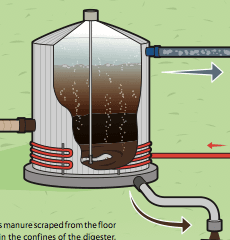 Along the way Reinford managed to cancel out one of his biggest liabilities: managing thousands of tons of cow manure. The neighbors complained about the smell. Like all concentrated animal feeding operations, or CAFOs, Reinford used to keep the cow poop in a giant manure lagoon (mmmm!) until time came to spray it on the crops. Even then, this natural fertilizer was sometimes more than the plants could handle and “burned” them with an excess of nutrients. Reinford says his lagoon never leaked or overflowed. But manure often escapes from CAFOs and is a serious source of pollution in streams, where it predictably doesn’t do fish any good.
Digesters have barely made inroads into U.S. farms; only 170 of the country’s 257,000 feeding operations have them. But it is starting to make economic sense. Just this week, a new and well-funded enterprise, Tamar Energy, launched in Britain with plans to build 40 anaerobic digestion plants that are expected to generate 100 megawatts of power. It is funded with $100 million from the Rothschild family and Fajr Capital, a venture-capital firm in Dubai — hardly a bunch of treehuggers.
The best argument comes from Reinford himself.
“We haven’t bought any fuel for the last two years for the house or the barn,” Reinford says. Each month he makes up to $1,300 selling digested solids as cow bedding and another $600 to $700 on renewable-energy credits. Add the excess electricity he sells to the grid and Reinford estimates that he’s making a pretax profit of $200,000 a year.”
Not a bad return from a pile of cow poop.

Leave a Reply