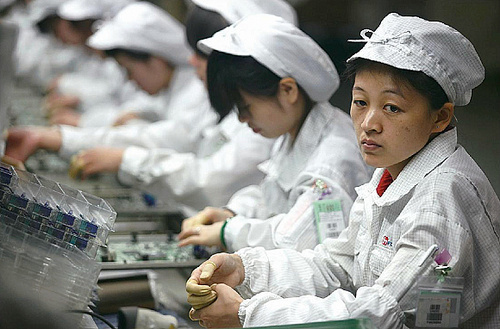
Workers at a Foxconn factory, China. Photographer unknown.
I almost forgot to mention an interesting story I wrote last month for Workforce.com about Apple and its recent misadventures in China.
The story, Who Makes Your Widgets? Lessons from Apple’s PR Nightmare, is addressed to companies worried about what labor violations might lurk in the supply chain. How can a company avoid a black eye like Apple’s?
Finding out what really goes on in a factory in China, Bangladesh, Honduras, or even Los Angeles is a daunting task. I heard that over and over again from companies hired to investigate the factories and do the site visits. These visits are known as “social audits.”
The auditors and factory managers play a cat-and-mouse game that can border on the absurd. The auditor’s goal to uncover abuses, such as the hiring of underage workers, sloppy safety procedures, and the maintaining of double sets of payroll to hide unpaid overtime. The factory manager’s goal (at a bad factory) is to hide such abuses during the auditor’s visit, so the manager may get back to producing things, and making money, as quickly as possible.
I interviewed Rachelle Jackson, the senior director of sustainability practices at UL Responsible Sourcing, and received a list of episodes that the company’s auditors experienced during site visits around the world. This “adventures in auditing” list is worth reprinting in full.
UL Responsible Sourcing In the Trenches
Lockdown in Los Angeles
While auditing a factory in Koreatown for a retail client, UL Responsible Sourcing found violations of wage laws that would potentially result in “hot goods” if found by labor inspectors. “Hot goods” mean the product cannot be shipped for interstate commerce due to wage violations, potentially allowing the Department of Labor to embargo the product. To avoid this scenario, the client wanted to take custody of their product immediately.
A three-person audit team from UL RS, along with a security guard, were sent back to the factory to take custody of the goods. When presented with the request to remove the goods, the factory owner pulled a gun out of his desk, put it under his belt, and refused to release the goods. The factory owner then decided to shut down the facility and told all his employees to leave the factory before he locked it up. One of UL RS’s auditor refused to leave and reminded the owner, “This product belongs to the client, not to you.” The owner locked up the factory with the auditor inside and went away. He called the police and shortly thereafter the factory owner returned to open the doors and let the auditor out.
Still, UL RS wasn’t able to take custody of the product and told the client that in all likelihood the factory owner would try to move the product out of the factory during the night. The client agreed to have overnight surveillance conducted on the factory – watching from a safe distance using binoculars – and at 5:00 a.m. the owner showed up with a large truck and began moving everything into the truck, including the sewing machines. UL RS called the client, who had several trucks and a team of workers on standby to come and collect their goods. They went straight to the site, took custody of their product, and took it away on their trucks.
Bribery Backfires
Bribes are offered quite often in factories in China, especially when there are major violations observed during a social or labor assessment. Melissa Tang and Stella Li, UL RS auditors, conducted an assessment at a printing factory in China that was particularly noteworthy because of the large amount of money offered, the manager’s insistence, and his emotional reaction to their rejection of the bribe.
After many inconsistencies were observed, the auditors asked the facility to provide more accurate payroll records for review. Soon thereafter, the facility manager placed four red envelopes containing RMB 40,000 (almost US $ 5,900) into the auditor’s bags and claimed that the offer made was not due to the inconsistencies, but as gifts for the coming Chinese New Year.
Tang and Li returned the four envelopes with the money and adamantly refused the offer. The facility manager kept trying to put the money back in their bags and a struggle ensued. Li finally got her bag back, put the four envelopes on the desk, and asked the manager to think about providing the real records, which he did not. The manager refused to have the closing meeting and stood at the door of the meeting room and locked it. Fortunately, an employee helped UL RS persuade the manager to sign the completed audit report and to let them go.
Hazards in Haiti
When UL RS auditors Rachelle Jackson and Wendy Barahona agreed to audit a factory for a large food and beverage manufacturer in Port au Prince, Haiti in 2007, they knew that political instability in the country meant a high risk of kidnapping (for ransom) on the road from the international airport. The client promised a security detail would stay with them at all times, but when they arrived at the airport only a driver from the factory was there to greet them.
Normally auditors wouldn’t accept transport from the factory to avoid being in a compromised situation, but Jackson and Barahona decided the factory driver was preferable to an unknown taxi driver and the threat of kidnapping.
During the audit, it became obvious that the factory had some serious issues including fork lift safety (Jackson was nearly hit by a fork lift racing around a blind curve at top speed), wage payments problems, and worker safety and hygiene (none of the toilets had worked for weeks, if not months, and were difficult to approach for inspection, must less to use).
After finishing the audit at the Port au Prince factory, Jackson and Barahona traveled to another city to audit a different part of the company’s operations. While there, they got an urgent phone message that the director, who was not happy about their findings, wanted to see them following their return to Port au Prince. Despite clearly informing the factory’s HR manager that they were not authorized to return to the Port au Prince factory but would be available at their hotel for any questions or concerns, the HR manager said, “Well, I am driving you back to the hotel, so we will just stop at the factory on our way back from the airport.”
Luckily, Jackson and Barahona were able to get a security detail to pick them up at the airport, so that they could not be taken back to the factory against their will. They left Haiti the next day.
Hiding in Warehouse With Workers
Upon arrival at a factory in China, Betty Liu and her auditor partner saw dozens of employees fleeing from their workstations to a stairway. They asked the facility contact where these employees were going and were told, “it was time for them to rest and that most of them would go to the rest rooms.” Since 9:45 a.m. is not usually a “rest time” in factories, the auditors sensed that there was something going on.
Liu (who had dressed like a factory worker to blend in) quickly put down her bag, took her mobile phone, and went after the employees. Together with other employees, she was guided to the downstairs warehouse. It was noisy and everyone was confused about what was happening and why they were there. Then, the warehouse controller shouted, “THE INSPECTION TEAM HAS COME. BE QUIET AND STAY HERE! BE QUIET!!” Then the light was turned off and the door was locked. It was dark inside the warehouse and everybody was quiet. Liu counted a total of 40 female employees – many young looking – in the room.
Liu then asked the warehouse controller to, “Turn on the light and open the door.” The warehouse controller asked, “Who are you?” Liu replied, “I am the auditor.” The warehouse controller seemed surprised, but opened the door. The auditors then started asking the warehouse workers their names, age, and when they started to work for the factory. Although many were reluctant and unwilling to talk, they got information on 17 of the employees – two who were only 15 years old – before management made them return to their workstations. The minimum working age in China is 16 years old.
The employee information sheet that Liu locked in a room during their lunch, was mysteriously “adjusted” to add 10 years to each of the child laborers. While management denied tampering with the information, they signed the completed audit outlining all of the violations found.
Confrontation in Cambodia
During a factory audit in Cambodia for a major U.S. retailer, auditor Rachelle Jackson was able to speak with 10 female workers during their lunch break about their working conditions, work hours, pay, and overall treatment. One of the older women in the group was the most vocal at the beginning, answering questions and saying everything at the factory was fine. As Jackson’s questions continued, some of the younger women in the group began to show signs of agitation. One girl faced the elder women. As she began to speak to them directly, her voice became strong and urgent; her face and eyes took on a determined look. Her hands began to wave around and move in front of her almost pleadingly.
Jackson jabbed her elbow at her translator, “What is she saying? What is she saying?” He had been so transfixed by the young girl’s appeal that he nearly forgot to translate. When he began the translation, Jackson understood the urgency in her voice. “They hit us,” the girl said. “When we make a mistake, they throw things or slap us. The things these women are saying are not true. They are not telling you what is really happening here. We are abused here.”
As the end of Jackson’s audit, she met with a dozen Chinese men who owned and ran the factory. They sat in a board room in their dark suits with Jackson dressed in her “factory clothes.” They understood English, but Jackson knew she had to keep it simple since there was no room for error trying to be diplomatic. “You can’t hit the workers,” explained Jackson. They looked at her in silence. Some of them nodded.
Saving Jobs in Bangladesh
When UL RS auditor Rashmi Bhalla conducted an audit in Bangladesh for a major U.S. apparel buyer, factory workers shared information about their working conditions that helped the auditor understand that the factory was not in compliance with work hours and wage laws. Having taken a risk in providing the truth to the auditor, workers asked for her contact information, just in case. Bhalla provided them with the name of the hotel where she was staying and, later that night, received a phone call from one of the workers. Everyone she had interviewed at the facility had been identified by the management and fired. Even though the auditor hadn’t shared information that would implicate the workers, the factory decided to fire them anyway for contributing to their failure in the audit.
Bhalla called her U.S. client and told them what had happened. The client was upset and called the vendor to demand that they contact the factory and require the workers be reinstated to their jobs. After a few days of sorting things through, including a meeting with the workers at the auditor’s hotel, the workers got their jobs back.
Five Employees in an Oven
During the health and safety facility audit in Guangdong, China, auditor Fred Waelter saw a production building that appeared to be empty on the side of the facility’s complex. Inside was a worktable where no one was working, and one employee who appeared to be by himself. In the center of the building was an industrial oven measuring approximately 2 meters tall, 4 meters deep, and 3 meters wide, with a door on two sides that locks from the outside with a bolt that runs flat across the door.
Waelter heard voices coming from inside the oven and discovered five employees inside when he unlocked the door. Four of these employees were from the hole-filling department, and one was a young-looking male worker that later claimed he was not directly employed by the facility but just helping out.
The auditor interviewed the employees involved in the oven incident and they all had the same story, “it was cold that day and they were too lazy to work, so they hid in the oven because it was warm there and no one would see them.” The employee who was standing alone outside of the oven said he had closed the door from the outside because he was afraid that the employees were going to get in trouble when the auditor entered that area.
This explanation did not seem plausible to the auditor because the employees were paid piece-rate wages, meaning their failure to work would result in lower wages, so it did not seem likely that they were lazy and decided to linger in the oven because it was warm there. Also, there was no light in the oven, so it seems unlikely that the employees were inside for a long period of time because it was completely dark when the doors were closed.

Leave a Reply