One little-known problem with the giant hydroelectric dams of the Columbia River in the Pacific Northwest is that they kill salmon, millions each year. It’s not just the adult ones going upstream to spawn, which have gotten lots of attention; it’s the young ones heading downstream. As many as 10 percent of salmon smolt perish as they try to wriggle through the whirling blades of hydroelectric turbines.
I’ll save my breath and let you read the fascinating story here.
But I do want to add one salmon nugget that didn’t fit in the story. The Sensor Fish is not just facilitating the redesign of turbines, but shining a light into another aspect of salmon behavior — and in the process is saving even more fish.
The Sensor Fish. Image Credit: Pacific Northwest National Laboratory
The Sensor Fish’s key contribution has been to flip the science of fish mortality on its head. Observers thought that what was killing salmon in hydroelectric dams was the blunt trauma of striking the turbine blades, or maybe concrete. But the Sensor Fish and its armory of sensors discovered that the culprit was an abrupt change in pressure as a smolt falls past the blades.
The pressure drop sometimes causes a fish to “burp” from its internal air bladder so by the time it reaches the tailrace (the bottom pool of the dam) it is negatively buoyant. In other words, it sinks like a stone. In order to restore its internal equilibrium, the smolt immediately surfaces to gulp some air. And at the surface an enemy awaits.
Birds of prey have figured out that the tailrace of a dam is all all-you-can-eat salmon buffet. They swoop down on the traumatized, beleaguered fish and add to salmon mortality.
Dr. Tom Carlson, the guy who invented the Sensor Fish, told me that awareness of this phenomenon has led to an easy fix. Managers of dams in the Pacific Northwest are starting to place nets over the tailraces of dams to frustrate the birds and give salmon smolts a little breathing room.
Keep an eye out for the Sensor Fish story in the “Tech Watch” section of Popular Mechanics in the May print issue. It will be accompanied by a sweet graphic that reveals how the Sensor Fish does its magic.
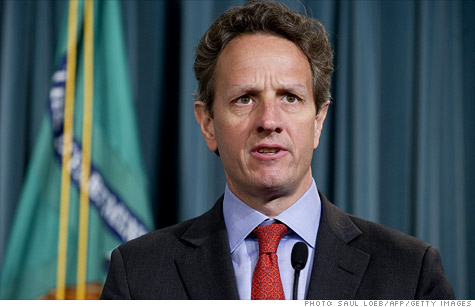
Tim Geithner, the stressed-out Secretary of the Treasury. Photo by Saul Loeb.
The blonde surf instructor clinched the deal with an offhand comment. We stood outside her shack a few blocks from the beach in Rincon, Puerto Rico, just after New Year’s Day, as I sized up a surfboard I might rent. “Tim Geithner rode this board just yesterday,” she said casually.
The United States Secretary of the Treasury rented this thing, seriously? The board, a nine-foot-four Greg Taylor in pale blue with lightning bolts down the rails, suddenly became an object of fascination. The man at the reins of our creaking economy, whose signature is on every freakin’ dollar bill, had spent New Year’s…surfing?
This comes as a surprise if you know anything about surfing and have ever seen a picture of Tim Geithner. The man approaches his job with a deep, abiding and un-surfer-like sense of worry. It is written all over his face.
At his best he looks wary and at his worst he looks hunted, like a man who might at any moment turn a corridor and face an angry mob of Occupy Wall Streeters with torches and pitchforks. This is not an unreasonable fear. In 2008 President Obama tapped Geithner as the point man to pull the United States back from the lip of economic Armageddon, and things haven’t gotten much easier since. Continue reading A Board Meeting with Tim Geithner
Illustration for the story at Ecomagination. Artist: Travis Barteaux
Did you know that only three percent of dams in the United States create electricity? What a waste. I heard this factoid a few months ago and was curious if anyone was trying to capture all that unused power. Yesterday a story I wrote on the subject was published at Ecomagination:
As I follow the sustainability and clean energy beat, I am repeatedly dismayed by how wasteful our industrial economy is — and encouraged that creative solutions are emerging to capture that waste.
In the course of reporting this story, I discovered that a new suite of businesses and technologies are coming into existence in order to capture the power of water that falls…a short distance. It is a niche that the hydropower industry has traditionally overlooked as it focused on giant, gigawatt-scale, river-blocking dams. Collectively the field is known as small hydro or low-head hydro (to indicate the drop is not that great).
I wrote mostly about retrofitting dams, but the field of small hydro hopes to wring clean electricity from all sorts of falling water: wastewater treatment plants, viaducts, even drainage pipes. How cool is that?
For this story, I took the liberty of coining two terms that, as far as Google tells me, aren’t in circulation: Dumb dam and smart dam.
A dumb dam is one that just holds water (for navigation, irrigation, drinking water, flood control, etc.) and misses the opportunity to produce electricity.
A smart dam is a multitasker that produces power while also serving some other valuable purpose.
While almost no projects are actually producing electricity yet, hopefully many of them will come online in 2013 and 2014. Let’s hear it for smart dams.
In August, just before Hurricane Irene hit, I visited New York City in search of its most interesting and attractive green roofs. The intention was (and still is) to produce a print story about green roofs in NYC, but the subject matter cried out to be videotaped.
So I whipped out the video camera and here are the results. Based on research and visits, I believe the five sites captured here represent the best green roofs in New York, and by “best” I mean I the most unique, diverse and beautiful. If there is a fabulous planted roof in New York that I missed, or another unforgettable spot elsewhere in the country that deserves attention, please let me know in the comments.
A detail area from the infographic for this issue's Innovate column.
For the current ‘Innovate’ column in Sierra magazine, I took a look at what’s being done to green the data center. The task was challenging not just because data centers themselves are complex, or because energy efficiency is hard to explain, but because creating an infographic that shows how these two interact was enough to make my brain bleed. I hope the graphic (done with graphic designer Brian Kaas) is understandable, and I welcome your comments on how it turned out.
Data centers have long been energy hogs, mainly because it takes so much air conditioning to keep thousands of servers from overheating. Meanwhile, these computing powerhouses continue to multiply and grow as more and more computing work occurs in ‘the cloud.” Now data centers are caught in two competing crosscurrents of the early 21st Century: the need for ever-greater computing power and the need to reduce our carbon footprint and energy use. How do we meet the burgeoning demand for data centers and have them collectively make less impact?
While researching this story I learned about the metric of Power Usage Effectiveness (PUE) that has become the industry standard in the last few years. You can’t manage what you can’t measure, and now that power usage can be measured, data centers are becoming dramatically more efficient. But PUE doesn’t tell the whole story. Organizations like The Green Grid are pressing forward on creating other metrics to reduce the footprint of data centers, such as Carbon Usage Effectiveness (CUE) and Water Usage Effectiveness (WUE).
Other efforts are afoot to make data centers work in tandem with sources of renewable energy, like solar and wind farms. A few months ago I wrote about one such research push being made by HP, AMD, and NYSERDA. But the field is young, and it will probably be years before anyone can boast that they are Googling entirely on power drawn from the sun.
Christian Belady
The profile subject for this month’s column is Christian Belady, the general manager for data center research at Microsoft. Belady is credited by many as the creator of the PUE metric and is a leader in prodding his employer toward greater computing efficiency. As a lover of camping, I was amused to hear Belady’s story about how he help start the drive toward energy-sipping data centers by shoving some servers into a tent during the Seattle winter, to show that they could operate just fine without all that wasteful air conditioning. Now that’s my kind of tough love.
A couple of weeks ago, midway through a flight from Frankfurt to Montreal, the pilot of our Air Canada flight came on the loudspeaker and said, “Passengers on both the right and left side of the airplane may want to raise your blinds and take a look at Greenland.” We did, and collectively gasped. I have flown over Greenland before, but never with this little cloud cover or with this crystalline clarity.
An eyeful of Greenland’s coast raised in me two contradictory responses. The first was, “Holy toboggans, look at all that ice! Where are my crampons?” The second was, “Should I be worried that there isn’t more ice?”
The legendary icecap of Greenland is getting smaller, and that is a reason to worry and to take action. The culprits are the carbon dioxide and other greenhouse gases that our cars, factories, and power plants (and yes, the plane in which I sat) spew into the air in ever greater quantities. They are trapping heat in the atmosphere and heating Greenland, the planet’s second-biggest collection of glaciers after Antarctica.
The breathtaking view from the plane made me want to visit Greenland and explore the unimaginable vastness of its ice. The great white expanse on the horizon of the photo continues for another 1,500 miles, nearly the distance from New York City to Denver.
But temperature trends point toward a lot less ice. In 2010, the melting season in Greenland lengthened by 50 days compared to the average. That’s almost the same as spring starting a month earlier and winter holding off a month longer. Meanwhile, Greenland’s capital, Nuuk, experienced the warmest spring and summer on record. Greenlanders have some reason to celebrate; their home is becoming a much greener and more pleasant place to live. For the rest of us, it’s not such good news.
If this freezer section of the Northern Hemisphere were to thaw out completely, it is estimated that ocean levels would rise 23 feet, in the process drowning most of our coastal cities. With leading Republican presidential candidate Rick Perry convinced that man-made global warming is a hoax and with the climate debate producing mostly hot air, there’s little standing in the way of the Big Melt. The view from 30,000 feet says that Greenland’s gleaming whiteness is something worth saving.
Last night I visited the Goethe Institut for a screening of The 4th Revolution, a German documentary that explores how a transition from fossil fuels to renewable energy would transform the world. It’s an inspiring, uplifting, and even important film, but not an easy one for Washingtonians to get their hands on.
So far, the movie has had three screenings: Once in March at the DC Environmental Film Festival, once as part of the “Green Screen” series put on by the Washington Film Institute, and yesterday’s well-attended showing. Each took place at the Goethe Institut.
Since that first showing there has been significant interest in showing at in other, non-German venues, according to Robert Robinson, an activist with DC Sun, which sponsored yesterday’s showing. (The film has English subtitles.) He said the Carbon War Room, the German Embassy, and the Solar Energy Industries Association have all wanted to screen it and spread the word. But so far the German producers have said nein.
Why the reluctance to put a film in front of such influential people? I sent an email to the production company that made the film, Fechner Media, but have not yet received a response. I’ll do an update if I get any other information.
The love affair started with a Mac much like this one.
When Steve Jobs announced last week that he is leaving Apple, I felt a stab of grief. Part of it is the sadness we all feel, losing the visionary who pulled marvelous rabbits out of the drab beige box of computing, and part of it is personal. My relationship with Steve and his creations goes all the way back to high school.
Steve Jobs and his co-founder at Apple, Steve Wozniak, both attended Homestead High School in Cupertino, California. Fifteen years later, so did I. Their names were first mentioned in the newsroom of The Epitaph, our school paper, because the two entrepreneurs had given us a computer. It sat in a closet and at first no one touched it. After all, we were busy assembling the paper by hand — cutting out the headlines, bylines, and text of stories with X-Acto knives, arranging them on boards of plywood with rulers, and affixing everything in place with wax rollers. Who had time for a computer?
But this nerdy guy on staff, Eric Ly, hunched over the glowing screen playing around with a program called PageMaker. After a little practice, he could complete a page in a fraction of the time that we could, and by the end of the year every page was being assembled by Eric and churned out on our snazzy new laser printer. Steve Jobs had shanghaied us into doing some of the world’s first desktop publishing.
Steve's first appearance on the cover of Time. Source: mac-history.net
About the same time my family replaced its electric typewriter with a Mac Plus. (Imagine, one computing device for a whole family.) We got our mouths around terms like “font” and “dropdown menu.” We learned that a “mouse” signified something other than a rodent and an “icon” something other than a person. One night I was finishing a big term paper for English class when I was visited by the dreaded “bomb” icon. The computer crashed and I had to suffer through an all-nighter to rewrite the paper. I’ve almost forgiven you for that, Steve.
When I went away to college I brought along a Mac II and covered it with In-n-Out and “Dukakis for President” stickers. I loved that machine. Many years later, after floppy disks had long since flopped, I reluctantly brought it to a computer recycling center in San Rafael. The recycling guy, a tower of junked electronics piled up behind him, turned my Mac in his hands and regarded it affectionately. “Aw, it’s so cute,” he said. “Are you sure you want to get rid of it?”
I put it back in the car. He was right, it was too cute to get rid of.
Then came the onslaught of the “i” products: iMac, iTunes, iPod, iTouch, iPhone, iPad, each more sleek and impressive than the last. Steve had cracked the code and made computing fun for the masses. Steve himself became the icon, donning the jeans and mock black turtleneck that made him as spare and instantly recognizable as his gadgets. The hits were wondrous indeed — but at the same time they elicited in me just the tiniest of shrugs.
They felt like candy, these new toys. We the Mac faithful had learned the beauty of Apple’s devices in the 1980s and clung on through the dark 1990s, during Steve’s exile from Apple and during those years when the PC crowd was seized by a puzzling excitement about Windows. And now the world was clamoring for the Steve aesthetic and the new converts lined up outside the Apple stores like children, children who needed to be entreated with something small and shiny.
Steve's latest appearance on the cover of Time. Credit: mac-history.net
But I should get off my high horse because I am as seduced by an iPhone as anyone else. I cradle its smooth shell in my palm like a toy. There are many machines and gadgets I use every day, but none of them emerge from a singular vision like those from Apple. None have the staying power, or have created a fraction of the enjoyment, as the machines that Steve has been dreaming up for thirty years now. Thank you for all you’ve created for us, Steve. You may have graduated, but we hope you’ll come to visit for many years to come.
Geothermal energy — or drilling down to trap the earth’s internal heat — is an exciting source of clean power because it exists everywhere and could supply a steady and reliable source of energy. But what does it look like, this power under our feet?
I was obliged to draw a picture of geothermal energy for my latest Innovate column for Sierra magazine. That’s harder than it sounds. I’m a writer, not a graphic designer, and I’m more comfortable with a reporter’s notebook than a sketchbook. But in order to fulfill the column’s mission of revealing the world’s coolest and cutting-edge energy technology, I had to dig down and find my inner sketchist.
I thought it would be interesting to show you how my original, hamfisted drawing turned into the sleek, glossy infographic you see in the magazine. Here, side by side, are my original sketch and the final, professional infographic that appeared in the July/August 2011 Innovate, Geothermal in Coal Country. (Click on the images to expand.)
My original drawing.
Final graphic by artist Brian Kaas.
The idea for this column started with one factoid: A study had determined that the most promising spot on the East Coast for clean, emissions-free geothermal energy was in West Virginia. West Virginia? Like, coal-belching, mountaintop-removing West Virginia? I made a few calls and got ahold of Brian Anderson, an assistant professor at West Virginia University. Over the course of several conversations, he laid out for me his complex yet ingenious scheme for harnessing Appalachia’s subterranean heat.
You can see the details in the column, but I’ll add that I was impressed by the scope of Anderson’s plan. He has done nothing less than re-imagine West Virginia’s energy system, using geothermal heat as the key to an interlocking set of energy loops that turns the clippings from the timber industry (the state’s third largest) into biofuel, and uses the greenhouse gas emissions from the local Mount Storm coal plant to drive heat from the ground. He’ll need buy-in from big industry if he hopes to build such a mammoth and expensive project.
My challenge was to present this graphically — a far lesser challenge than Anderson’s, but difficult nonetheless. (Neither Anderson nor anyone else had ever created a drawing.) How could I depict three distinct yet interconnected energy loops operating above ground, while showing another loop circulating 2.4 miles underground? With explanatory callouts? And do this in a graphic that’s less than eight inches wide?
After tapping my pencil awhile on a blank page, it occurred to me that I could show the underground portion with a diagonal cutaway that would take up only a small part of the graphic area. Above ground, I decided to take the three above-ground systems — homes, forests, coal plant — and give them each a chunk of real estate on the page.
Here’s what I came up with (the attractive final product was created by graphic artist Brian Kaas). What do you think? What could this ink-stained scribbler have done better? Many more Innovates lay ahead, after all, and I welcome the feedback.
On Friday, the Huffington Post published my story about DC Biofuels and its plan to create the first urban biodiesel plant on the East Coast. In short, DC Biofuels wants to take the used cooking oil from Washington, D.C.’s restaurants and make it into something truly valuable: biodiesel to fuel trucks and buses. I learned about it last week at a brown-bag lunch hosted by the DC Environmental Network, and left wondering if smelly old grease is on its way to becoming a valuable commodity.
Used vegetable oil is a messy material that restaurants long haven’t known what to do with; if poured down the drain it gums up the sewer, and traditionally the restaurant has paid to haul it away. Restaurants that make greasy fare, like fast-food restaurants and Chinese joints, can produce dozens of gallons of it a week.
These days, a proliferating number of enterprises will take a restaurant’s greasy leavings for free and try to make some money off it. In the D.C. area, the suitors include Greenlight Biofuels, Smarter Fuel and the American Renewable Fuel Institute. Another operator is Valley Proteins, which mostly converts old oil into animal feed. (If readers know of others, please mention them in the comments.)
Participants in the DC Environmental Network event groused that Valley Proteins isn’t a worthy recipient of played-out cooking oil because the company is using it for something other than fuel.
None of these enterprises have to pay for the leftover grease — yet. But as they get more established, how long will it be before the restaurants realize they could make a few bucks by selling it?
That would truly be a sign of our resource-constrained times.
Note: Thanks to reader feedback, this post has been modified from its original version.