August 1st, 2012  Water Street, the main avenue through Eastport, Maine. Photo credit: Wikipedia Back in May, I had the opportunity to visit Eastport, Maine, for a story I’m writing about tidal power. Eastport sits at the mouth of Cobscook Bay, which has some of the strongest, swiftest tides in North America. A company called Ocean Power Renewable Corp. (ORPC) is in the process of attaching several electricity-generating turbines to the bay floor. By September, the project is expected to deliver tidal power to the electrical grid — a first in North America.
The visit was both inspiring and depressing. Inspiring because ORPC is, after years of toil, about to inaugurate an entirely new source of power for our cities; depressing because the town of Eastport is quiet — too quiet. It lost 19 percent of its population between 2000 and 2010, home values are dropping, and Water Street, the main drag through town, was nearly deserted during my visit. Not a good sign during the Memorial Day weekend.
I wrote a post about Eastport’s predicament, and the solutions that tidal power may offer, for Forbes today. [Postscript: This has become a heavily commented-upon post, mostly by citizens of Eastport debating whether my take on their hometown was correct, or too negative.]
Read the entire post here.
July 26th, 2012  Image credit: Essess Essess is a Boston company that plans to drive by your home in the middle of the night and create an image that looks like this.
The footage was captured by an infrared thermal camera mounted on a Toyota RAV4, and the resulting picture has been tweaked into what Essess employee Navi Singh calls “campfire colors.” The blues and purples are the cool spots, suggesting that the insulation is adequate. What ought to worry you are the parts that are yellow and orange — that’s where heat (and money) are escaping.
Yesterday I did a post for Forbes about how the company’s business model could help make homes more energy efficient, and what Essess plans to do with that eye-catching picture of your house. Read the whole post here.
July 24th, 2012  Image credit: i.r.w.i.n. on flickr Creative Commons It almost goes without saying that the more gadgets we buy, the most waste we create. Our shiny iPhones, cameras and wireless routers get bypassed by something newer and even shinier, and eventually the bruised electronics end up in a toxic junkyard in China. But what if a new kind of device created less waste by its very design?
I blogged today about the emerging technology of wireless charging. It promises to free us at last from those long, tangled power cords we haul around, which would be great. Even more exciting, it could lighten our landfill footprint and brighten the prospects for electric cars. I invite you to read the post.
July 19th, 2012  Photo by Paul Bica / flickr creative commons I write about some pretty out-there ideas for my “Innovate” column in Sierra magazine, but the most latest subject is one that is almost ready for the big time. The technology is ocean thermal energy conversion, or OTEC. It is the unwieldy, unsexy name for a power source perfectly suited to islands.
I’m proud to have collaborated with Kate Francis at Brown Bird Design on what is probably one of the best drawings ever made of how OTEC works and what its uses could be.
Hawaii has been the site for the most successful tests to date, and the largest version ever is slated for construction in the Bahamas. For more detail on what projects are underway and who’s who in the industry, read the recent post on Forbes.
May 5th, 2012  The roof of the Vancouver Convention Centre, which I nominated as "Most Unique." This week, American Way magazine, the in-flight rag of American Airlines, published “Rooftop Wonders,” a story I wrote about the best green roofs in North America.
I composed this story, strangely enough, while aboard an American Airlines flight from Baltimore to Dallas back in March. As I typed I glanced out the window occasionally to inspire myself; after all, that’s exactly what I encouraged the magazine’s readers to do.
Green roofs are starting to catch on across America. Like so many environmental trends that started on the fringe, this one is gaining respectability because it makes better dollar sense than what we’re doing now. Traditional roofing materials like tar paper may be cheap, but blanketing the roof with dark material makes the building permanently more expensive to operate. It heats the building underneath and causes the dwellers to crank up the A/C in summer. Rooftop plants do the reverse, cooling the building in summer and also acting as a layer of insulation in the winter.
The green-roof industry is maturing and gaining expertise, and the costs for materials and installation are dropping. Furthermore, cities like New York are beginning to change their building codes to make it easier for developers (or redevelopers) to do the right thing. Witness the sprawling green roof being installed on the Javits convention center in Manhattan.
The benefits bestowed by a green roof don’t stop at the four corners of a building. Green roofs counter the heat island effect, in which cities become several degrees hotter than the open lands that surround them as the sun’s heat soaks into all that asphalt and concrete.
Also, when a rainstorm hits, a green roof clings to water that a regular roof would shed. That’s important because all those hard, impermeable surfaces of the city give water nowhere to go. A downpour floods into the sewer, where it can overwhelm water-treatment plants and send sewage into waterways.
Though green roofs are starting to grow in cities everywhere, they are usually invisible from the street. Even residents of those buildings that have green roofs are often not permitted to enjoy them — some of the plants best suited to rooftops are fragile and can’t handle much foot traffic. That’s why I’m happy to publish this story in an airline magazine. Oftentimes the air is the only vantage point.
So next time you fly into a city, keep your peepers peeled for the green roofs. Also, I invite you to watch the video tour I recently did of New York’s green roofs.
May 2nd, 2012  Searching about for a topic for a recent column, I stumbled across the work of Dr. Lenny Tender and his benthic microbial fuel cell. The idea blew me away once I grasped it. Tender, an electrochemist at the Naval Research Laboratory, procured a tiny but steady stream of electricity from …. river mud. Searching about for a topic for a recent column, I stumbled across the work of Dr. Lenny Tender and his benthic microbial fuel cell. The idea blew me away once I grasped it. Tender, an electrochemist at the Naval Research Laboratory, procured a tiny but steady stream of electricity from …. river mud.
Amazing indeed, but it also begs the question of who could use such a power source. One of the most tantalizing applications is as a battery-recharging station for underwater robots. Tender’s military paymasters are intrigued, and so am I; the mud-powered robot is the subject of my latest Innovate column in Sierra magazine.
Check out the the mind-bending simplicity of the idea.
Recharging a battery with silt is just about as eco as it gets. But what about the robots themselves? How will the wildlife of our oceans adapt to finned robots swimming among them? Feel free to sound off in the comments.
April 10th, 2012  Workers at a Foxconn factory, China. Photographer unknown. I almost forgot to mention an interesting story I wrote last month for Workforce.com about Apple and its recent misadventures in China.
The story, Who Makes Your Widgets? Lessons from Apple’s PR Nightmare, is addressed to companies worried about what labor violations might lurk in the supply chain. How can a company avoid a black eye like Apple’s?
Finding out what really goes on in a factory in China, Bangladesh, Honduras, or even Los Angeles is a daunting task. I heard that over and over again from companies hired to investigate the factories and do the site visits. These visits are known as “social audits.”
The auditors and factory managers play a cat-and-mouse game that can border on the absurd. The auditor’s goal to uncover abuses, such as the hiring of underage workers, sloppy safety procedures, and the maintaining of double sets of payroll to hide unpaid overtime. The factory manager’s goal (at a bad factory) is to hide such abuses during the auditor’s visit, so the manager may get back to producing things, and making money, as quickly as possible.
I interviewed Rachelle Jackson, the senior director of sustainability practices at UL Responsible Sourcing, and received a list of episodes that the company’s auditors experienced during site visits around the world. This “adventures in auditing” list is worth reprinting in full.
UL Responsible Sourcing In the Trenches
Lockdown in Los Angeles
While auditing a factory in Koreatown for a retail client, UL Responsible Sourcing found violations of wage laws that would potentially result in “hot goods” if found by labor inspectors. “Hot goods” mean the product cannot be shipped for interstate commerce due to wage violations, potentially allowing the Department of Labor to embargo the product. To avoid this scenario, the client wanted to take custody of their product immediately. Continue reading Hide-and-Seek in a Chinese Factory
March 26th, 2012  Fat cats don't much like my new blog at Forbes. Photo credit: Steve Hardy It’s been an eventful few months here in writer-land, with stories in Forbes, Sierra and Popular Mechanics. Take a look at the latest newsletter!
If you like what you see, sign up to receive future editions in the “Sign Up for David’s Newsletter” box on the right column of this page.
March 5th, 2012  Scientist-turned-filmmaker Randy Olson. Ecomagination has published my interview with Randy Olson, a most unusual kind of filmmaker. If you prefer to read it as a feature, it’s available in that form here. (Note: both stories are currently offline because of some glitch. Check back for updates.)
For the first half of his career, Olson pursued the career that is the dream of many a geeky adolescent: marine biologist. By the young age of 38 he actually achieved it. He earned a tenured professorship in marine biology at the University of New Hampshire.
But upon reaching his dream he found it wasn’t quite a fit with his personality and aspirations. You see, Olson harbored another unrealistic fantasy, that of being a documentary filmmaker. He thought he could do both by working as a full-time academic and making movies on the side. But that’s before the scientific community met his plan with derision and scorn.
“Had they supported what I had in mind I would have been happy to stay as a professor, but I could see the writing on the wall and now it’s 20-some years later and they have not supported one goddamn thing that I’ve done,” he told me.
So, in a breathtaking gamble, Olson resigned his position at the University of New Hampshire and moved across the country to resettle in Los Angeles, where he enrolled in film school at the University of Southern California. The professor was again a student, starting from zero.
He worked hard — and he partied hard –in Hollywood, and amazingly enough he made it all the way in his second dream career. Twenty-one years after his fateful decision, he is a bona-fide documentary filmmaker. But that might not be his most lasting contribution.
He also travels the country running workshops for young and mid-career scientists to teach them how to turn their research into a stories that the larger community can understand. It’s hard to overstate how important this service is.
A large cross-section of American society has been bamboozled into dismissing scientific findings that it doesn’t agree with, particularly when it comes to climate change. While much of the responsibility rests with those who fund the deception, some must be placed with the scientists themselves.
Scientists are trained from the beginning to speak to each other, not the public. They express themselves in charts, tables and dense technical prose that efficiently distributes knowledge through the scientific community. Scientists hope and assume that regular people (and politicians) will somehow catch the drift and let them alone.
But in the case of climate change, the politicians have certainly not left them alone. The reaction to this among scientists remains one of puzzlement. The researchers at the Intergovernmental Panel on Climate Change has assembles a giant edifice of research that would lead any reasonable person to conclude that humanity’s burning of fossil fuels is warming the planet, and that this warming is causing our oceans to rise and our weather to freak out, with grave consequences for the future of civilization.
But they are expressing it in the language of science, and that is simply not a language that a normal person can understand.
Olson hopes that with his deep background as both a scientist and as a communicator, he can help scientists and their discoveries to be better understood by John Q. Public. However, he admits that getting scientists engaged in bettering their communication skills is a hard sell.
“One third loves it , one third thinks it’s OK, and one third just wants to lynch me they hate it so much,” he said.
Why is it that scientists have such a hard time telling their stories? I’d appreciate your theories in the comments.
February 25th, 2012  There are two reasons to be excited about my most recent column in Sierra magazine. One has to do with the topic, which is farmers using cow patties to fuel small electric power plants. The other has to do with the graphic we used to tell this remarkable story. There are two reasons to be excited about my most recent column in Sierra magazine. One has to do with the topic, which is farmers using cow patties to fuel small electric power plants. The other has to do with the graphic we used to tell this remarkable story.
In this issue, for the first time in its four years of existence, the ‘Innovate’ column has expanded from one page to two. This is a permanent change (as permanent as anything can be in publishing) and is of enormous help in helping readers make sense of clean energy.
The main complaint I get about the column is “it’s so small!” A page eight inches wide is not sufficient to show the complex machinery and processes that make up the biggest technological revolution of the 21st Century. The change to a full spread provides room for the concepts to expand into the mind of the reader. I wish I could say the switch was occasioned by my brilliant reporting, but I believe it has more to do with the shifting priorities of the Sierra Club, which publishes the magazine. The Club has been extraordinarily successful with its “Beyond Coal” campaign that focuses on shuttering greenhouse-gas-spewing coal plants. But if the Sierra Club is going to truly catalyze a sea change in America’s power supply, it ought to put some focus on the “Beyond” part.
We are also working with a new graphic designer, Kate Francis, who is a pleasure to work with and creates vivid, approachable pictures.
So I invite you to enjoy the column without the squinting. Load the full size version onto your browser (pdf). Now we
 Illustration of Steve Reinford. can turn to the anaerobic digester that is the subject of this issue’s column. Seriously, take a couple of minutes and study the remarkable ways that a digester and its associated machinery chases down every scrap of waste and recycles it into something useful.
An outstanding example comes from the farmer I profiled, Steve Reinford. This Pennsylvania dairy farmer is one of the most creative and entrepreneurial in finding ways to turn noxious waste into dollars. In addition, Reinford accepts vegetable waste from 50 nearby Walmarts and Sam’s Clubs, which doubled the output of his digester while allowing him to collecting a dumping fee. He’s also perhaps the first to try other innovations like using the hot air exhausting from his generator shed to dry corn, and the waste heat from the generator engine to heat water that pasteurizes the milk for his calves.
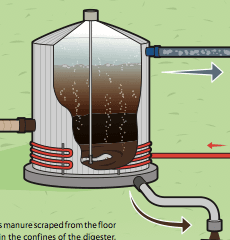 Along the way Reinford managed to cancel out one of his biggest liabilities: managing thousands of tons of cow manure. The neighbors complained about the smell. Like all concentrated animal feeding operations, or CAFOs, Reinford used to keep the cow poop in a giant manure lagoon (mmmm!) until time came to spray it on the crops. Even then, this natural fertilizer was sometimes more than the plants could handle and “burned” them with an excess of nutrients. Reinford says his lagoon never leaked or overflowed. But manure often escapes from CAFOs and is a serious source of pollution in streams, where it predictably doesn’t do fish any good. Along the way Reinford managed to cancel out one of his biggest liabilities: managing thousands of tons of cow manure. The neighbors complained about the smell. Like all concentrated animal feeding operations, or CAFOs, Reinford used to keep the cow poop in a giant manure lagoon (mmmm!) until time came to spray it on the crops. Even then, this natural fertilizer was sometimes more than the plants could handle and “burned” them with an excess of nutrients. Reinford says his lagoon never leaked or overflowed. But manure often escapes from CAFOs and is a serious source of pollution in streams, where it predictably doesn’t do fish any good.
Digesters have barely made inroads into U.S. farms; only 170 of the country’s 257,000 feeding operations have them. But it is starting to make economic sense. Just this week, a new and well-funded enterprise, Tamar Energy, launched in Britain with plans to build 40 anaerobic digestion plants that are expected to generate 100 megawatts of power. It is funded with $100 million from the Rothschild family and Fajr Capital, a venture-capital firm in Dubai — hardly a bunch of treehuggers.
The best argument comes from Reinford himself.
“We haven’t bought any fuel for the last two years for the house or the barn,” Reinford says. Each month he makes up to $1,300 selling digested solids as cow bedding and another $600 to $700 on renewable-energy credits. Add the excess electricity he sells to the grid and Reinford estimates that he’s making a pretax profit of $200,000 a year.”
Not a bad return from a pile of cow poop.
|
|

