In winter the New York streets are a gray asphalt tundra. Then one day in April…Daffodils! They nod at you on the sidewalk, bright as sunlight, gentle as Easter. Surrounding them is a tiny, valiant iron fence.
I saw a woman on 65th Street reach past the fence with one hand – the other held a cellphone to her ear — and grab two stems with her fingers. A gardener had nurtured those shoots, someone else had trucked them into the city, and yet another person did the planting. The result: yellow florets of gentility amid the concrete and exhaust.
I heard the roots rip from the soil. The woman carried them off to adorn a cubicle or kitchen table. Two freebies for her, two less breaths of fresh air for the rest of us.
Early this morning a congregation of about 150 Jews stood by the United Nations building and did something that seemed almost pagan: They blessed the rising sun.
I braved the chill and dark to join this event because it combined two rarities. Jews are everywhere in New York, but if one’s not Jewish it’s unusual to see them worship. And no one goes out of their way to celebrate Apollo in Manhattan. Dionysus maybe, but not Apollo.
The event, called a Birkat Hachamah, comes only once every 28 years, when the sun rises in the same position it did on the week the Earth began. That’s approximate, of course; to learn how the rabbis arrived at this date, read this informative New York Times story.
As the sun peeked out over the East River, a trio played music. The congregants sang along with “Dayenu,” a hymn of thanks that Jews will sing again tonight during Passover. Among the men in yarmulkes, a black man in long dreadlocks mouthed the words with tears streaming down his face. The rabbi Joshua Metzger spoke over the roar of construction trucks roaring across 1st Avenue.
The ancient tradition of Birkat Hachamah is more relevant than ever because, Metzger said, “These days, natural processes are seen to be as magnificent as the splitting of the Red Sea.”
I squinted at the sun rising up from Queens and said, Amen.
LEDs at Greenhouse go easy on the eye, and the electricity.
The other night I attended a fundraiser at Greenhouse, the SoHo club that claims to be New York’s first eco-disco. The rumors said Stevie Nicks would be there. Even more than her purring vocals, I sought a bigger hit: Can a hipster nightclub really be “sustainable,” or is it an illusion?
Since it opened in December in West Chelsea, Greenhouse has sought two stamps of approval. One is LEED status from the U.S. Green Building Council, to prove wise use of resources. The club claims to have installed low-flow toilets, swanky waterless urinals, high-efficiency ventilation systems and bamboo paneling. It bought wind-energy credits to supply the power for the speakers, which tonight played (you guessed it) Stevie Nicks.
The second and more important stamp of approval is, of course, the clientele’s. A “green” nightclub must walk an uneasy line: kind to the Earth, yes, but without denying patrons the sense of luxury that they expect. No one wants to party with Dudley Do-Right.
The magic bullet? LEDs!
LEDs are the no-brainer of eco-chic. They use one-thirtieth the power of incandescent bulbs, going easy on the power grid, but they are twinkly and pretty and still novel enough to be hip. As an environmental gesture they are easily and immediately understood. I can’t confirm of Greenhouse’s other environmental claims without examining the water bill or drilling a sample of the bamboo siding. LEDs, we get.
Selso, Tim and Bobbi keep it chic at a corner table.
Greenhouse lays them on thick. Thousands of them twinkle from every wall. Alongside them climb ivylike leaves. Greenhouse says these are real plants, treated with fireproofing material, but between my fingers they felt like plastic. Hundreds of crystals hung from the ceiling.
I found my friend Bobbi and her friend Tim at a corner table. Under the transparent tabletop sprouted an arrangement of pinecones. In a moment we met Bobbi’s friend Selso, who wore a black cloth over her eyes and was, as the song goes, too sexy for this club.
Since this was a benefit the drinks were free. I was so bowled over by this fact that I neglected to notice if my martini was made with Vodka 360, the eco-brand that Greenhouse promotes as its house spirit.
Then Stevie Nicks arrived and proved a big disappointment. She walked with her entourage straight through to the VIP area, said she was delighted to see us all, then surrendered the mike without singing a note. Half an hour later she left. I found it much more enjoyable to talk with Selso, who commented how handsome I was before she sashayed away for a drink. I asked Tim, “So how do you know her?”
“Oh, Selso’s not a her,” Tim said. “Selso is a man.”
My jaw dropped. I watched Selso turn heads as he swung his hips and showed just a glimpse of corset. Which just goes to show that in New York, the women, and the clubs, are not necessarily to be trusted. The sparkly things can deceive you.
Today I visited Washington, D.C. to cover the Blue Vision Summit, a gathering of ocean scientists and ocean activists, and rarely have I been so depressed and inspired in the space of a single speech.
Roger Payne addresses the Blue Vision conference.
That speech was the keynote by Roger Payne, the biologist who discovered in the 1970s that humpback whales have songs, and who has done hard-hitting research since. He hit the crowd with a dreadful five-minute litany of the ocean’s problems that aren’t global warming: rainforest destruction, cyanide poisoning by the aquarium fish trade, pollution by undersea oil wells, the slaughter of bycatch, sewage entering the ocean and coral reef deaths, to name a few.
He went on to talk about his signature species, whales, and his most passionate topic, whaling. He detailed how Norway, Japan and Iceland continue to kill thousands of whales each year despite international treaties. Even worse, he went on, harpoons are no longer the biggest whale killers. Rather it is suffocation in abandoned nets and poisoning of the whales’ food, tainted by the toxins humans have poured into the sea. Payne gripped the lectern so hard it shook.
Where’s that “inspiring” part, you might wonder? It came at the end. Payne concluded with something that everyone knew but needed to hear: “The chance to make a giant change has never been better than at this moment.”
That opportunity for change, embodied by our new president, is why 400 or so people crowded into a hall at George Washington University on a Sunday morning, after losing an hour of sleep to the beginning of Daylight Savings Time.
Barack Obama is, as one speaker put it, “the first bodysurfing president” and the first to grow up in the Hawaiian Islands. Following the Bush years, he’s a manta ray of hope for those who want the oceans treated more kindly. No one knows for sure whether he or Congress will champion the oceans or not. However, many attendees put their names to the sign-up sheets to meet Congressional delegations later in the week.
The conference was a clear sign that the ocean lobby enters the Obama era with a wind at its back.
I attended the Greener Gadgets Conference in New York City today, and pricked up my ears when the experts in electronics and design debated an urgent question: How can the ever-changing consumer electronics industry innovate without adding yet more gadgets to the trash bin?
Saul Griffith breaks down his personal carbon footprint.
The conference, now in its second year, met as both the electronics industry and the green movement suffer from the economic downturn. Half the seats stood empty in the conference room, and the show floor held more journalists than there were exhibitors to them to interview.
Keynote speaker Saul Griffith, a design pioneer, advocated reducing our carbon footprint through what he called “the Montblanc pen approach to design”: Make far fewer products, but make them so well that they never need to be replaced.
But does that formula apply to gadgetry that is in perpetual upgrade? Stephen Harper, the director of energy and environment policy for Intel, said his company hopes to foster “a culture of repair rather than replacement” – an easy argument to make when your company makes just the microprocessors.
On the same panel, Michael Murphy, the manager of worldwide environmental affairs for computer-maker Dell, pointed out that constant replacement has its pluses: today’s Dell PC is far more energy-efficient than one made six years ago.
One thing is sure: The goal of a “sustainable” cellphone or music player is still many product cycles away.
Hello, and welcome to my first movie. Last month I returned from a three-week trip to India, starting with Chennai in the South and then to the Golden Triangle of Agra, Jaipur and Delhi to the North. I shot footage from taxis, the bus and a bicycle rickshaw, and even from the back of an elephant.
This movie is all about motion because India is on the move these days. No matter where you go, people sweep, sell, travel, talk, argue and gesture with relish. Even in a land bound by such deep traditions one gets a sense of hustle. I hope this movie conveys that energy for those who haven’t yet seen India for themselves.
The Ferris Files has been so quiet recently that you might wonder if your trusty outdoor correspondent died suddenly without leaving a forwarding URL. Did a giant swell at Ocean Beach bury David’s head in the sand? Did he run too far up a trail and into a pride of hungry bobcats?
I’m writing to tell you that reports of my demise are greatly exaggerated and that the adventure continues here:
That’s right, A Year In New York. I’ve moved to the Big Apple for a year! From July 2008 until July 2009, I am reporting every day for 365 days from the biggest, liveliest, most rat-infested hive of activity America has ever known, New York City.
What is it like to be a newcomer to America’s premier city at the beginning of the 21st Century? What sort of trouble can an outdoor adventurer find in deep urban canyons, on an island surrounded by fast-moving rivers, with a little open space known as Central Park?
That’s what I’m looking to create in a daily snapshot. Have a look, and post a comment. I’d love to hear from you.
1. Click on the “Leave a Comment” link, in the grey bar below.
2. Make a comment such as, “Hello you two, I bought you this great gift.” Please include the exact product name/s, as some items in the registry are similar.
3. When prompted for your email address, enter David or Anjali’s email address. This way we won’t know who you are.
4. Don’t worry that your comment will be seen by others on the Internet. This comment will be forwarded to me, where I will gather the information and delete the message.
5. When we receive your note, we will remove the gift listing from the Registry page, so others won’t be able to claim it, unless we want a duplicate.
I have two jobs now, as a personal trainer and as an editor at Sierra magazine, the publication of the not-for-profit Sierra Club. All morning I roam around Marin, meeting Bob for a run or coaching Cathy through a set of pushups. In the afternoon I head to San Francisco to an office on Second Street and climb four flights to my cubicle, where I tap at a keyboard and talk on the phone.
This situation is extremely strange. Here’s some pictures that convey the strangeness.
Work at this office pays the big bills…
…but to save the environment, I work here.
These are the tools of my swanky job…
…and these are the implements of my nonprofit job.
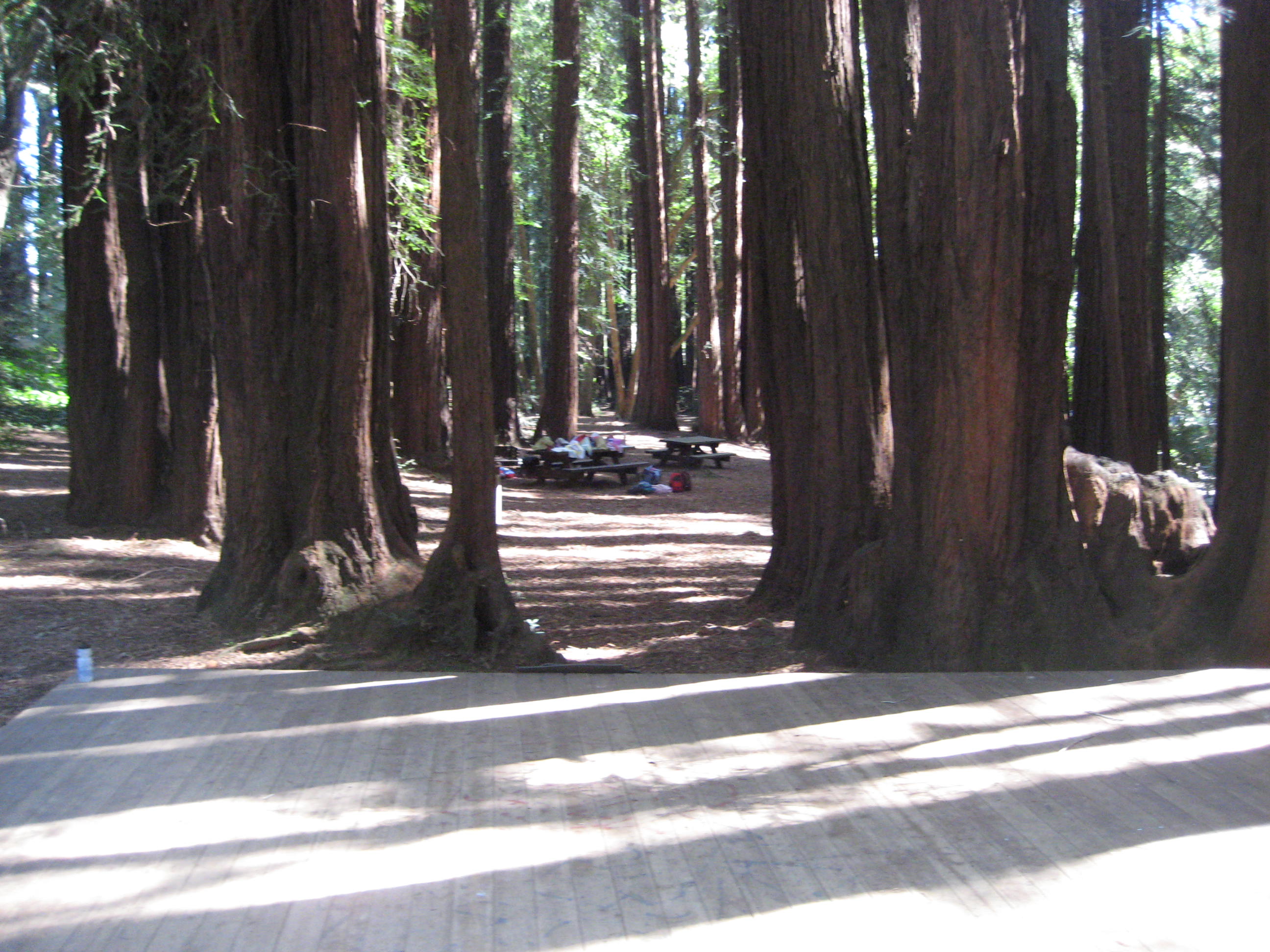
In an idle moment at my manual-labor job, I look up at this…
…and at my “green” job, I contemplate this.
This tells me that that things have gone so awry in America that the important work, even that which saves the world, compresses us into light-starved cubicle-crawling gnomes, with the best antidote being a foray into the outdoors for some fresh air. Once there, people have so thoroughly forgotten how to move that trainers like me are needed, to remind them how. No wonder our environment is in need of saving.
 In winter the New York streets are a gray asphalt tundra. Then one day in April…Daffodils! They nod at you on the sidewalk, bright as sunlight, gentle as Easter. Surrounding them is a tiny, valiant iron fence.