In the current issue of Sierra, I have a story about a new magazine called Meatpaper. This disturbing little publication got me thinking in an elliptical way about my girlfriend Anjali.
Meatpaper is memorable because it pulls meat out of the context in which we’re accustomed to seeing it. There’s no guide to the leanest cuts or recipe for a tangy marinade. Instead, there are profiles of butchers and reviews of artists who use meat as a medium and explorations of what meat means. Open its pages and I realize again that, oh right, meat is from an animal, a creature coursing with blood and a beating heart.
Anjali is Hindu and shuns beef, respecting the sacred role of animal life. At first I thought this would be a source of friction between us (I enjoy the burger, yes I do).
We have been together more than two years and I just noticed that I’ve almost stopped eating beef at home. I’ll go on a red-meat bender at a restaurant when the lust emerges, but that’s about it.
Anjali is also a surgeon. She spends her workdays cutting into the meat of our fellow humans. On the few occasions I’ve seen her wield a scalpel, I am cut to the quick. I get wobbly and have to sit down. Maybe that’s because I’m seeing something I’m not meant to see. Or maybe it’s because I catch a glimpse of what an animal I am, how despite my skills with a steering wheel and keyboard and cell phone I am no more than a sack of flesh and blood, vulnerable to the knife.
And, who knows? Perhaps even tasty in a tangy marinade.
Among the several hats I wear, I lead an outdoor workout for employees of the city of Mill Valley twice a week at lunchtime. This is a fun job and one with unexpected perks.
For an hour I hector a group of office workers, mostly women, to climb up and down flights of the fabled Dipsea Steps, and then I make them do all sorts of unpleasant, sweaty things with dumbbells in Old Mill Park. Often they are miserable. But they keep coming back.
This has been going on for several years now. One day a few months ago, while hanging around at the library that adjoins the park, I ran into the library’s director (and one of my students) in the company of a photographer.
The result is this photo which appears on the “Find Books & Do Research” page of the library’s website. The reference librarian in the picture is named Cathy and, truth be told, we are not finding books and doing research. We are clowning for the camera. Consider it our little secret.
San Francisco’s wastewater treatment plant sits directly opposite the city’s most popular surf break, but the doctored water doesn’t end up there. Nowhere close, in fact. The effluent is discharged from a pipe four miles offshore and 90 feet down – in other words, a fish’s problem, but not yours, unless of course you eat fish.
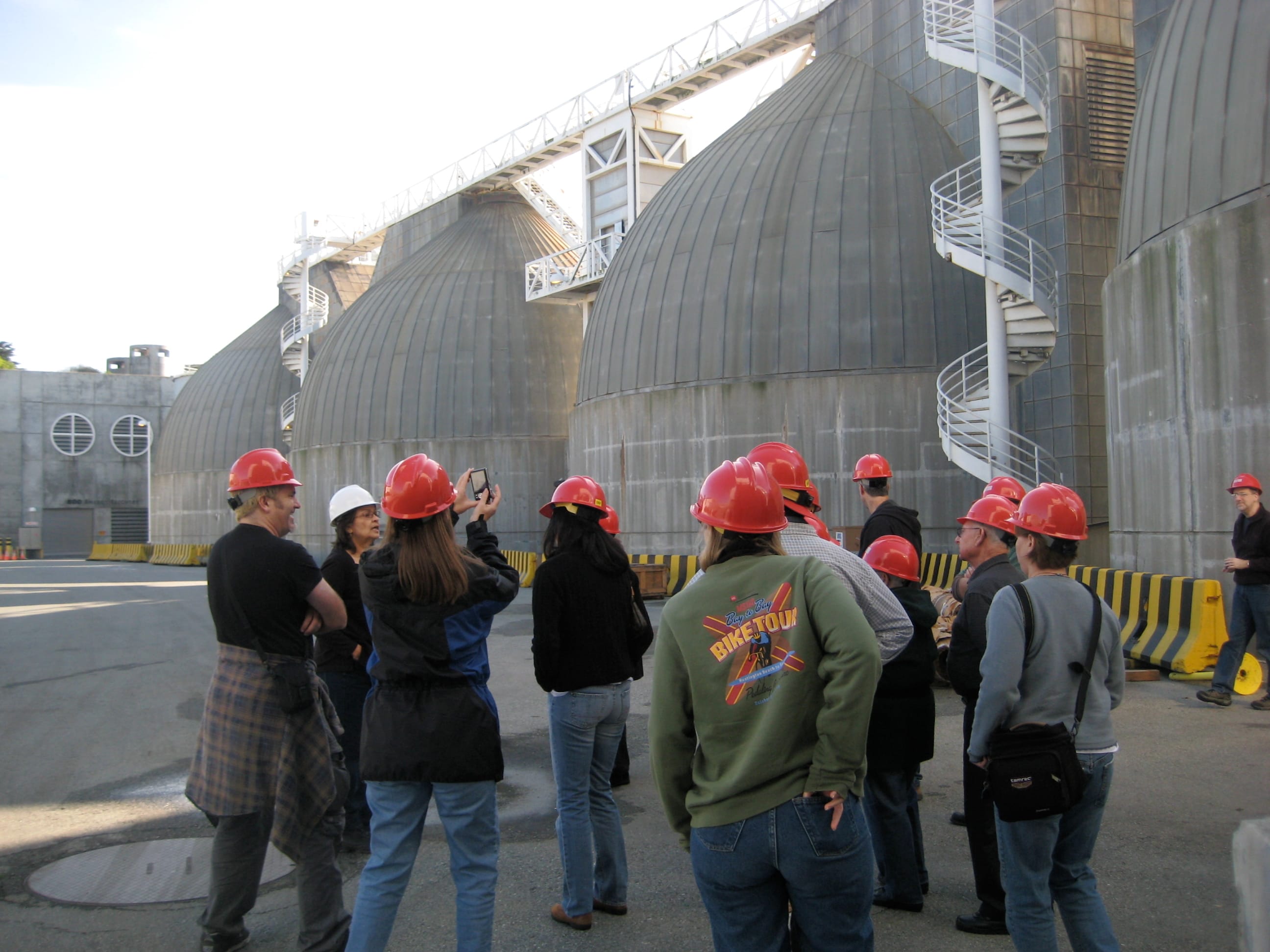
Our guide Catania led us hard-hatted curiosity-seekers to a little trapdoor in the floor, where we could see the water flowing out of the plant toward the deep blue ocean. Doesn’t look too pure to me. I took a video. Judge for yourself.
What does it smell like in a wastewater treatment plant? Not as bad as you might think. A powerful chemical-detergent smell pervades, masking something the nose can’t quite identify.
These “climber screens” are the first line of defense, where things like rags and sticks are taken out.
Once through the door and into the innards of the Oceanside Water Pollution Control plant, our guide Catania showed us the “influent gates” where the first big chunks are removed, and from there on to a series of vast, almost Home Depot-size rooms where alien activities took place.
One was the basement level of the 70-foot-tall, 750,000-gallon “digesters” where the solid waste is mixed with bacteria and, over the process of two weeks or so, turned into “biosolids.” This transformation emits loads of heat, which is harnessed to supply almost half the plant’s power.
The bottom of a digester looks like a concrete stalactite.
Where does all that stuff end up? About 60 percent of solid waste in the United States is turned into fertilizer. In San Francisco about a quarter of what goes down the drain and the toilet ends up tilled into the farms of Sonoma County.
Will I be able to forge this the next time I breathe in the aroma of a Sonoma cabernet?
As news emerges of sewage emerging into San Pablo Bay, it is only highlights how little we Bay Area watermen and -women know about the waste that might reside in our water. That was the question that motivated my recent visit to San Francisco’s wastewater treatment plant, 11 miles south of the spill and opposite the most popular surf break on Ocean Beach.
I drove down the Great Highway and past the entrance to the San Francisco Zoo, which has more to do with the neighboring treatment plant than most people know. The plant scrubs and burbles underneath the animals; seventy percent of the plant is dug into the hillside, making this the wastewater plant where one is most likely to be mauled by a tiger.
Following the directions I’d been given, I turned on a sidestreet I’d never heard of and through a tunnel with a massive gate that looked like it could withstand a direct nuclear attack. I emerged into an open courtyard with concrete buildings and to the left a row of onion domes 70 feet tall, each of which, it turns out, can hold 750,000 gallons of sludge. Wow, I thought as I craned my head out the car window. This is an operation.
A staff of 53 works round the clock every weekday, on an annual budget of almost $17 million, and all to clean the dirty water of just one third of the city, and a quiet third at that. That’s how much effort it takes to, in the words of our guide Catania, “get your dirty water clean again.”
Catania walked us across the courtyard to a metal door leading into the plant. We eyed it with caution. Behind the door the entire building hummed, almost rumbled. The plant consumes two megawatts of electricity daily, a third of that dedicated to ventilation. I pictured banks of giant generators rattling, red-lining, barely constraining San Francisco’s waste from surging into the streets.
She opened the door and a great wind blew in our faces.
A few weeks ago I braced my sniffer and joined a tour of San Francisco’s wastewater treatment plant. No, I’m not mentally ill. The Wastewater Enterprise Oceanside Plant sits directly opposite the break at Ocean Beach where I occasionally surf, and I wanted to know exactly what I’m swimming in.
The answer to that question turned out to be a lot less interesting than some other things I learned. Example: If a toothbrush is flushed down the toilet, it can, under unfortunate circumstances, melt inside a piece of high-performance equipment and cause $10,000 in damage.
It’s never occurred to me to flush a toothbrush down a toilet. I looked around at the 17 other people on this tour – kind, gentle people wearing red hardhats labeled “VISITOR” – and concluded that the kind of people who would tour a wastewater treatment plant on a Saturday morning are not the same people who commit acts of toilet-bowl terrorism.
This did not deter our guide, a stern, sixtyish woman named Catania, from enlisting us into the ranks of the hygienic. She passed on these gems:
— In order to get your hands really, truly clean, scrub your hands with soap for 20 seconds. This is as long as it takes to sing the “Happy Birthday” song twice.
— A major contaminant of SF’s water is dog poop. San Francisco is home to 140,000 dogs, which is greater than its population of children, and with poorer bowel control.
— Another polluter is the new DeYoung Museum, the copper façade of which is leaching heavy metals into the soil of Golden Gate Park.
— When you put synthetic towels, like wet-wipes or Swiffers, or down the toilet, you make the sewer people very, very unhappy. These things don’t degrade, and they collect, and then somebody has to go down there and break up the big clumps of sewage by hand. Bad news. The same goes for cooking oil.
And we haven’t even gotten to the tour, which I will have to cover in another post.
Two of my biggest passions, writing and the environment, have just come together into a new job. For the next few months, I’ll be the editor of “The Green Life” section of Sierra magazine.
As a writer it’s a unique opportunity to be the editor for while, see what life is like on the other side of the desk. Even better, I’m doing so on behalf of one of the largest and most storied environmental organizations in the country, founded in 1892 by John Muir.
Strangely, this green job will expose me to more concrete than any position I’ve had in years. I’ll access the offices at 2nd and Mission streets in downtown San Francisco via a rattling Muni bus, a few crowded city blocks and a wobbly elevator.
One headland north of my standard break is a beach called Rockaway that I have never surfed. I peer down onto it from Highway 1. The waves look inviting, but I have heard rumors of strange circular currents, huge sets, broken boards. I keep on driving.
My surf buddy Matt said the swell was small today so he was going to give Rockaway a try. Why not? I paddled out just before sunset. Rock pinnacles stood in black against a sky of apricot and lemon. Seven guys were out, Matt and I on our longboards and the rest shortboarders, locals, whooping and catching every good wave and slapping the lip with their aerials.
As the sun departed all the hotshots did too, leaving me and Matt alone in the undulating orange and pink. I paddled for a wave, dropped down the face and turned and there it was off my shoulder: a wall of water, steely blue, with its lip about to drop on my head.
My eyes are wide. This is virgin terrain. I have been surfing smaller waves, but now am getting into overhead territory, where the wave is less like a countertop and more like a wall. There is some elegant way to manage this moment, sneak under the lip and enjoy a long glorious ride, but I don’t know what it is.
I am coasting at the bottom of the wave’s parabola, where, if you graphed the wave out, the x-axis would originate. In this flat spot there is no speed or power. If I stay here the wall will topple onto me.
So I lean hard on my back foot, hoping I still have enough speed to climb the wave and ride down the line. In my desperation, though, I make the turn a little too hard, rocket straight up the y-axis and go flying off the lip.
I have launched off the lip before, but never on a wave this muscular. I go so far skyward that my arms start to pinwheel before I splash back down into calm water, the wave spending itself with a roar behind me.
Matt and I stay out until well after dark, navigating by the lights of the burger joint and hotel on shore and by the three-quarter moon blazing in the sky. When I catch a wave and can’t see its shape next to me, I know it’s time to call it a day.
I haven’t posted in a while, I know. I’ve been busy. Today Wiredran a story I wrote about science cafes. At a science cafe, a scientist lectures on his or her specialty at a bar, and people show up to learn and ask questions.
The cafes are spreading across the country on a shoestring budget and without much fanfare. They’re revealing that Americans aren’t necessarily a bunch of knuckle-draggers when it comes to science. People can be amazed by science at the right opportunity, especially if that opportunity involves beer.
Today the wind whipped Ocean Beach into a frothy soup, so instead of getting wet I ducked into the Wise surf shop. I consoled myself with sport’s second-greatest joy, which of course is buying new stuff.
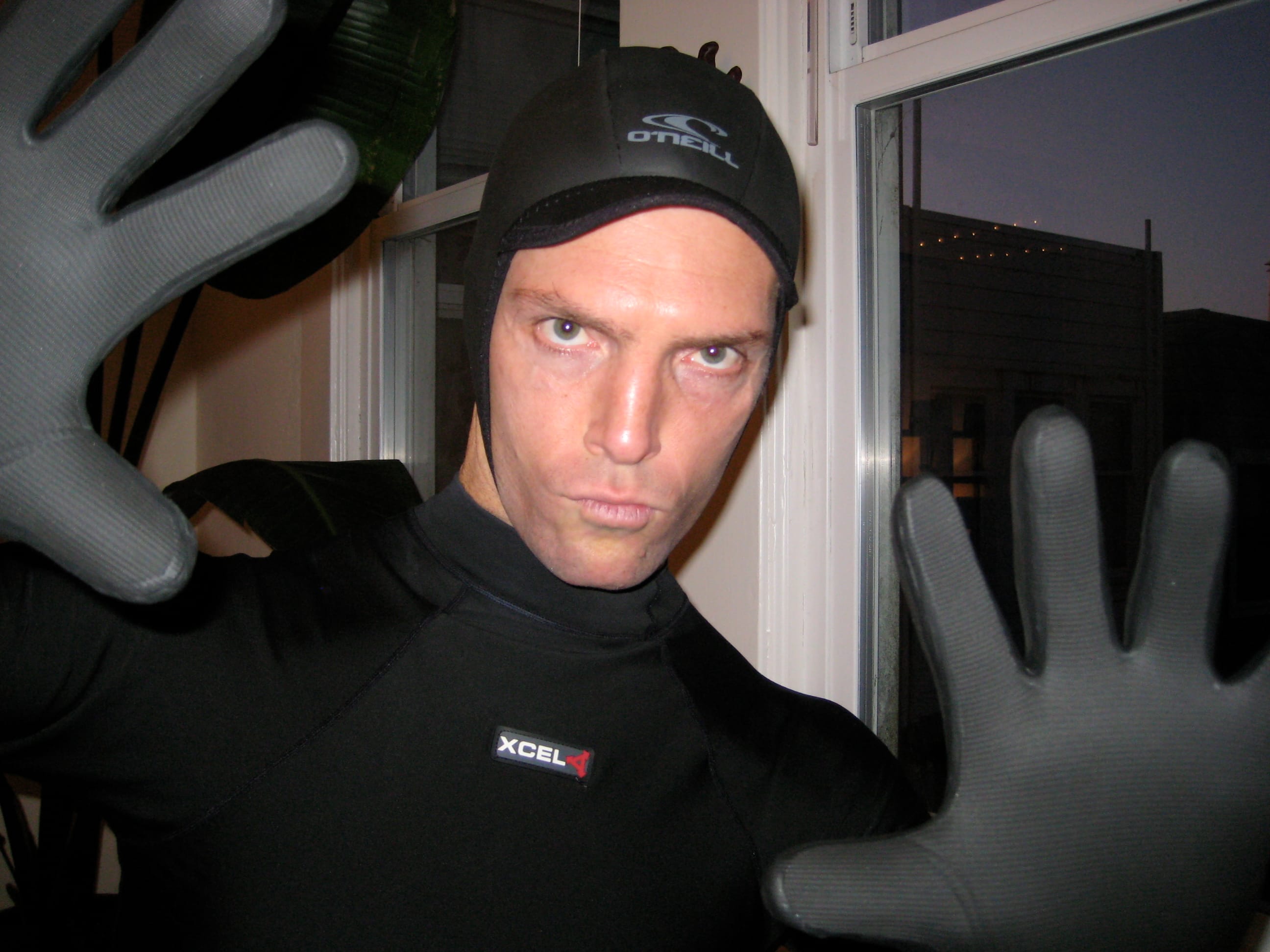
Yes, that’s me below, modeling the O’Neill SL Psycho Glove and the O’Neill Squid Lid, both in black. There is no other color. Among Northern California surfers, black is the new black.
I know what you’re thinking: These new synthetic rubber accoutrements round out my surfing look in the same way that a Versace suit just sings if you get the right handbag. But I admit it isn’t all about the looks.
There’s also the temperature. Today the air at Ocean Beach was 55 degrees, and the water was five degrees colder than that. It’s just so last year to come out of the surf all blue and numb and shivering.