September 13th, 2007 So that’s the kind of day this will be, I thought. Good waves, none of which I would ride; each would be snared by the superior surfers who lurked in a testosterone-addled cluster at the peak.
Then, inexplicably, all the obnoxious surfers left, probably for their pressing appointments to kick neighborhood dogs or steal candy from children. The sun remained, though, as did the light offshore breeze and the banks of fog at postcard distance. Every surfer was polite and did not hoard, and best of all, the cranky beast of Ocean Beach delivered the mellowest of waves.
Then, just when it seemed that things couldn’t get any better, a foursome of dolphins surfaced, not thirty feet away. Two big ones and two baby dolphins. Baby dolphins.
“All we need now is a rainbow, and an ice-cream cone when we paddle back to the beach,” I told the fat longboarder in the silver helmet.
“Yep,” he said, taking another gander at the dolphins sunning themselves. “Doesn’t get a lot better than this.”
September 11th, 2007 Rodeo Beach is a junkyard dog of a surf break. It is fast and steep and has bitten me every time I’ve visited it; this morning I tiptoed in, hoping to have a couple joyrides without making it angry.
 Only three other surfers were out and they placed themselves in the gunsight of the break, just 20 yards or so from the cliff that forms the beach’s north wall. I floated a little farther south, on the break’s crumbly shoulder, hoping for just that, some crumbs. Only three other surfers were out and they placed themselves in the gunsight of the break, just 20 yards or so from the cliff that forms the beach’s north wall. I floated a little farther south, on the break’s crumbly shoulder, hoping for just that, some crumbs.
An unassuming wave rolled by and I tried to hop aboard. Whoa, I’m up! I coasted the face with an ease and speed that surprised me (I haven’t been out in a while). The beach zoomed up under my feet.
The wave at Rodeo breaks almost right on the beach, as if a successful ride would leave you and your board stuck upright in the sand like a child’s sandcastle shovel. None of that. I jumped off the board and into two feet of water.
I repeated this. Two more times! The mean old dog was snoozing for sure. Wow. Could I head into where the real waves are and take my chances?
I watched a five-foot wave roll through and collapse on itself with a SMACK!
Naw, I thought. Don’t push your luck with a pit bull. Time to go home.
August 29th, 2007 I have long considered golfers a bunch of lazy so-and-sos whose greatest feats are 1) not spilling their lattes when they get out of the electric cart and 2) thwacking a tiny, spring-loaded ball across a giant lawn that has already been mowed for them by a Mexican.
 If that passes for “sport,” then we set a dangerously low bar for all those other sporty types like triathletes and hockey players and rodeo cowboys and wakeboarders who sweat and grunt and turn an ankle once in a while. Would you have respected Michael Jordan as much if, having just sunk a basket at the final buzzer, he had perspired so little that he could skip the shower and stroll right to the clubhouse for a bourbon? I mean really. If that passes for “sport,” then we set a dangerously low bar for all those other sporty types like triathletes and hockey players and rodeo cowboys and wakeboarders who sweat and grunt and turn an ankle once in a while. Would you have respected Michael Jordan as much if, having just sunk a basket at the final buzzer, he had perspired so little that he could skip the shower and stroll right to the clubhouse for a bourbon? I mean really.
I recently tried golf for the first time, and after just one round I discovered how to make it the rough-and-tumble adventure that sport ought to be. Follow these instructions and you’ll have plenty of stories to swap with your mountain-biking, bass-fishing, elk-hunting, ultramarathon-running, cow-tipping, midget-throwing buddies over a pitcher of Coors Light.
1. Par? Forget about it! The “conventional wisdom” of golf asserts that he who hits the ball the fewest times wins. What kind of rule is that? If you’re looking for a sporty kind of workout, the work ought to be done by you, not the ball. No one ever burned off a carne asada burrito by shooting a hole in one.
The more times you hit the ball, the more opportunities you have to walk, put down your golf bag, swing, send a divot of turf flying, curse, swing again, curse again, pick up your bag, and walk the five yards to your ball’s new position.
All that exertion is great for your heart. However, it might be unpopular with the party of golfers behind you, who will call you names and throw things. Ignore them. Remember, this is your workout and they’re just living in it.
2. Take the route less traveled by. There’s a reason that the poet Robert Frost wandered in the woods and not down a fairway. The woods are so much more interesting.
Golfers spend vast sums of money on swinging lessons and titanium drivers in order to make their game as predictable as possible, which could be summed up as “sending the ball down the fairway and to the hole by the shortest possible line.” To which I say: Booooo-ring.
Imagine that after a round of golf you head to a bar to meet your friends, who are grizzled and dirty from a few days in the woods and have an elk strapped to the hood of their GMC Yukon.
When you tell them about the perfect thwock your ball made as you birdied on the 14th hole, they will not clap you on the back and buy you a round. Rather, they will guffaw and demand that you buy them a round, and when they have spent all your money and left you passed out at the bar, they will steal your golf cart and stuff an elk eyeball into your drink holder.
If you want a good bar-worthy story, the last thing you want to do is stay on the fairway. Get comfortable with the bushes, the tall grass, and especially the stands of poison oak way off on the hillside. Hit the ball across other golfers’ fairways. When you get to a sand pit, really wallow in there, like a pig, if a pig wallowed in sand and carried a metal stick.
Note: bring a few extra balls.
3. Dress the part. Have you ever seen a pro football player at spring training going through drills wearing Dockers, two-tone leather shoes and a dumb little microfiber jacket? Of course not. That is because these are not the clothes one uses to exercise.
When you go on your next golf trip, consider wearing something more suitable to exercise, such as Converse high-tops or military fatigues or one of those reflective vests that make power-walkers look so cool. I go for the “Tony Hawk meets Lance Armstrong” look – plastic elbow guards and knee guards and those stretchy black pants that make the derriere look just smashing. Besides, it’s smart to wear a helmet; those little balls can come out of nowhere.
With these simple rules, you might be able to save your money on a gym membership and instead spend it on green fees, or rather, one green fee, as golf is just a leeeeetle more expensive than other sports.
When you limp back to the clubhouse, covered in mud and welts and grass clippings and with that big smile on your face, you may find the door locked. You might see that all the golfers inside are brandishing their putters as they cower behind a line of nervous Mexican busboys.
Remember it’s just because they’re jealous. Don’t take it personally. They just wish they could have a golf workout that’s half as exciting as yours.
August 14th, 2007 Last Thursday I played my first golf game ever. The first tee at the Presidio Golf Course is a doozy, a 362-yard drive that doglegs to the right so hard that you can’t see the green through the trees.
I squared up to the ball – somewhere I heard that’s what you’re supposed to do, square up – and ignored the stares of my companions, including my Dad and two guys named Billy and Gus. Everyone wondered how the new guy would do. I swung.
 Thwack! The ball sailed long down the fairway, past where the other three men had hit, and sliced it to the right – that’s what you call it, a slice – around the trees and toward the hole. Thwack! The ball sailed long down the fairway, past where the other three men had hit, and sliced it to the right – that’s what you call it, a slice – around the trees and toward the hole.
“Oooooooooohhh,” everyone said together.
It was all pretty much downhill from there.
On the third tee, I sent two balls into the berry bushes with such extreme prejudice that I probably created some tasty berry jam, if only I’d been able to find it, or the balls.
I sliced another ball so high into a stand of Monterey cypress that I thought it might just stay there. Then I saw the white dot fall. The ball landed on the asphalt path, and upon encountering such a hard surface it rocketed all the way across the adjoining fairway, where I had to make a walk of shame past another party of golfers. I did this not once but twice.
At least they didn’t yell at me, like the party of duffers behind us. My zigzagging, par-12 style was probably annoying them plenty. Then I landed in a sand trap (first of three times), fought my way out and walked off. “Hey! Clean the trap!” someone hollered. Ooops. I guess that’s what that rake next to the sand trap is for.
All of this was a blast, I’ll have you know. The nice thing about being a new-sport virgin is that everything you do is a personal best.
“That,” I told Dad after another ten-stroke disaster, “was the best fourteenth hole I have ever shot.”
August 8th, 2007 I discovered the tip of the Baja Peninsula six years ago, when my friend steered her Jeep off the carretera, down an arroyo and right onto the sand. The ocean tinted green and blue like the Caribbean and invited us to lose our sandals. The beach stood empty. Looking around I saw the land was too; nothing but cactus all the way to the mountains. Where are the people? I wondered.
I visited again last week and found the people. In my absence the entire snout of the Baja peninsula – the area between San Jose del Cabo and Cabo San Lucas known as “The Corridor” – had been colonized by hotels like the Querencia and the Westin Regina. Somebody sprinklered the desert and spawned golf courses. They paved roads for the SUVs and in the medians they planted yucca and blue fan palms, wild plants made tame.
 And the concrete trucks are just revving their engines. All over Cabo San Lucas and in the smaller towns along the coast, the empty windows of half-finished cinder-block buildings stare back at you. Rebar reaches into the sky like minarets. At the new Home Depot, “Grand Opening!” banners snap in a dry wind. And the concrete trucks are just revving their engines. All over Cabo San Lucas and in the smaller towns along the coast, the empty windows of half-finished cinder-block buildings stare back at you. Rebar reaches into the sky like minarets. At the new Home Depot, “Grand Opening!” banners snap in a dry wind.
Part of the appeal of Mexico is eating tacos de camaron at a roadside palapa when a rusted-out old Chevy rattles past with its tailgate fastened with baling wire and five guys standing in the back.
Now there are roadsigns reminding you that seatbelts are the law and the truck speeding by is much more likely to be a shiny and sleek Ford F-150 Lobo. Which is fitting because everyone seems to be moving just as fast as they can. Look around the traffic entering Cabo San Lucas and you see a lot less cowboy hats and a lot more button-up cubicle shirts.
Drive north from Cabo San Lucas and immediately the landscape opens to wilderness again. On the road to Pescadero, however, I passed by a gated community, or at least the shell of one; it had a gate, a street, a guard, but not a single building yet. Flags flapped above a wasteland of cactus, which made me wonder what exactly the community was gating itself against. Tarantulas, maybe?
When I come back in another six years, I am sure I will find out.
July 31st, 2007 Just as I visited Libby, Montana, the town was putting a bold new face on its tragic past, a face with beady eyes and a curved beak. The morning of July 4 saw the official inauguration of Libby as “The City of Eagles.”
[nggallery id=2]
Libby does have real, blood-and-feathers eagles, as evidenced by the Eagle Cam, but it’s the giant steel ones that really grab your attention. They are apparently the handiwork of the high-school shop teacher, who is displaying skills beyond the classroom.
July 31st, 2007 Storefronts can reveal how a town makes its living. On a sunsplashed morning in early July I drove slowly down U.S. Highway 2 through the mountain town of Libby, Montana, tallying enterprises that together made no sense.
Six tiny casinos, none of them any larger than a Denny’s, and two or three state health offices and, right downtown, an office of the Environmental Protection Agency. Curious.
I also saw a sign pointing toward a mine. “Is that how Libby makes money?” I asked our hosts, Jana and Dave. They were to be married the next day and my girlfriend Anjali and I were there to celebrate with them. We all were tucking into scrumptious plates of huckleberry flapjacks and hash browns at the bustling Libby Café on the street that comprised downtown.
“Well, it used to…” Dave said reluctantly.
The Zonolite Mine outside of town is the world’s largest repository of vermiculite, a mineral that is an ingredient in fireproofing, insulation, and many other products and that for decades made Libby a prosperous mining town.
Residing under the soil with vermiculite was tremolite, which, it turns out, is one of the most toxic forms of asbestos and thus a cancer-causing killer, according to the newspaper report that revealed the scope of the tragedy.
The mine ground up rock and spewed its tailings in the form of white dust that traveled home on the clothes of the miners. This dust blew into town sometimes, where children would draw figures in the dust on the cars. In the early 1990s a doctor called attention to the ridiculously large number of respiratory problems among miners and their families.
As of 2001, as many as 30 percent of the town’s population of 2,600 had contracted a fatal disease, and hundreds had died. The W.R. Grace Company, which owned the mine and knew about its deadly contents, has paid out millions in settlements to the citizens of Libby. But legal reparations haven’t rehabilitated the town, where heathcare agencies are still the biggest employer.
It is startling to learn that the town you visit on vacation – lounging in a hot tub, eating flapjacks, admiring the Cabinet Mountains rising out of town – is, by the way, the epicenter of the largest community poisoning in U.S. history.
July 17th, 2007 Today I would like to take a moment to thank the heavy-metal band AC/DC and its unique assistance it has lent to drunk white people who can’t dance. I am, of course, talking about the 1980 anthem “Back in Black,” which is legally required at wedding receptions in 28 states.
 Our collective debt to this Aussie quintet became apparent at a wedding I attended in Troy, Montana a few weeks ago. The DJs had pointed their speakers toward a wooden deck and served up a whiplash-inducing variety of music – country swing, then screaming grunge, and then a little hip-hop, leaving everyone confused and the dance floor pretty much empty. Our collective debt to this Aussie quintet became apparent at a wedding I attended in Troy, Montana a few weeks ago. The DJs had pointed their speakers toward a wooden deck and served up a whiplash-inducing variety of music – country swing, then screaming grunge, and then a little hip-hop, leaving everyone confused and the dance floor pretty much empty.
Late in the evening, when the locals had taken some beer, the opening guitar salvo of “Back in Black” burst from the speakers, accompanied by AC/DC vocalist Brian Johnson, who sings like a parched desert nomad who has just been attacked by a cat. Suddenly, men who had been avoiding the dance floor like it was the perfume counter at Macy’s grabbed their gals’ hands and moved toward the floor.
It was as if a virulent strain of epilepsy had swept through northwestern Montana. People herked and jerked and scrunched up their faces and muttered along with the incomprehensible lyrics which, I’ve concluded after some research, include, “So look at me now, I’m just a makin’ my pay, Don’t try to push your luck, just get outta my way.”
I am unsure what these lyrics have to do with the holy union of marriage. I am also unsure what the sign of the devil has to do with marriage, or for that matter with AC/DC, but when listening to “Back in Black” the fingers just naturally stick out that way, as you can see (that’s me with the bride).
I can only assume that this song is an unlikely force for good.
Or at least a force for “it felt good at the time.”
June 27th, 2007 If you stood on shore and watched me surf, you would not be reminded of the muscular boardwork of Laird Hamilton or the boys of “Endless Summer” cruising off Diamond Head. You would watch me pitch face-first off my board, again, and ask yourself: Should I call 911?
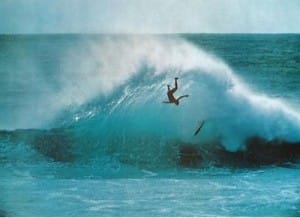 Photo Credit: your-local-surf.blogspot.com Then, as you saw me sputter to the surface, you would think, Wow, that guy must really love surfing. I have been surfing sporadically for seven years now and am proud to say I am no longer awful. But the learning curve has been almost as painful as the wipeouts. If one learns from falling, I ought to be a Rip Curl posterboy.
Fortunately my shortcomings can be explained with simple math. The overwhelming majority of time one spends “surfing” is, in fact, just a bunch of floating. Go ahead and watch sometime. Occasionally a good wave comes through and then it’s time for the falling (off the board that is). And once in a while, when the right wave comes through and you don’t fall, then you’re surfing. On a good day, this will represent 30 seconds of a three-hour surf session.
By this arithmetic, in my seven years of “surfing,” I have spent, optimistically, ten minutes actually riding a wave. This is about the length of two runs at a ski resort. Think of this when the paramedics pull me from the water, and please look appropriately sympathetic.
The damn thing is I love it anyway. I love strapping the board to my roof. I love floating out through the chaos of whitewater to the smooth swells. I love watching the birds wheel overhead and the sun glistening on the water. I love the drama inherent to a wave, coiling in silent power as it heads toward land. I adore a good ride, of course, but I even love the wipeouts – falling down the face of a wave, arms pinwheeling as if I’ve been thrown from a skyscraper, getting tumbled in the power-washer, and, after this epic catastrophe, bobbing to the surface intact and having the chance to paddle out and try it all over again.
June 20th, 2007 I hadn’t quite finished pulling in behind the van when from its driver’s seat hopped a woman, a little Filipina in a huge denim shirt and with a band-aid under her left nostril. She wanted a jump.
 Photo Credit: jstangroom's flickr page Sure, I said. Something about her seemed a little strange, but a dead battery is a dead battery. I drove my shiny little red box of a car around so it was nose to nose with her hulking van, which, I now noticed, was more than a little dirty and piled high in the back with stuff. She produced a set of jumper cables and she mumbled something about being in town to visit her daughter, who is in the Navy, and her battery being dead because she’d left a light on overnight.
So I connected the red end of the cable to the red lead of my battery and the black clamp to the black lead, just like dad taught me, and experienced the same pang of doubt I have no matter how many times I use jumper cables. Wait – is it positive to positive and negative to ground? Or negative to negative and positive to ground? Or does it need to be grounded at all? The hell with it. Let’s see what happens. I got back in my car and turned the key.
She climbed in behind her wheel. Nothing happened for a moment. Then I saw smoke curling gently from the seams of her battery. Smoke began to drift up from other parts of her engine compartment too, and I quickly switched my car off before something caught fire.
The air smelled like fried wire and when we got out to look the reason was obvious: every piece of cable we could see in her engine was smoking, its rubber housing melted off. The jumper cables were hot to the touch. As I wincingly removed them from my battery I noticed that cable itself had gone soft and melted a black smudge on my grille.
She had mistakenly attached the red to the black and the black to the red, so instead of charging her battery I had given her a giant power jolt, like a child sticking her finger into an electrical outlet.
“I think, uh, I think your car might need to be towed to a repair shop,” I said, feeling apologetic though I hadn’t actually done anything wrong. “A jumper cable isn’t going to do a lot of good.”
“Yeah, my car needed a jump the other day too,” she said, unperturbed. “I ran out of gas and it just died at the station. Can you believe it?”
Do you need some help?
“No, I’ve got a friend coming. We stay sometimes on 14th Street in West Sacramento, at the homeless shelter. Do you know it?”
I shook my head, no. I got back in my car, which has its insurance paid and tags valid and its oil changed recently, the kind of little measures that assure me my car – and life – is in good working order. I knew a little problem with my car could turn into a big problem. She didn’t seem to have the same foresight. And she’s homeless.
Which makes me wonder. Maybe a person ends up homeless not because she’s lazy or unlucky, but because somewhere in her circuitry a fuse blew out. Maybe a disturbance like that makes a person blind to a small problem becoming a big one.
|
|



