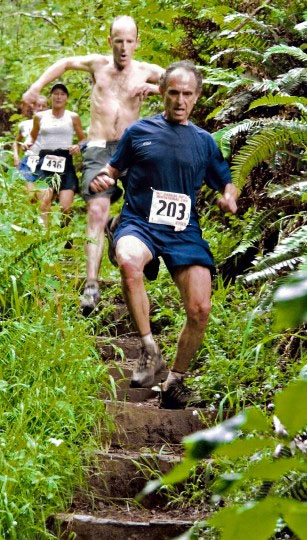
June 13th, 2007 I am barely three minutes into the famous Dipsea footrace and though my lungs are heaving and my quads are burning, my mind is sharp as cutlery, having already drawn up and finalized a list of five reasons to explain why this race will end in miserable failure.
 Photo Credit: dipsea.org I have trained too little; I have eaten too much; it is beastly hot; I woke up tired. Also, this race is stupid, so who cares. The list is so complete and satisfying that I silently congratulate myself for thinking so clearly under duress.
Other runners are streaming past me at a steady rate as I climb the 672 steps of the Dipsea Steps and continue up to Highway 1 and then down toward Muir Woods.
Ain’t no big, I say to myself, and go back to rehearsing my excuses. This time I imagine I am telling them to, of all people, my client Cindy. My body is pounding down Highway 1 but in my mind I am saying to Cindy “it was soooo hot out there.” Cindy nods sympathetically.
The Dipsea Race is an easy place to make excuses if one is so inclined. The course is 7.1 miles long and pretty much straight up, or straight down. It is the second-oldest footrace in the country after the Boston Marathon. Since 1904, people have been hobbling up the trails with pained expressions and throwing themselves down the steeps like lemmings bent on suicide.
We do it…well, no one can adequately explain why we submit ourselves to such torture, but Marin runners can’t get enough of the Dipsea. People wait in long lines to grab one of the 1,500 spots and then lay out race-day strategies as intricate as Napoleon’s.
My comfortable reverie of excuses is uninterrupted after I plod up an endless and relentlessly sunny section of uphill called Hogsback and enter a stand of trees and their shade. Shade. I can handle this race if it’s cool. And I start running harder, just like that.
I am flying. Forget about excuses; there are too many runners to pass. “On your left!” I breathe into the ear of a hapless woman in a pink baseball cap.
I end up finishing the race, at a little park on Stinson Beach in front of a cheering crowd, in one hour 13 minutes 21 seconds, more than five minutes slower than last year. I lurk around the finish line suspecting my showing is so poor that I will not make Invitational (the top 750 runners are invited back to race again).
But as it happens I place 464th, dropping just 74 spots from last year. It seems everyone wilted in the heat. Instead of entirely sucking I was just a little off.
Somehow this is a bit of a letdown. It only seems fair that this great list of excuses I compiled should be shared, enjoyed, even emulated. So, what do you think?
June 6th, 2007 Driving out of Santa Fe, my girlfriend Anjali and I made one final stop to see the New Mexico state capitol building. We stopped in the middle of the street – no traffic anywhere – and looked around expectantly.
“It’s supposed to be right here!” Anjali said.
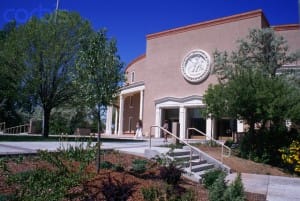 Photo Credit: Corbis The capitol, we concluded, must be the adobe to the right behind a row of suburban trees. That it was made of adobe was not the surprising thing. Everything in Santa Fe is made of adobe – houses, office buildings, freeway overpasses. The modest brown rectangles everywhere charm the eye and create a strange anachronism: I am driving a Hertz rental car through an 18th Century pueblo.
(Imagine the titanic battles over building materials that must have been waged on the city planning commission. “Adobe bus shelters for the people!” one cried. “Keep the fire hydrants red!” another yelled.)
No, the surprising thing about the state house is how easily I could mistake it for, say, a medical-supply company or a Presbyterian church. Even when we drove around and got a full-frontal, it lacked everything I expect from a seat of government. No marble, no Greek columns, no sky-piercing dome, just a two story building with a flat top. There wasn’t even the obligatory obelisk to remind the legislators to stick it to somebody today.
This made me so curious that I did a little research. Did you know that state legislators in New Mexico aren’t paid? In odd-numbered years they meet for 60 days a year, and on even-numbered years it’s only 30. This is shocking to a resident of California, where we recently had to pass laws to make the legislators not spend their entire careers in Sacramento. Oh, and our governor is a multimillionaire movie star who made his name by flexing the biggest muscles in the tiniest bikini.
The motto of New Mexico is “It Grows As It Goes,” which, like the statehouse, is curiously unstatesmanlike, so un-Manifest Destiny. It’s like designing a whole city to be the color of earth. They might as well have painted the phrase “Easy Does It” or “Hakuna Matata” on the signs at the Arizona border.
May 30th, 2007 This is our local bear.

She has been living in the tree outside my living room window for many years. She comes and goes with the seasons. Every spring my landlord Dan carries an aluminum ladder out to the sidewalk and climbs up to place her in the notch of the tree. In the fall he takes her down again.
This teddy has lived outdoors so long she’s gone feral. The pink fur has turned matted and dirty and gray, even rotten in places. The bag of sugar under her left arm has split and is leaking stuffing. You wouldn’t even want to touch her. No self-respecting mother would ever let such a bear in a child’s room. Certainly Rosine, who is Dan’s wife, isn’t thrilled. She’d toss it in the garbage if she could.
No one knows how, or why, the bear took up residence. It just showed up one day. There it sat a long while. Then Dan took it down and threw it in trash.
But the neighbors came calling, quite distressed, especially the children. “What happened to the bear?” they cried.
So Dan pulled the bear from the trash and put her back in the tree. And the annual migration has continued ever since. The bear summers in our tree and winters in a dry alcove in the side alley.
Someday, when I don’t live here any more and I’m driving through the neighborhood during the dry season, I will come by and look for the bear, just like the kids. If she is not there I will be a little disappointed.
How could I not? I mean, she’s our bear.
May 23rd, 2007 I reside in San Francisco a few blocks off Geary Street in the middle avenues of the Richmond District. It looks like nothing special, at least to an outsider. Let me tell you about it.
The Richmond’s middle avenues are a place of tight ethnicities and tight purse strings, where Chinese men chat all day at the Golden Donut, where Russian men who look like Boris Yeltsin and tiny stooped women and Jewish men in yarmulkes swarm the grocery to buy apples for 59 cents a pound, where Joe’s Pharmacy is only two blocks away from Joe’s Ice Cream.
But all that only masks the uneasy economic currents circulating through the neighborhood.\
A few months ago the Jeff’s Jeans on the corner ceded half of its square footage to a Peet’s Coffee, and immediately that chain store had a line out the door, served by a cheery band of baristas shouting, “Can I help the next guest?”
A move is afoot to recall the local supervisor, Jake McGoldrick, for supporting things that would be a shot in the arm to the local economy, like light-rail and tourist attractions at nearby Golden Gate Park. One suspects that’s because the locals like things just the way they are, such as easy street parking and a community garden by the school.
They might like to see more of the Chinese women who walk around carrying their obligatory plastic shopping bags and less of the likes of my new next door neighbor, who drives his golden retriever around in an SUV and carries golf clubs, if he carries anything at all.
May 12th, 2007 Today I helped some friends move a giant pile of firewood from one place to another, and in the process I became a little less alarmed about America becoming so fat and stupid.
I “work out” several times a week and I “work hard” at my job, but I don’t spend much time doing what used to be called “work” – whacking dust out of a rug, digging ore out of the earth with a shovel, pushing a plow, or scrubbing laundry against a corrugated board, the sort of tasks we humans spent much of our time doing before machines started doing them for us. I use these machines but resent them at the same time. They declare our laziness. We are growing unfit for manipulating things, the very jobs our hands and muscles were designed to do. Can our brains be far behind?
Then today, six guys and I are confronted by a dump truck’s worth of wood. We had to get it down a narrow, poorly paved sideyard to a storage area maybe 150 feet away.
First we tried carrying it by hand, but that was depressingly slow and gave us splinters. Then we used this big bucket. I lugged it down the alley with a guy named Kishore over and over again. We sweated and our shoulders rounded against the weight. We all agreed that the job sucked.
So I put my mind to how to do it better, and so did the others. There wasn’t an announcement or plan. It’s just what we humans do. We don’t want to spend our time carrying wood and getting splinters, so we turn to our big brains because there’s got to be a better way, and it’s kind of fun, figuring it out.
We tried dragging logs on a piece of plastic (bad idea). Then we emptied out a few of the recycling and garbage containers which abound in San Francisco, the wheeled kind you leave out at the curb (so a machine can come by and pick them up) and put wood in there.
This was the most efficient solution. In other words, it moved the most wood in the shortest time with the least effort. You could say we were being lazy. But we were also being smart. It’s easy to forget, when contemplating the infinite and ever-evolving gadgetry of modern America, that serious creativity is involved in the creation of each one. So we may be fat, but at least we are still smart.
I, for one, intend to do the sweaty work of delivering this blog to you for the foreseeable future. Or at least until the Blog-o-Matic comes along, maybe five years from now.
May 9th, 2007 My girlfriend Anjali loves trees and this weekend I took her to see my favorites: the coast redwoods of California, the tallest and most venerable on the planet.

We drove to Big Basin Redwoods State Park, the oldest state park in California, which is accessed by curvy roads shaded intimately by pines and oaks. It feels mighty far away considering it is just an hour’s drive from the stucco-sprayed suburbs of my youth.
The wonder of a coastal redwood is that it grows straight up, true as a flagpole, to a height of more than 350 feet. It is covered by a furry bark that makes it near-impervious to forest fire, which is important if you grow to be 2,000 years old, as these trees do.
We set up camp that night at the Wastahi campground at the base of a giant redwood near a ridgetop. We awoke in the middle of the night to an urgent roar that came close and subsided, then came close again.
The answer was apparent as we looked up to the treetops framed in moonlight. A mass of air had rushed through the Santa Cruz Mountains, tripping over the trees and rustling a billion leaves. Where we lay the air was still. Other trees swung back and forth but our giant redwood was so massive and strong it barely shifted its weight.
May 2nd, 2007 “We make the world with our thoughts,” the Dalai Lama said, and I tried to focus on his words. But my eyes were on his hand, which was fishing around inside his robe. The leader of Tibetan Buddhism pulled out a visor, one that matched his maroon robes perfectly. He looked up at the thousands assembled before him and squinted up at the stage lights.
“It is all in your thoughts,” he continued, “but sometimes you need a visor.”
 The most refreshing part of seeing the Dalai Lama on Sunday at the Bill Graham Civic Auditorium was the offhanded way he bears the mantle of religious superstardom. He shuffles out on stage making gentle namastes toward the crowd, clad in robes and a pair of sensible leather shoes. He sits in the airmchair prepared for him and deliberately unlaces the shoes so he can comfortably sit cross-legged, as monks do. The empty shoes sit there his whole talk. He shares a little laugh with the tech who pins a mike to his robe. The most refreshing part of seeing the Dalai Lama on Sunday at the Bill Graham Civic Auditorium was the offhanded way he bears the mantle of religious superstardom. He shuffles out on stage making gentle namastes toward the crowd, clad in robes and a pair of sensible leather shoes. He sits in the airmchair prepared for him and deliberately unlaces the shoes so he can comfortably sit cross-legged, as monks do. The empty shoes sit there his whole talk. He shares a little laugh with the tech who pins a mike to his robe.
The concepts in his speech – service to others and tolerance of all religions – drew big applause from the San Francisco crowd. It was his unstatemanlike gestures caught us by surprise. At one point the Dalai Lama, winner of the 1989 Nobel Peace Prize, scrubbed a finger inside his ear canal, pulled it out to inspect the wax and rubbed it away. We all tittered.
The one time he seemed troubled was when the subject turned to the people of Tibet, the land from which he was exiled in 1959. He listed the woes of Tibet under the Chinese government: Dilution of the native population with the mass emigration of ethnic Chinese, environmental degradation and the muffling of Tibet’s political voice. I could read the sadness in his face.
Though the Dalai Lama is a monk who has renounced most of life’s pleasures, he seems like someone you’d want to have a beer with. If you made a joke about vegetarians, he’d probably laugh, if it was a good one.
April 23rd, 2007 My girlfriend Anjali makes no secret of her desire to move with me to Seattle one day. This weekend we made a quick visit. While staying at her friend’s place in North Ballard I took an evening run down to Puget Sound, to see what I could glean about this place.
I plodded like a slug. My Uncle Ken and Aunt Nancy had put me up the night before at their house on Bainbridge Island, and all day I had been eating. At lunch they served a huge pot of clam chowder. Now I had all the pep of a shellfish, with pure cream in my veins. 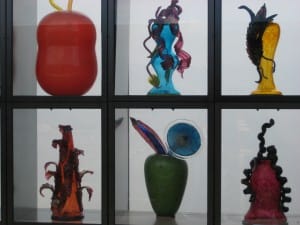
“The great thing about Seattle,” Ken had announced, as he launched into the fifth great thing about Seattle, “is you can do all the things you could possibly do in the Bay Area in a week, and do them in one day.”
I ran past gardens where rhododenrons and magnolias pulsed in pink and purple, down streets of mossy asphalt, and through a wood choked with ferns and broad-leaf plants. I passed a sign to the Nordic Heritage Museum and down the steep steps to Golden Gardens Park, a pebbly beach on Puget Sound.
Nothing golden at the Gardens that day. The sky was iron gray and the Olympic Mountains, which I knew to lie just across the Sound, were buried in rain. Here it was dry, however, and the park was full of merry people grilling and chatting around bonfires and playing volleyball in flannel shirts and long underwear. The sun may not have been out but they acted as if it was.
The next day the sun did come out and Seattle was transformed. We visited the Museum of Glass (pictured) and sunned ourselves on the beach at Point Defiance. We walked through Pike Place Market and admired the freshly-washed buildings of downtown, the shiny skyscrapers and the stately brick facades, and the bustling port in the middle of it all. When the sun is out, Seattle is one of the most beautiful cities anywhere.
But this day the gray would not lift, and I trudged on home. I took off my Montrail shoes, covered in the dark brown mud, mixed with rotted vegetation, that is the signature of the Northwest woods. It was nearly nighttime, and I wanted coffee.
April 17th, 2007 I am a runner and enjoy running fast, but there’s a certain speed limit to what you can do on two feet. That is why go-kart racing this weekend kind of twirled my Nikes.
 Photo Credit: gokartracer.com I promised this outing to my dad and my brother-in-law, Steve, at Christmas as a manly-men-doing-manly-things sort of thing. My mom and sister tagged along to admire us. We visited GoKart Racer, a Peninsula warehouse that is enjoying an exciting second act as a racetrack.
We donned navy-blue jumpsuits, complete with yellow piping, and pulled motorcycle helmets from the rack. Then we entered the prep area to meet the vehicles. There’s not much to a go-kart: a seat, a 9-hp Honda engine, a gas tank ensconced under your knees, a roll bar and a plastic guard around the base to blunt the inevitable collisions. As you strap into the shoulder and waist belts, a guy in a black polo shirt and padded headphones comes by and pulls a chain, starting you up like a lawnmower.
I snapped my visor into place and tentatively brought my foot down on the green accelerator pedal. Brrm brrrm brrrm vroom! In a moment I was speeding the track, which snaked around under cold lights. A go-kart can manage 35 miles per hour, and while I’m not sure I ever reached terminal velocity, I went fast enough to get my neurons into a tizzy. It doesn’t take much when you’re doing hairpins on a track fifteen feet wide and hovering an inch off the ground.
Real-time results for the 10 racers were posted on screens in the viewing area, so our cheering section knew for whom to root. I’m proud to say on the Yokohama track I edged out Steve to take seventh place. Next up was the more technical and twisty Monza track, and I felt confident I would only do better.
Steve surprised everyone by coming in third. I surprised myself by grinding into the wall on a particularly tight turn not once, but twice, and so firmly that a padded-earphone guy had to climb onto the track and back me out of the predicament by hand. I emerged in ninth place. The only thing that kept me out of the cellar was Dad, who exhibited the same caution on the racetrack as he did behind the wheel of the family Chevy Nova when I was ten.
Despite my embarrassing performance, I walked out, or better strode out, like an astronaut on final approach to a space-shuttle launch. I got behind the wheel of my 2005 Scion xB, which my friends have unkindly compared to a hearse, and took a turn wide back toward San Francisco, ignoring the lane lines. After all, it’s my road, isn’t it?
March 28th, 2007 The Ferris Files has a new set of eyes. For my birthday my girlfriend gave me a digital camera, which is practically* the first I’ve ever owned.
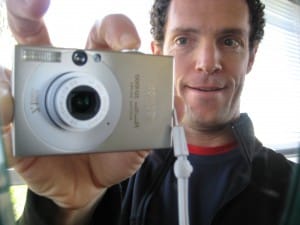 All week I have been cuddling and stroking its burnished silver skin. The Canon PowerShot SD1000 is All week I have been cuddling and stroking its burnished silver skin. The Canon PowerShot SD1000 is
capable of 7.1-megapixel resolution. That’s so many pixels that I could blow up a lame, overexposed snapshot of Aunt Edna to the size of a concert poster and retain all of the original’s sharp-edged clarity.
This camera is so small I don’t notice it in my pocket. This benefits you, dear reader, as I’ll be snapping eye candy for you wherever I go.
* A few years ago my father gave me his castoff digital camera (which says a lot about my rate of technological adoption). I promptly lost it at Burning Man.
|
|