Readers, sorry to take until nearly Thanksgiving to inform you of events that happened in summer. This post was especially hard to write, and came as I entered a busy patch that caused me to fall behind.
The weather has been alarmingly pleasant since we moved to Seattle. The first week in our new house, the mercury topped 90 degrees for five days, shattering the historical record. Seattle has literally never had this warm of a summer. Welcome to Los Angeles. The rain jacket we’d planned for Dubsie to wear has stayed in the closet. Instead she dons sandals and high-SPF sunscreen.
For the next few weeks the sun rises day after day into an untroubled blue sky. I take Dubsie down to Golden Gardens, the beachfront park near our house, and lazily push her back and forth. Across Puget Sound, the Olympic Mountains stand in bold, unclouded relief. Normally they are hidden in precipitation and when they do reveal themselves are clad in snow, but this year they are brown. Mummy grew up here and says she has never seen them that way.
Near the end of August the long string of sparkling days end, not with rain but a grayish-orange sky. The wind that normally blows off the Pacific has moved in reverse, bringing in smoke from the east, from the wildfires in the Cascade Mountains. The forest fires are the largest and hottest the state had ever seen; even the Olympic rainforest to the west, usually one of the wettest places on the continent, has its own blazes. The photos of Dubsie from that weekend have a ruddy evening light to them, though I take them at noon.
Then the weather manages a return to its time-honored pattern. A wet storm blows in, followed by a day or two of cloudy gloom, followed by another wet storm, and daytime temperatures drop into the sixties. Dubsie is compelled to wear socks.
Despite the rain, we stick with our plan to hike on Mt. Rainier this weekend. We drive out of Seattle and its brown lawns and up Highway 7, which takes us by Alder Lake, a reservoir on the western approach to the massive mountain. I’ve thought of Alder Lake as mysterious because it always seems to be swathed in mist. Today there is no mist, and moreover there is almost no water. The peaceful green shoreline has vanished. Instead there is a landscape of stumps, left over from when the reservoir was first filled. Alder Lake has become nothing more than a creek, wending through a boneyard. On the far bank a fire smolders.
We roll on into Mt. Rainier National Park, where things look enough like they usually do that we feel we can stop worrying. Tall strong mossy trees deck the roadside. We climb to Paradise, the park headquarters from which so many adventures are launched, which on average gets 53 feet of snow a year, but today there is none to be seen. The permanent glaciers that crown the mountain aren’t visible; a brow of clouds frowns just above us. We embark on a trail called Dead Horse, and the layer of clouds rises almost in tandem with our ascent.
Mummy and I taking turns carrying Dubsie. In some stretches she insists on walking, and sometimes she nearly runs, her toes turned out and her left arm tucked by her side as her right one swings. Her head lolls back and forth with each stride. She’s so new to running she hasn’t worked out the kinks. But she is running farther than before, and uphill, and when I scoop her up, breathing hard, she says to me I will go there, pointing upward in the direction of the peak we can’t see.
The goal today is a point on the map known as the overlook of the Nisqually Glacier, one of 20 glaciers that makes Rainier the most ice-capped peak in the contiguous United States. We climb and climb but no sign of ice yet. It isn’t until we are nearly upon the official outlook that we finally see the the tail of the glacier, sticking out from underneath the blanket of clouds. Below it, stretching for thousands of vertical feet, is a valley of mud and stones that show us where the glacier used to be as it melted and retreated over the prior decades. It’s a forlorn sight, like the impression in the bed from a lover that’s gone away.
The view from the Nisqually Glacier overlook.
Back down we hike. Dubsie wants to run. She points her pigeon toes downhill and careens, nearly tripping, arms flailing, every stride a bloody nose nearly happening, and I race forward to grab her, to hold her back before anything bad happens, to use my grip for now to restrain a girl that is restlessly growing, to restrain clock that is endlessly spinning, to restrain a thermometer that is relentlessly rising, the unstoppable forces that are pulling my daughter out of my grasp and toward a future of muddy, iceless slopes, of burning forests, of acrid smoky skies. I hold her tighter because I sense that a larger hand has released itself from the wheel, and we are careening toward God knows where.
Like so many amazing childhood events, this one arose from the most mundane of circumstances. Dubsie played in the bathroom while Mummy and I were organizing toiletries. Dubsie started rooting through a box on the floor that contained toothbrushes (known in Spanish as cepillos), toothpaste, various shampoo bottles, and her Ergo (a type of baby carrier).
Not wanting to see our toothbrushes turned into floor scrubbers, nor our shampoo used as finger paint, I grabbed the box and put it out of her reach on a ledge in the shower.
Dubsie whimpered the way she does when we have committed an injustice. She turned toward her mother and, with tears in her voice, lodged the following compliant.
“Da-a-a-a-ady took za box and a wahna and zzz ergo is innere an i pick it up and i just wahna cepillo and plaaaay gah nah brusha teeth and waaaaaaaaaaaa na play in it an d-dad go an I wahna play za lil piece and just cuz go weeee an my ergo is innere nah nice an shower on na floor and d-dad take it awaaaaaaay.”
Hear my rendition of her manifesto:
Mummy and I looked at her with open mouths. That was four or five times more words than we had ever heard her say at once. We turned toward each other and burst out laughing. It wasn’t just a sentence — it was a whole diatribe, and I was proud of my daughter for articulating herself so passionately, for lodging a protest with tears in her eyes and while wearing a set of elephant onesie pajamas.
This gem appears thanks to alert reader (and fellow toddler father) Nathaniel Tishman.
At 3 a.m., Dubsie will wake up in her room and rattle the baby gate until she gets what she wants. What she wants is to be carried to our bed, the warm cushy king bed, and installed between her parents. You’d think there’d plenty of room in king bed for two adults and a toddler.
We plop her in the the textbook position — head to headboard, foot to footboard — and offer certain inducements for staying there, such as her own little pillow and the company of her stuffed monkey, Hoho, but really the sleep acrobatics show is just beginning.
She’ll climb up over the bluff of the comforter and end up fully inverted, head somewhere down near our knees, and burrow deep into the bedding, as if dropped from a height, so in the morning only her rump is visible when I open my eyes. Other times she spoons Mummy and affectionately thrusts her head backward into Mummy’s nose, which makes Mummy hyperextend her own neck so she starts the new day with a crick.
But most often she will rotate 90 degrees, stretch herself to full length between our heads, and force us both to the edges. I often wake up with Dubsie’s skull firmly wedged beneath my cheekbone, as if to prevent any part of me from touching my wife. Meanwhile she will, in a preview of her adolescent years, kick her mother in the face.
It’s probably time for an intervention for our little interventionist.
The good news is that Dubsie is well on her way to being potty trained. The downside is that this requires more time and vigilance than the days when toilet management meant changing a full diaper. We must get her to the baño regularly, every 90 minutes or so, whether or not she wants to, or has any particular business to attend to.
The sessions can be lengthy. Dubsie enjoys sitting, and when on the throne she has the additional bonus of an adult’s undivided attention. In order not to spend all afternoon sitting on the bathroom floor, we have learned certain ways to, um, move things along.
If we think she’s on the way to a #1, we whisper to her a soft pssst pssst pssst. If it seems more like a #2, we mimic what she does when she is pushing one out. Look her in the eye, hold your breath, strain your face until it’s purple, and make little grunting noises. Which mostly Dubsie just thinks is funny (“Make the potty face!” she’ll say), but other times it leads to the successful, and strangely fascinating, passage of poop into the toilet.
At which point I’m ready to move on. “All done?” I say, and reach for her armpits to hoist her down. “No, there’s more!” she says and waves my hands off. She smiles at me and kicks her legs in an amused way, and I resume my position sitting on the cold tile floor, with no way of knowing if I am facilitating an important skill, or if I am being played.
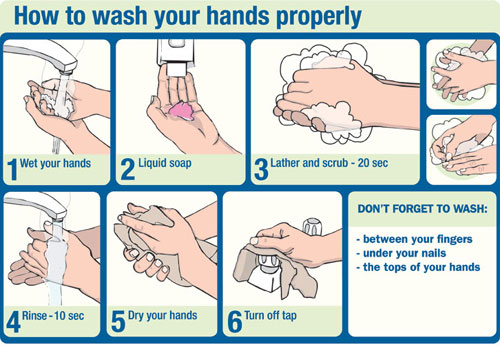
I am, truth be told, a mediocre sort of person when it comes to hand washing. I disregard the signs that are in every public bathroom these days, instructing good citizens to spend 20 seconds scrubbing every nook and cranny and an additional 10 seconds rinsing. Personally I can pump-soap-rub-palms-splash-water-scrunch-a-towel in about five seconds, and after years of doing so I’ve probably saved far more time than I’ll ever spend fighting off staphylococcus.
So it’s ironic that I have made myself policeman when it comes to Dubsie washing her hands. I insist on proctoring her trips to the bathroom. Not that Dubsie finds this burdensome. She loves washing her hands, and is so eager to hit the sink that I have to persuade her to wait to wash until after she’s used the toilet.
First we get our hands wet, I tell my eager novitiate. And then we squeeze some soap, and then we rub the palms together.
OK! She says, and her hands rub back and forth, getting all sudsy and adorable.
Now get your thumb! Now get the other thumb!
I proudly note that she knows where her thumbs are — what a smart little girl! — and so much more dextrous than last month.
Now let’s rub the backs of our hands!
(I have no idea why I insist on such a pointless activity)
Now we bring the fingers together, and scrub scrub scrub!
She scrub scrub scrubs, and I am absurdly proud to be an advocate for proper hand hygiene, though my pride has less to do with warding off disease and more to do with something else. Maybe this ritual ablution will produce a Ferris Version 2.0, an update with the bugs fixed, a person who will give regularly to charity and keep her hands on the steering wheel at 10 o’clock and 2 o’clock and won’t fall asleep in calculus. There we go with the rinse, sweetie. Rub rub rub with the towel. All sparkling clean.
I keep asking Dubsie if she wants to throw rocks in the Sound, and the answer comes back a stubborn no.
We are living for the week in a cabin on a beach on Camano Island. Camano is one of the islands of the archipelago that occupies Puget Sound. We have just moved from Washington D.C. to Seattle, which also sits on the Sound. In our new lives we will be constantly looking at and visiting this body of water.
The beach isn’t a Californian’s idea of a beach. No pillowy drifts of fine sand, but gravel and rocks, millions of rocks, many worn to roundness and in shades of gray to amber. And shells. The broken carapaces of bivalves are everywhere, reminding you that under the stones is a tangy menagerie of mussels and clams and a gigantic local delicacy called the geoduck. Silently filtrating saltwater in the darkness beneath your slightly uncomfortable butt.
Dubsie won’t only not throw rocks in the water; she won’t even go over the low concrete wall and onto the beach unless she’s carried. Set her down and she flails her arms for rescue. Maybe it’s hard to traverse those rocks in little, Teva-clad feet.
But the source of her disorientation could also be the water. It stretches for more than two miles to the far shore. At first I thought that demarcated the far side of the Sound, but no, it’s just the shore of another island, called Whidbey, and beyond that the Sound rolls on for miles and more miles.
What is a sound, anyway?
I take iPhone in hand and look it up. Wikipedia says it is “a large sea or ocean inlet larger than a bay, deeper than a bight, and wider than a fjord.”
Oh, well, that clears it up.
So I punch “Puget Sound” into Google Maps. Someday when Dubsie is older she will have lots of questions about Puget Sound, and a father must be prepared. But even that is not much help. My screen shows a blue spidery maze of bays and channels and inlets. The inlets are so long and convoluted that I have to follow shorelines with my finger to distinguish island from mainland.
Puget Sound. Image courtesy of David Rumsey.
Where does the ocean come in? In the northwestern quadrant of the map the world gets more watery, so that’s the direction the Pacific lies. But I can’t see it. In order to find the ocean I expand my view of Google’s map again, then again, and then again. Broaden out from Puget Sound and one finds that it’s merely the southwestern fringe of a colossal inlet that extends deep into Canada, nearly halfway to Alaska. The Canadian portion is called the Strait of Georgia, defining the shore of British Columbia and its massive satellite, Vancouver Island, and is spangled with enough archipelagoes and channels and shorelines for Riya to explore for a lifetime.
Feeding it all, almost due west of where Riya and I stand, is the Strait of Juan de Fuca, a channel funneling straight to the North Pacific. It is ten miles wide at its narrowest. Ten miles wide! That’s when I realize that it is ocean, nearly pure raw ocean, lapping up gently on this stony shore. Seagulls laze overhead, and if you paddling offshore, you see schools of jellyfish.
Which is a long way of saying that Dubsie was not the only one taken aback by the bigness of it all.
The next week we visited our friend B, who lives in a house on a hill with a view of the Sound but also a stony little creek running through the backyard. Dubsie surprised me by asking to put her feet in it. It isn’t cold water or stones that overwhelms her. It’s the big water of the Sound that will take some getting used to.
Note to readers: Your correspondent has fallen a bit behind as a blogger in the last few months, due to the tumult surrounding a cross-country move. Watch for a burst of posts in the next week or so.
An announcement, in case it’s not already known: Dubsie and Mummy and I are moving from Washington, D.C. to Seattle.
Moving sucks, of course, as it must when you’re stowing an entire family’s belongings into boxes and bubble wrap, but this is my first move that involves a child. I have become aware of the particular misery that the process inflicts upon a two-year old.
Dubsie sat on the stairs as I dismantled our first-floor baby gate. “What are you doing, daddy?” she asked.
“I’m taking this apart because we are moving to Seattle,” I replied. We’ve told her about the relocation a million times. She doesn’t understand it even a little bit. No surprise there: asking a toddler to comprehend leaving the only home she’s ever known is like expecting a chimp to do algebra. Add to that impenetrable idea the fact that the place we’re moving from and the one we’re moving to are both called Washington. Where do you live? we ask. “Washing DC,” she replies. Where are you moving to? “Washing DC,” she says.
Back on the steps, Dubsie said, “I want to stay here in Washing DC.”
“You could,” I said slowly, “but Mummy is moving to Seattle. And I am moving to Seattle. You don’t want to stay here all by yourself, do you?”
Dubsie looked back at me blankly. The prospect of moving and the prospect of being alone being equally impossible.
Crying fits come all the time this week, as the fixtures of daily existence disappear around her: the couch, the coffee table, the art on the wall. The place where the easy chair was is now a Tetris stack of UHaul boxes. She swings open the pantry door to find empty shelves; her dolls and piano and her collection of frogs are consolidated into crates, and then the crates vanish. Deny her the smallest of things, even a Chapstick tube, and we’re in for a fit. First she scrunches her face and her lips draw back into a painful rectangle, and she flaps her arms as a gale of blubbering is unleashed.
As I race toward the finish, clearing the rooms bare, I begin to feel like the Grinch Who Stole Childhood, who slithered and slunk, with a smile most unpleasant, around the whole room and took everything present. Hampers! And blankets! Bicycles! Drums! Bookshelves! Houseplants! Guitars! And Rugs!
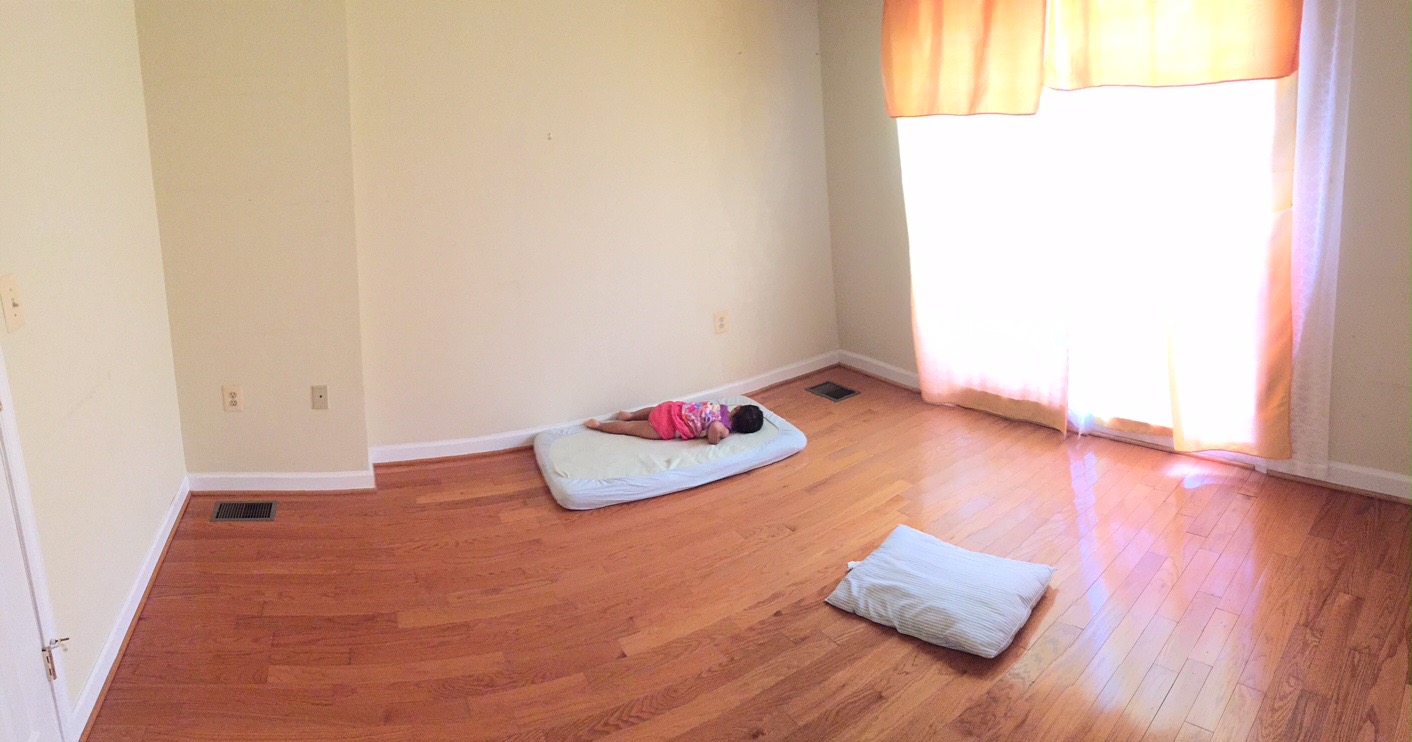
Dubsie whimpers every time she glimpses the perspiring, hurried forms of me and Mummy going up and down the stairs. To avoid trauma we sequester her and her sitter in Dubsie’s bedroom, which is now denuded of all toys and other diversions. The crib is gone; all that remains is a mattress, and then in the last moments before the doors close, even that.
Mummy and I have an ongoing difference of opinion regarding Dubsie’s feet, and whether they are to be celebrated or feared.
The thing is that Dubsie has big, fat feet. Observation of Dubsie’s ankle/arch/toe ratio indicates that either 1) this girl’s feet are still in a state of extreme baby chubbiness or 2) she has feet like mine, with the reputation that precedes them.
I have thick ankles, a low arch that causes an already wide foot to spread out even wider, and toes that are too small while also being too close together. One big toenail is only half-grown, owing to my having destroyed it by dropping a weight on it in the gym, and a pinkie nail is purple, from being stubbed against a chair leg. Then there’s the pale skin that makes the veins stand out, and the dark, irregular tufts of hair.
But, I retort. But. These are some great feet, in the way that my car (a 2005 Scion xB) is a great car. The original xB is one of the boxiest — and some would say ugliest — cars ever made. My friends regularly refer to it as The Toaster or The Hearse, and my buddy Les, who is a car buff, gets visibly angry every time he sees it. But that baby is reliable. Tons of storage space, loads of passenger room in rear, great mileage and huge windows. I can park it anywhere, and when I spin the little golf-cart-like steering wheel, it corners like a champ.
It also runs and runs and runs, which is exactly why it’s great to have these kind of feet. These feet have supported every step as I’ve climbed big peaks, surfed the chill waters of the North Pacific, played soccer and salsa danced, and (praise the gods) not a single sprained ankle.
None of which means a thing to Mummy, who has graceful ankles, dainty feet, and sensuously long toes, all wrapped in luminous soft skin. Her idea of a good foot is one that looks smashing in a strappy little sandal.
So Mummy worries that Dubsie is cultivating hobbit feet, as she calls mine, and wonder’s what she’ll think of her own feet in the flip-flop season. I look at Dubsie’s stubby little dogs and foresee a glorious life of adventure. If she’s lucky, the girl will have all the performance and also retain her mother’s good looks.
Dubsie and I have a weekend workout routine. “¡La pista!” (“The track!”) I yell, and she claps her hands and dashes off to find her baby jogger.
With me in my Nikes and her in her five-point restraints, we run to Banneker Park, a public athletic multiplex on 7th Street with an odd-shaped track that surrounds a baseball diamond. I narrate the laps because I worry about Dubsie getting bored. ¡Una vuelta! (One lap!) ¡Dos vueltas! ¡Catorce vueltas! Dubsie stares off into space or sings to herself. We comment on the other joggers, their shirt colors and whether they are moving fast or slow. Sometimes I pause to pluck her a dandelion or give her a water bottle. She feeds me a Cheerio.
When my run is over, I park the stroller in the grass and it’s time for Dubsie’s workout. We run on the lawn and hug a tree. We climb the steep grassy hill that fronts Seventh Street and say hi to the cars. Dubsie insists on wandering onto the track. “I do it myself,” she says. She careens from the slow lane to the fast lane, while Daddy waves off the passing sprinters. I do some squats, at the apex of which I fling Dubsie up in the air by her armpits, to much squealing.
Then it’s time for Dubsie’s favorite, which is lagartijas (lizards), the Spanish word for pushups. (Observe certain species of lizards and you will see they are always banging out a set.) Dubsie can’t do pushups yet — it’s very amusing to see her try —but she enjoys participating in mine.
“I am helping you, Daddy!” she hollers, and scoots to my side as I’m in the middle of forty reps and getting tired. She places both palms on the small of my back and presses down hard, all thirty pounds of her, and Daddy groans.
In our household, Dubsie’s cousin Vihaan has a sterling reputation. Rarely has there been such a good child. He is a role model at, for example, sitting in a high chair and eating food.
“If Vihaan were here, you know what he would do?” Mummy says to Dubsie, when Dubsie is hyper and un-hungry. “He would hold his milk in two hands and sip it down with one gulp.”
There are reports are that Vihaan is, just occasionally, not the saint we make him out to be. Some nights at dinnertime he races around the house hollering with a train in his hand, and his parents chase him with a spoon. But we’re not about to let some dumb facts stand between us and a role model.
The same goes for another cousin, Jade, who is world-famous for putting on sneakers and getting dirty outside. “Will you be like cousin Jade and go down the steps all by yourself and play on the sand?” we say.
Dubsie needs encouragement to get dirty because her bearing tends toward the regal. Other children sit in their high chairs; Dubsie presides. With one leg tucked daintily under herself, she attempts to decree whether she will have pasta or crackers, and whom will have the privilege of wielding the spoon.
Leave her without an attendant, though, it becomes clear that she is all thumbs at finger foods. Taking a bite out of something larger than a mouthful makes her look less than regal. She’ll try to absorb the whole enchilada — like a python attempting to swallow a Chihuahua.
We encourage more pedestrian ways by invoking Dubsie’s younger friend Tonita. Tonita is a picky eater, which we discourage, but we have observed that she most excellent at biting quesadillas.
“Bite it and pull it away… like Tonita!” Mummy says while offering a piece of cheesy tortilla. Evidence that we will stoop as low as biting competitions if it will give our parenting teeth.
 The weather has been alarmingly pleasant since we moved to Seattle. The first week in our new house, the mercury topped 90 degrees for five days, shattering the historical record. Seattle has literally never had this warm of a summer. Welcome to Los Angeles. The rain jacket we’d planned for Dubsie to wear has stayed in the closet. Instead she dons sandals and high-SPF sunscreen.
 We roll on into Mt. Rainier National Park, where things look enough like they usually do that we feel we can stop worrying. Tall strong mossy trees deck the roadside. We climb to Paradise, the park headquarters from which so many adventures are launched, which on average gets 53 feet of snow a year, but today there is none to be seen. The permanent glaciers that crown the mountain aren’t visible; a brow of clouds frowns just above us. We embark on a trail called Dead Horse, and the layer of clouds rises almost in tandem with our ascent.