February 1st, 2015  We imagine for Dubsie a life of sand in the toes and cleats in the snowboarding boots, of a nose that is sunburned despite the application of high-SPF sunscreen, of turkey chili nachos gobbled down at the ski lodge in order to make the backside by 3 p.m., of topographical maps and heavy-duty shoelaces and waxing a surfboard better than any girl in fifth grade. We imagine for Dubsie a life of sand in the toes and cleats in the snowboarding boots, of a nose that is sunburned despite the application of high-SPF sunscreen, of turkey chili nachos gobbled down at the ski lodge in order to make the backside by 3 p.m., of topographical maps and heavy-duty shoelaces and waxing a surfboard better than any girl in fifth grade.
One part of her education was to have happened last month, when I carried her onto the pleasant white-sand beach of a Caribbean island for a class entitled Sand 101, Its Uses as Construction Material.
Dubsie was serene when carried on high, but as I bent to establish first contact, her face took on an expression of extreme distaste. She tucked herself into a ball, her feet retracted as if I were lowering her into a pot of boiling fish heads.
“It’s great, Dubsie!” I’d say encouragingly. “You’re going to love it!” Mummy would urge.
But sand was soft and messy and stuck to the princess’ feet. It was nothing like the firm, flat floor of her playroom. After a few failed attempts, I just plunked her down in the deep stuff, saying to myself she’s a kid, she’ll figure it out. She stood rooted to the spot, a damsel stranded on her desert isle, fussing until someone came to her rescue.
After many tries, she deigned to stand on the strand, where the wet sand was hard and flat as the asphalt playground she knows from home. By the end of our visit, if you nudged her to the edge of the beach blanket, she would delicately visit with it, picking up a few grains and pouring them onto her thigh.
Soon after we returned, Washington D.C. had its first snowstorm of the season. I quickly bundled Dubsie up and sallied out the front door for Snow 101, Its Uses as a Projectile.
An inch of snow stood on our lawn, and again I endeavored to lower her into something pale and soft. But her boots drew up near her chin, as if Daddy was dropping her onto a bed of rusty nails, and she turned to look me a look as if to say I thought we’d gone over this. Finally I got her to stand on the walkway, where the snow had mostly melted. Her eyes darted around white desolation of our front yard and she cried, “Hands!”
Exclaiming the names of body parts is one of Dubsie’s favorite means of communication. (“Arms!” she says when wants you to cuddle her in bed. When you wrap one arm around her, she barks, “More arms!”)
OK, Dubsie, I told her, I get it, your hands are cold. Why don’t I tuck them into my gloves and we’ll go for a little walk around the block, experiencing the snowflakes drifting down, gathering on your sweet little lashes…
“Eyes!” Dubsie cried.
So we retreated back indoors, where Dubsie surveyed the few chunks of snow that had managed to accompany us back from the howling wasteland, and had a good cry.
January 25th, 2015
 Butter in a pat, Butter in a pat,
cream in a vat,
leave a dent in the mat where you sat kind of fat.
No ankle or wrists,
break the teeth when you zip,
will the jeans ever fit on those hips kind of fat.
Buddha belly jar of jelly
links of sausage in the deli
pat the butt even when it’s smelly, that kind of fat.
Roly poly holy moly
She’s a ball we need a goalie
Please don’t ever get fit or flat kind of fat.
January 18th, 2015  “Dubsie, do you want to play in the snow?” “No!” Each morning I feed Dubsie her standard breakfast of steel-cut oats, half a mashed banana, a dollop of whole organic milk and — here’s the kicker — a whole hard-boiled egg, shredded into little bits.
Most observers are not fond of this recipe. (“Gruel?” said a seven-year-old boy recently. “You feed her gruel?”) Adults look at the gelatinous beige concoction, spotted with mottles of egg, and then look at me, as if wondering what sort of man would inflict this meal on such a sweet little girl.
I am obliged to explain that, sure, you might find it disgusting, you with your mature taste buds, but it’s a nutritional wonder for a toddler who can be easily fooled. You’ve got your complex carbs (the oats), fat (milk and yolk), protein (egg white) and a sweet, all-natural banana finish.
And besides, you can’t argue with results.
Since she started on solid food over a year ago Dubsie has eaten astonishing quantities of it, day in and day out. She is bumping up against the top of the growth charts while maintaining thighs as plump as the Pillsbury Doughboy’s. She has opened her mouth wide to accept spoonful after spoonful, month after month, at least until a few weeks ago, when she began to discover the astonishing Power of No.
Yes, it’s No now, invoked in response to everything, morning till night, uttered like a mantra, addressed to anyone who ventures to offer any food or toy or activity, at almost any time. Such as to her Mummy, at dinnertime:
Mummy: Are you hungry?
Dubsie: Mmmm hmmmm.
Do you want chicken?
No.
Do you want rice?
No.
Do you want…umm…(searching fridge)…carrots?
No.
Do you want two giant fistfuls of candy?
No.
She states the negative with relish, with gusto, with a rising and dramatic Nnnnnnno! that betrays how much she enjoys saying it. Think of how satisfying it must be, as a little creature just discovering words, to find that No — a single syllable and one of the very easiest to pronounce — can stop a full-grown adult in his or her tracks. How intoxicating. You’d want to say it all the time.
Dubsie is working through the varieties of negation, scoping out her personal style. She likes Not! and Naaaah! and occasionally adds a Go ‘way! The one that leaves me particularly dejected is when she yells Nope! and puckers her lips to pronounce the P with a percussive pop.
So there I was last week, a spoonful of gruel in my hand, parrying with a year-and-a-half-year old reveling in her Power of No. I thought that I should propose to Congress, or perhaps to Merriam-Webster, that we permanently retire the word No and replace it with a word that requires some grown-up enunciation, like lilliputian, or prerogative.
But the utterance itself didn’t matter. I needed only to look at her expression of extreme distaste to know that she had exercised her lilliputian prerogative. Every time I brought a dripping spoonful near her mouth, she swatted at the air as if battling a cloud of mosquitoes. Then this little girl, my own daughter, looked me straight in the eye and made a brilliant counter-proposal.
“Daddy eat it,” she said.
January 11th, 2015  The eyes were her mothers’, that was the first thing we knew. Home from the maternity ward I peered into Dubsie’s unfocused peepers and fancied that I saw a hint of blue, a sign of my Northman’s banner carried forward, but no, that was wishful thinking. Those eyes resolved into a profound brown and brown they will forever be. They are the eyes of her mother’s Dravidian stock, stewed in the equatorial heat of South India over thousands of years to the color of the fertile banana-plant earth, a genetic steamroller that flattens its pale Northern counterpart any day of the week. The eyes were her mothers’, that was the first thing we knew. Home from the maternity ward I peered into Dubsie’s unfocused peepers and fancied that I saw a hint of blue, a sign of my Northman’s banner carried forward, but no, that was wishful thinking. Those eyes resolved into a profound brown and brown they will forever be. They are the eyes of her mother’s Dravidian stock, stewed in the equatorial heat of South India over thousands of years to the color of the fertile banana-plant earth, a genetic steamroller that flattens its pale Northern counterpart any day of the week.
The rest of the face we weren’t not so sure. A newborn’s nose turns up and the chin vanishes in order to accomplish the job of suckling. But nearing age two there’s things you know, and others you can guess. Her eyes are mummy’s but the wide isthmus between them is most certainly mine, you only need to look at us together, and same for the big ears that tick slightly outward when she smiles. She will have only me to blame for the vast prairie of her forehead.
The lower half of her countenance is, fortunately for her, mostly Mummy. Of those pert luscious lips there can be question. The smile, though, can be a big generic half-orange-slice like mine, occasionally tilted into a hint of Irish mischief. The smooth rounded cheekbones are what my wife’s family affectionately call Bollyballs.
The chin remains the subject of speculation, while the skin is a mixture of coffee and cream, with the only question being exactly how beautiful it will turn out to be. The eyebrows are a mystery. They are square, cartoonish little caterpillars like those of Barack Obama, or a muppet, which is why we’ve taken to calling them muppet eyebrows. On the crown of her head is the curly dark hair that comes at her from both sides, poor girl, and the ringlets pounce off in every direction.
I may have lost the eyes but I am increasingly convinced that I have won the nose. The Broward Nose, named after my mother’s side. It is a good nose, I think, neither long nor squat, starting straight but curving up at the tip into something pugnacious or cute, depending on who’s wearing it, and it has emerged victorious in every parental joust it has entered. The Dravidians have the eyes, but the nose is Davidian.
January 3rd, 2015  Dubsie dearest. Photo by Vita Images. Because the years are short, because the Year is New, because my daughter Dubsie is 20 months old and growing and morphing faster than a busy father can take note, I resolve to blog about her, every week, during the year of two thousand fifteen.
We climbed the stairs last night without my first turning on the light. Dubsie enjoys being carried up the stairs, a strong forearm under her ample rump. As we reached the landing, her voice came out of the blackness and surprised me. “So dark!”
So dark? Wait, when did she learn that the word “dark” meant the absence of light? When did she learn to precede it with the the adverb “so” in order to form a comment on said darkness? Isn’t this girl who was drooling all over herself, like, yesterday?
These discoveries, hers and mine, are what I want to capture here. I am minding the admonishment that I heard from seemingly every parent before Dubsie was born: that it goes by so fast and you need to capture the tics and foibles of a developing personality before the new ones arrive and gallop them flat in your memory.
Discoveries, yes, but also the tears, the messes, the frustrations, the things that will be broken.
“The Sandbox” is what I’m calling it. Children have sandboxes so they can create and reshape and epically destroy with nothing in the way of consequences. Adults also need such sandboxes. My sandbox has to do with noticing life and writing about it in ways I wouldn’t usually. For example, I never have started a sentence the way I started the opening sentence of this post, with a series of repeated “becauses.” Writers care about stuff like that.
Dubsie and I are both groping along in the dark, as I learn to be a father and she learns to be a person. May this journal be the flashlight that reveals, if not where we’re going, than at least where we’ve been.
March 18th, 2013  The boxy little Mahindra e2o I drove around Bangalore back in January. Back in January, I got the opportunity to test drive the Mahindra e2o, the first new electric car to be built in India in more than a decade. This wasn’t something I expected. On a visit to the new Mahindra Reva factory in Bangalore, I was scheduled to have a chat with the founder of Reva, Chetan Maini. But first I got a tour of the gleaming new plant and then the chance to take this four-seater hatchback around the block a few times.
Read about the experience about halfway through my story about the e2o that appeared recently in the New York Times.
The car had its much-anticipated release today in New Delhi. The colorful styling and high-tech remote controls will grab the attention of some, but I was dismayed to see the sticker price. Mahindra Reva had very much hoped that the government would supply a subsidy of nearly $3,000 for the car, but after waiting months for it to materialize, the automaker decided to stop waiting and release the car at the price of over $15,000. That may not be much by American standards, but it will send most Indians into sticker shock.
Check out the story about today’s release here.
February 14th, 2013 Your correspondent has returned from India and is infused with a sense of gratitude. Gratitude for the simple things that America provides that India does not, like tap water fit for drinking, a lack of shame around eating meat, and the opportunity to let my malaria meds expire. But what I am grateful for above all else is sidewalks.
India does have margins on the border of roads that might be defined as “sidewalks.” But the term “sidewalk” presumes that what occurs there is walking. This is patently not the case in India, mainly because there are so many other creatures and objects already occupying the space reserved for the hapless pedestrian. Many of these obstacles are surprising and most are outrageously unsafe. In a salute to Indian craziness, here is a partial list of what occupies the “sidewalks.” Enjoy.
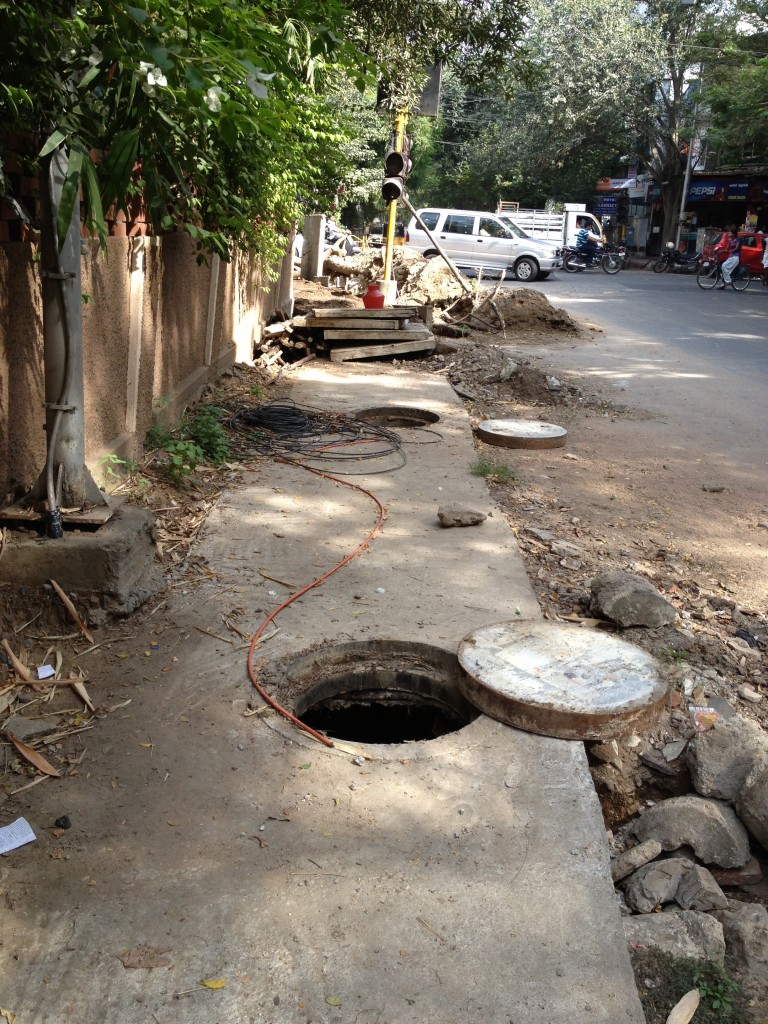 Open Manholes
 Cars Continue reading Photo Essay: What I Stumbled Upon in India
January 24th, 2013  K.S. Sivaprasad. Photo credit: David Ferris Last month I sat down with K.S. Sivaprasad, an Indian engineer and entrepreneur, to hear about his plans to bring a waste-to-energy factory to India. I learned that this sprightly 80-year-old had been at this effort for quite some time. Forty years, to be exact.
The interview inspired a story I wrote for yesterday’s New York Times entitled “Why India’s Waste-to-Energy Industry Won’t Catch Fire.” Sivaprasad’s tortoise-like race to design and build a new kind of factory is interesting. But the story of why it is so hard to get such a plant built in India is the story that needed to be told.
I expect to write again about India’s efforts to cope with its waste and energy problems, so keep an eye out for another report, most likely in a matter of weeks rather than decades.
January 23rd, 2013  Image credit: creepyhalloweenimages For Americans, the automobile horn is emergency equipment, deployed to avoid collision or express road rage. For Indians, the horn is more of a conversational tool, used by everyone — and I mean everyone — as they jostle in traffic. The racket is deafening. One wonders if the Indian motorist is some sort of terrestrial bat, navigating with ears instead of eyes.
In this din, driving an electric scooter feels a bit insurgent. Ampere, a maker of electric two-wheelers, loaned me one of its bikes near the tail end of my two-month stay in India. I mentioned Ampere in a story about the connection between power outages and the electric vehicle industry in The New York Times, and wrote about the company’s frugal engineering techniques at Forbes.
I have nosed the bike cautiously through the streets of Chennai in the early morning and late at night when the traffic dies. If the street is quiet enough, pedestrians can hear the bike coming from behind. I can tell by the way they cock their heads that they detect an unfamiliar pitch. Here comes my electric scooter, emitting not the blat of a gas engine but that distinctive electric motor sound, somewhere between a buzz and a whine. It is safe for them to gasp because I leave no exhaust in their faces.
January 9th, 2013  Photo credit: New York Times Today, The New York Times published a story I wrote about the state of the solar industry in India. This is an issue I’ve been keeping a close eye on since arriving in Chennai, India last month. Chennai is the capital of the state of Tamil Nadu, and Tamil Nadu is Exhibit A in what can go wrong when a government takes a hasty and haphazard stab at something as complicated as solar energy.
Read the story here, but here is the intro for the story, titled, “In India, Solar Ambitions Are Suddenly Outsize“:
After years of lagging behind China and the West in the adoption of solar power, some states in India are proposing to build solar farms at a galloping pace that leaves them at risk of falling short of electricity (a familiar problem here) or of paying higher prices for it.
In just the last five months, five Indian states have announced plans to bring giant amounts of solar power online within five years, including 1,000 megawatts in Andhra Pradesh, 350 megawatts in Rajasthan, 800 megawatts in Madhya Pradesh, 1,000 megawatts in Chhatisgarh and a whopping 3,000 megawatts in Tamil Nadu.
The story goes on to explain what happened last week when the rubber hit the road and Tamil Nadu received its bids for solar power projects. The results: underwhelming. Hit the link for more details.
|
|
 We imagine for Dubsie a life of sand in the toes and cleats in the snowboarding boots, of a nose that is sunburned despite the application of high-SPF sunscreen, of turkey chili nachos gobbled down at the ski lodge in order to make the backside by 3 p.m., of topographical maps and heavy-duty shoelaces and waxing a surfboard better than any girl in fifth grade.