July 14th, 2010  The Solar Impulse. Image Credit: Reuters This is David’s summary of the week’s news for the Matter Network. To see the original, or post your comments, go here.
Solar Plane Goes All Night: A milestone in clean transportation was achieved on Thursday when pilot Andre Borschberg flew the Solar Impulse for 26 hours, setting new altitude and speed records for a solar plane and conducting the first all-night flight on battery energy stored from the sun. Next: a model due in 2011 with a pressurized cabin for transcontinental flight.
Move over, Prius: One of the biggest perks of owning a Toyota Prius or other hybrid in the state of California is access to the highway carpool lane. But — holy halos! Hybrids are set to be booted from the HOV lane in 2011 in favor of all-electric cars. Don’t cry, Prius owners: At least you won’t be sucking anyone’s fumes as you park in second place.
 Emaciated polar bears. Image Credit: Andrew E. Derocher In other car news, Ford discovers that soy oil makes rubber twice as stretchy, and the first volleys are fired in the Chevy Volt vs. Nissan LEAF flame war.
Safeway Fakes a Farmer’s Market: When a Safeway in Kirkland, Wash. launched a farmer’s market, there were just a couple problems: no local food, and no farmers. Instead, the supermarket planned to use its own employees to sell industrial produce in the parking lot. The brilliant plan collapsed before the first Chilean avocado was sold; the”market” violated both state and union rules. Compare this to Whole Foods’ declaration last month that it will require all its personal-care suppliers to verify the “organic” claims on their labels.
Why Are the Polar Bears So Hungry? Everyone knows that the melting of the Arctic is bad for polar bears — but will it really kill them off? An interview in Yale Environment 360 explains exactly how melting ice puts the polar bear in peril, and what the prospects are for the magnificent mascot of the North.
 The AQUA2 in its native habitat. Image Credit: McGill University Breakthroughs of the Week: A new road material promises to suck up exhaust from the tailpipe; the little AQUA2 robot conquers land and sea (and looks kinda cute); and undertakers ask for the right to dissolve human corpses and flush ’em.
July 7th, 2010  Terrafugia Flying Car This is David’s summary of the week’s news for the Matter Network. To see the original, or post your comments, go here.
Solar’s Sugar Daddy: During his Saturday address, President Obama lavished an astonishing $2 billion in loan guarantees upon two solar companies. This upended the administration’s seedling strategy with renewables — a few million for algae research here, a few million for efficient buildings there — without choosing winners. No question, then, that Spanish firm Abengoa is a favorite horse, receiving $1.45 billion for its plans to build 250 megawatts of solar concentrators outside Phoenix, Arizona.
This Week’s Reason to Hate BP: The British oil company is falling far short of its promises in cleaning up the epic leak in the Gulf of Mexico. Since April 20, “BP has skimmed or burned about 60 percent of the amount it promised regulators it could remove in a single day,” the Washington Post reports.
Bulldog Bingaman: If any climate bill gets passed this year, it will probably be thanks to the tireless backroom efforts of Senator Jeff Bingaman (D-N.M.) Politico reports how the chairman of the Energy and Natural Resources committee has quietly gained the support of some Republicans for a proposal to place a cap on emissions from power plants, without ever stepping in front of a camera to take credit. quietly gained the support of some Republicans for a proposal to place a cap on emissions from power plants, without ever stepping in front of a camera to take credit.
Recession? Don’t Tell the Propellerheads. Americans bought almost 10,000 small wind turbines last year (100 Kw or under), growing the market by 15 percent even as the recession held the country in its chilly grip. Call it retail activism, call it a clever use of subsidies, but the end result is more than 20 megawatts of clean, domestic electricity.
Finally, a Flying Car: Terrafugia is taking orders at $10,000 a pop for its “roadable aircraft.” With fold-up wings and a top cruising speed of 115 mph (in the air), this might be the wonderbug we’ve all been waiting for.
June 30th, 2010  Investors Love Tesla: Observers were taken aback by the overwhelming success of Tesla’s IPO. But does $226 million amount to even a drop in the oil pan? Investors Love Tesla: Observers were taken aback by the overwhelming success of Tesla’s IPO. But does $226 million amount to even a drop in the oil pan?
The Leaf Stampede: Nissan revealed that 90 percent of the U.S. presale orders for the all-electric Leaf are customers new to the Nissan brand. Perhaps there’s a lesson for other companies: Lead the way into green, and a whole new class of customers could follow.
Belkin Kills the Vampire: The company debuted a line of power strips and wall plugs that prevent ‘standby’ mode from bleeding the power bill. The Conserve Insight tells you how much electricity and CO2 a device uses, and the Smart AV power strip shuts down the cable box and DVD player when you switch off the TV.
 Photo Credit: Kathleen Cavalaro Solar Companies Buy the Farm: In Ontario, Canada, Hay Solar and Mann Engineering announced that they’ll buy a farmer a barn if he lets them cover it with solar panels.
Goldman Sachs Tracks Solar: Now really. Would the moneygrubbers at Goldman start covering solar-panel manufacturers like First Solar and SunPower if they weren’t poised to make a ton of cash?
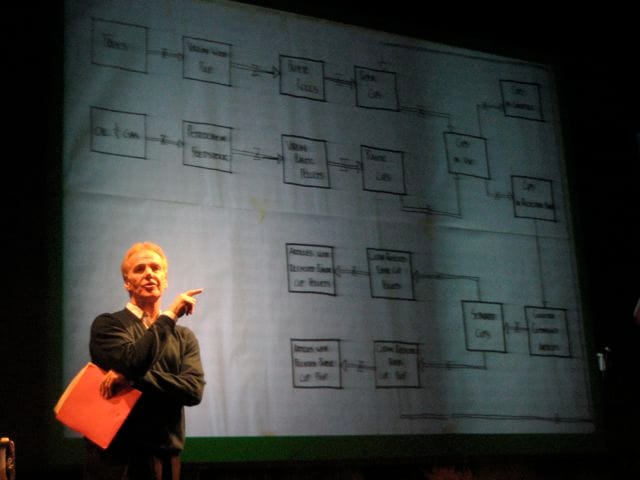
June 9th, 2010  Starbucks consultant Peter Senge explains what's so complicated about a new cup. In the world of sustainable marketing, few tales have grown as epic in scope as the redesign of the Starbucks cup. The coffee company seems to pursue its objective with the fervor of a moonshot; an effort that started in 2008 isn’t supposed to wrap up until 2015, and the company says it’s behind schedule. What could be so complicated about refashioning a paper cylinder with a plastic lid?
At the Sustainable Brands conference in Monterey on Tuesday, attendees learned just how far-reaching and complicated the effort has become. Starbucks wants to have 100 percent of its cups recyclable or reusable by 2015, with three sub-goals: complete a recyclable cup strategy by 2012, serve 25 percent of drinks in tumblers or permanent cups, and have front-of-store recycling in all stores owned by the company.
That’s ambitious enough, but a couple of presentations by Ben Packard, the head of corporate responsibility, and consultant Peter Senge of the MIT Sloan School of Management, made clear that along the way the project has turned into something much larger. Executives admit they have more questions than answers.
And if Starbucks is to be believed, it wants to transform not just the cup, but the materials used to make it, the process by which cups and lids are manufactured and recycled, and the role that customers play in the ritual of buying coffee.
Here are some insights from the conference:
Starbucks Recycles City by City. The company seems to have learned that, like politics, all recycling is local. Waste practices, haulers and rules vary by city and state, and Starbucks is in conversations with recyclers in the biggest cities that are most amenable to change. Customers in San Francisco and Seattle now have recyclable cups, Manhattan will have them by next month, and negotiations are underway in Chicago, Atlanta and Boston.
Old Materials in New Ways. The company has learned that most heavy-duty bottles in the U.S. are non-recyclable by design. Pure polypropylene is mixed with the dyes that make up a company’s colors and logo and then baked. This bastardizes the polypropylene, making what would otherwise by a valuable and reusable substance into something that can only be shredded and made into lawn furniture. Senge suggested that Starbucks might spearhead an industry standard that would preserve the value of the polypropylene by instead producing a plain white vessel with a thin, customized overwrap.
Putting It Back on the Customer. Starbucks wants to retrain its customers to bring their own cups to the store, as 80 percent of customers walk out the door with a cup in their hand. The obvious corollary is the durable bags that customers are now growing accustomed to bringing to the grocery store. “How do we make the cup the grocery bag?” Packard asked. “How do we make it the responsible choice?” On one day in April, Starbucks tried the “stunt” (Ben’s words) of giving a free cup of coffee to anyone who brought in their own tumbler.
First Contact Across Industries. Also in April, Starbucks held its second annual “Cup Summit” with paper manufacturers, suppliers, waste haulers and recyclers. It took Starbucks’ muscle to make it happen; Packard said that these meetings marked the first time that International Paper had ever sat down with leaders of the recycling industry to talk about the cradle-to-grave journey of any product, including a cup.
Let’s hope that the end result is a lot less waste, or perhaps none, from the world’s best-known coffee company. Too bad it will take until nearly the end of the second Obama administration for it to happen.
June 3rd, 2010  Lessons from the Deep: If the unstoppable hose at the bottom of the Gulf has taught us anything, it’s that we don’t know much about the ocean. Don’t know how to stop a leak, don’t know whether deepwater oil floats or sinks — and know even less than we thought about the oceans’ role in global warming. This week Yale Environment 360 reported that the last Ice Age may have ended when a giant belch of carbon dioxide erupted from seabed. Add similar revelations about the world’s bajillions of microbes, and it seems we know almost nothing at all. Lessons from the Deep: If the unstoppable hose at the bottom of the Gulf has taught us anything, it’s that we don’t know much about the ocean. Don’t know how to stop a leak, don’t know whether deepwater oil floats or sinks — and know even less than we thought about the oceans’ role in global warming. This week Yale Environment 360 reported that the last Ice Age may have ended when a giant belch of carbon dioxide erupted from seabed. Add similar revelations about the world’s bajillions of microbes, and it seems we know almost nothing at all.
Forests Get Breathing Room: Indonesia’s government agreed to halt the cutting of its rainforests for two years in exchange for $1 billion in ransom. Norway made the offer because Indonesia holds hostage some of the largest remaining rainforests; what’s left around the world might keep more CO2 from the atmosphere than all the world’s cars, trucks, ships and planes combined.
Deforestation = Poor U.S. Farmers? Meanwhile, a report made a persuasive argument that deforestation in the tropics leads to economic ruin for U.S. foresters and farmers. By rapidly clearing land, tropical nations flood the market and undercut Americans’ prices for soybeans, beef, timber, vegetable oil, among others.
GM Retreats from Indian Rival: General Motors pulled out of a partnership with REVA, an Indian electric car company in India, after REVA was acquired by the Indian conglomerate of Mahindra & Mahindra, a major Indian manufacturer that has set its sights on the United States.
Nissan and Zipcar Grow: Nissan broke ground on its battery factory in Smyrna, Tennessee and said it will make 200,000 electric batteries a year. Zipcar announced plans for a $75 million IPO to fuel its own growth in the car sharing, despite competition from rental companies like Hertz and Enterprise.
That’s a Lot of Plug Points: Matter Network’s own John Gartner made headlines with his estimate that in five years, the world will need 4.7 million new charge points for electric cars. A few days later a coalition announced that 4,600 would be installed in nine U.S. cities by Coulomb Technologies and bankrolled with $37 million in government funds. Too bad China provides far more stimulus than the American government does.
Tough to Be a Small Fish: As the big boys jostled, HybridCars pointed out how smaller electric-car companies like Fisker, Coda, Aptera and Tesla have no margin for error as they try to compete.
 image credit: picasaweb.google.com/mikelo Veni, Vidi, Veggie: In the New York Review of Books, Michael Pollan took a look at five books that collectively point to a tying together of what’s loosely known as the “food movement” — urban agriculture, farmland preservation, food labeling, the organic movement, to name a few — into something more than the sum of their parts.
No Free Ride for Factory Farms: The EPA announced that factory farms — exposed in Pollan’s own book “The Omnivore’s Dilemma” — would be identified and their animal waste’s impact on waterways measured. As a result, thousands of Concentrated Animal Feeding Operations, or CAFOs, are likely to face new regulations.
Innovations of the Week: Cornell students figure out how to harness electricity from small wind; scientists grow BPA-free plastic from the atmospheric scourge of CO2.
May 27th, 2010
 image credit: International Bird Rescue Research Center The End of the World…Or the End of the World As We Know It? The Gulf oil nightmare deepened, as crude oozed deeper into Louisiana’s wetlands and British Petroleum sputtered in its attempt to “top kill” the leak. Yet as the Deepwater Horizon officially surpassed Exxon Valdez to become America’s worst oil spill, another, quieter event seemed destined to compete with it in the history books. Craig Venter created a bacterial cell that is, as he called it, “the first self-replicating species we’ve had on the planet whose parent is a computer.”
The biofuels community immediately pondered what it all meant, while we hoped Venter’s computer might upgrade the Labrador retriever. No more hair on the couch? Combine this revelation with the announcement of the first fuel cell implant that could power a pacemaker, and it became clear the energy revolution has barely blinked awake.
More Oil in the Gulf… The Deepwater Horizon spill took the express toward Florida and the Atlantic states as it entered the Loop Current, and several fisheries were closed.
…And Less Oil in the Tank: Meanwhile, President Obama signed a memorandum that will for the first time require trucks to meet a minimum fuel standard by 2014. Today, America’s truck fleet consumes more than two million barrels of oil a day and averages a pathetic 6.1 miles per gallon.
Midwest: The New Hotbed of Cleantech? A burst of announcements demonstrated that other Midwestern states are starting to make like Michigan and bet the future on cleantech. General Electric won a contract to supply five wind turbines to America’s first freshwater wind farm, slated for 2012 on the Ohio coast of Lake Erie. And that’s not all for the Buckeye State: Electric-vehicle company Coda said it would likely build a battery-assembly plant there. Meanwhile, in Milwaukee, Wisconsin, a Spanish company unveiled plans for a wind-turbine and solar-components factory, and Indiana officials planned to roll out the red carpet for a delegation from China to discuss joint ventures in electric cars, in addition to the Th!nk City factory that’s already on the books.
 Silicon Valley Gets Glam: When former British Prime Minister Tony Blair reinvented himself as a cleantech venture capitalist, he overshadowed the other celebrity event of the week: the kickoff of the Green Products Innovation Institute. Funded and endorsed by heavyweights like Wal-Mart, Google, Herman Miller and Brad Pitt, the GPII aims to be a third-party registry and establish standards for a new generation of chemicals. Its goal: to end the era where “endocrine disruptor” and “baby bottle” appear in the same sentence. Silicon Valley Gets Glam: When former British Prime Minister Tony Blair reinvented himself as a cleantech venture capitalist, he overshadowed the other celebrity event of the week: the kickoff of the Green Products Innovation Institute. Funded and endorsed by heavyweights like Wal-Mart, Google, Herman Miller and Brad Pitt, the GPII aims to be a third-party registry and establish standards for a new generation of chemicals. Its goal: to end the era where “endocrine disruptor” and “baby bottle” appear in the same sentence.
Toyota Hooks Up with Tesla: Toyota became the $50 million sugar daddy for Tesla, as the sexy electric-sportscar company moves into digs that are way too big for it. At first Tesla will curl up in a smallish corner of the massive, recently shuttered NUMMI plant in Fremont, California. Not that Toyota is done with sensible; it is reportedly working on a seven-seater Prius.
Popular Mechanics simulated the wonders and woes of driving an electric car in 2020, and car manufacturers announced that the electric car won’t be silent after all. It will make some sound so the deaf, blind, distracted, and earbud-wearing populace will know what hit them.
Meanwhile, Honda said it’s not so sure about the whole electric-car thing.
Buildings Beyond LEED: Yale Environment 360 wondered why building owners interested in saving money don’t seek out “building commissioning.” The practice is essentially a physical checkup for a structure’s energy-using systems, like ventilation, and often yields fixes that can save tens of thousands of dollars — even in buildings with that shiny LEED logo.
Triple Pundit took a look at Building Information Modeling, a 3-D simulation of heating, cooling, water and other systems that help construction managers avoid dumb and costly mistakes. Can’t come too soon; a Pike Research study estimates that by 2020 the world will install 53 billion square feet of green-certified space, a 900 percent increase from today.
The Week’s Best Ideas
Panera, the bread restaurant, is conducting an experiment in enlightened capitalism. In St. Louis it founded a sub-chain called Panera Cares Cafe that has day-old bread, but no cashier. Instead, you pay what you think you can afford, and if you can’t you donate your time. No word yet on whether St. Louis has seen a spike in free lunches.
Lawrence Berkeley National Laboratory says that if India made a dramatic investment in energy efficient lightbulbs, refrigerators, irrigation pumps and the like, it could wipe out its notorious electricity shortages within three years.
 image credit: Thomas Bresson The “Geobacter” project at the University of Massachusetts Amherst published the results of its mind-bending research into electrofuels. Researchers established bacteria colonies that feed off electrons from a solar-powered electrode. On a diet of water and atmospheric CO2, the bacteria “exhaled” acetate, from which many fuels and chemicals can be made.
California Synaptics told GreenTech TV how it greens the business by buying used office furniture, giving discounts to employees who bring their own dishware to the cafeteria, and offering prime parking and car detailing to employees who carpool.
Finally, a book review at Off-Grid gives useful advice on how to screen calls with a microwave, or cook a salmon in your dishwasher.
May 23rd, 2010 I am coming to the conclusion that the wind turbines of today — hundreds of feet tall, sporting three blades, clustered in the cornfields like rotary clubs — will soon go the way of the Model T. Good for their day, but we’ve moved on.
I explored alternative designs in wind power for my latest “Innovate” column in Sierra magazine, and can report that 31 flavors of turbines are poised to engulf the plain ol’ vanilla version we know so well. It isn’t that anything’s so wrong with Old Reliable; it’s more that there’s categories of wind that a giant whirligig just can’t use.
 Vertical-axis turbine. Image Credit: jetsongreen.typepad.com On the roof of Adobe Systems in San Jose there’s a gang of vertical-axis turbines, spinning in breaths of wind that would leave your traditional turbine inert. Go even smaller and you find the Windbelt, suitable for installation by the hundreds on bridges or porch railings.
 Sky Windpower turbine. Image Credit: skywindpower.com Then there’s Earth’s atmosphere, where winds blow with even more power than they do on the Dakota prairies. A propeller on a steel post could only dream of catching the breezes harnessed by an out-there generation of kites. Tethered to the ground with a power line, these models describe endless circles in the sky 1,200 feet up, outfitted with two small propellers like a cross between a barnstormer and a Predator drone. Or the Sky Windpower turbine, which is essentially a helicopter the size of an airliner held to the ground by the world’s longest extension cord. It would fly itself five miles up into the Jet Stream, and if it needed maintenance or if the weather got too rough, it would maneuver itself back to the ground.
 FloDesign generator. Image Credit: Sierra magazine Back on Earth, the contraption that might kill the garden-variety windcatcher is the FloDesign turbine, currently undergoing testing in Massachusetts. Designed by aerospace engineers, it might do to the standard Vestas or General Electric turbine what the jet engine did to the prop plane. FloDesign is optimized to suck in air so its rotor spins like a crazed dervish. Its compact design means turbines might be able to be placed closer together than today’s spidery creatures, and quite possibly generate more power. Less space, more power; hasta la vista, vanilla turbine.
 Aerogenerator turbine. Image Credit: Sierra magazine Finally, I am waiting for the ambitious mayor of some oceanside city to unveil plans for an Aerogenerator. Standing 450 feet off the water, this behemoth would produce enough power for 2,700 homes, but even more importantly it would become an icon admired for its sheer industrial size, like the Golden Gate Bridge or the Hoover Dam. Unlike other monumental architecture, though, it would move, making three ponderous rotations a minute for the tourists’ cameras.
Maybe the plain ol’ wind turbine won’t disappear. Maybe it just will lose its category-defining status, the way that the term “computer” has come to mean more than just a big beige box sitting on your desk. The wind industry will have its laptops, Google Androids and iPads, each with its own size blades — or perhaps no blades at all.
All this reflection on the wind turbine has me wondering when we will become familiar enough with turbines that we begin to experiment with something other than their shape and style. Henry Ford famously said that “People can have the Model T in any color – so long as it’s black.” How long until the wind industry breaks out of its own beige box and turn out a windcatcher in dashing red, or shimmering gold?
May 20th, 2010
 Image credit: National Geographic Another Bad Week, Or a Really Good One? Good news grows as slow as a tree, but bad news flows like a broken oil main. That seems to be the lesson from this week as BP, the U.S. government and an armada of ships and volunteers tried but mostly failed to contain the Deepwater Horizon oil spill. Though BP had some success at slowing the spigot, oil is pooling in the wetlands of the Mississippi Delta and resides at unmeasured quantities in the deeps. There it has joined the Loop Current with a probable next stop in Florida.
 Meanwhile, 1,500 miles north, an equally momentous event drew little attention: an agreement to curtail or end logging on 72 million acres of Canada’s boreal forest, an area roughly the size of France. An unlikely consortium of logging companies and Greenpeace agreed to halt the chainsaws altogether for three years in an area as big as Montana, and to develop a sustainable-forestry program for the remainder. The accord might be the forerunner to permanent protection for an area that encompasses two-thirds of Canada’s logging concessions. Meanwhile, 1,500 miles north, an equally momentous event drew little attention: an agreement to curtail or end logging on 72 million acres of Canada’s boreal forest, an area roughly the size of France. An unlikely consortium of logging companies and Greenpeace agreed to halt the chainsaws altogether for three years in an area as big as Montana, and to develop a sustainable-forestry program for the remainder. The accord might be the forerunner to permanent protection for an area that encompasses two-thirds of Canada’s logging concessions.
The Week’s Best Green Ideas: This week, GreenTech TV took a look at how Rush University Medical Center has become one of the greenest hospitals in the country. Read Part 1 and Part 2.
At Cleantechies, Chuck Colgan told California building owners, brokers and managers how to prepare for AB 1103, a California law that asks for 12 months of energy-consumption records when a building is sold, re-leased or financed.
Triple Pundit produced a field guide to the three organizations that can help a company develop a framework for its energy use: The Climate Registry, the US EPA Climate Leaders program, and the Carbon Disclosure Project.
Also, the U.S. Green Building Council told President Obama how his administration can make America’s buildings far more efficient without asking permission from those squirrelly congressmen.
Too Hot? Bring Your Own Water. Last month was the warmest April in recorded history, according to the United Nations. If you’d like to contemplate this alarming news from the shores of Walden Pond, carry your own hydration — the city of Concord has become the first in the country to ban plastic water bottles.
Will Nissan Leaf You Out? Pre-orders for the hit Japanese electric car reached 13,000 this week, a thousand more than Nissan planned to make. If you’d rather not crash the dealership, wait ’till next year and rent one from Hertz.
 Quiet Excitement: At Infineon Raceway in California, the TTXGP race pitted electric motorcycles against each other in the first — and the quietest — race of its kind. Quiet Excitement: At Infineon Raceway in California, the TTXGP race pitted electric motorcycles against each other in the first — and the quietest — race of its kind.
Price Check, Aisle Nine: At the Lightfair International convention in Las Vegas, Sylvania, Toshiba and Philips debuted their new LED bulbs for use in home lamps. Each bulb, as well as General Electric’s, will retail by early 2011 or sooner, for $40 to $60. Also, at the National Hardware Show, Honeywell announced that its $6,500 home wind turbine would arrive at Ace Hardware stores by August.
A Tweet that Really Matters: Populations of 150 North American bird species are plummeting as their habitat is destroyed. Could one source of their salvation reside as an app on your phone?
May 13th, 2010  The Oil Spill’s Unlikely Victim: As oil from the Deepwater Horizon spill continued to gush into the Gulf of Mexico, it tarred the feathers of an endangered creature: the climate bill. Sens. John Kerry and Joe Lieberman introduced a retooled American Power Act on Wednesday to little fanfare. Perhaps that’s because the media’s klieg lights were already divided between the grilling of oil executives on Capitol Hill or the so-far hapless efforts to plug the leak. Or maybe it’s because the two senators took to the dais without their erstwhile Republican ally, Lindsey Graham. Nevertheless, it was ironic to see a solution to our fossil-fuel addiction pushed to the side because of a fossil-fuel disaster. Must we cap the gusher before we get a cap on CO2? The Oil Spill’s Unlikely Victim: As oil from the Deepwater Horizon spill continued to gush into the Gulf of Mexico, it tarred the feathers of an endangered creature: the climate bill. Sens. John Kerry and Joe Lieberman introduced a retooled American Power Act on Wednesday to little fanfare. Perhaps that’s because the media’s klieg lights were already divided between the grilling of oil executives on Capitol Hill or the so-far hapless efforts to plug the leak. Or maybe it’s because the two senators took to the dais without their erstwhile Republican ally, Lindsey Graham. Nevertheless, it was ironic to see a solution to our fossil-fuel addiction pushed to the side because of a fossil-fuel disaster. Must we cap the gusher before we get a cap on CO2?
More Electric Cars Roll to the Starting Line: You’ve heard that the Nissan Leaf and the Chevy Volt are on the way, but how about the Think and the Wheego? Wheego, a maker of electric putt-putt vehicles based in Atlanta, hopes that 200 highway-ready copies of its Whip Life will roll off the assembly line by August, months ahead of the well-publicized launch of the Leaf. Meanwhile, the Norwegian carmaker Think raised $40 million this week and plans to start assembly of the tiny Think City in Elkhart, Indiana in early 2011.
 How Is an Electric Car Like an iPad? The CEO of Coda Automotive announced a novel approach to manufacturing and selling his company’s electric car — less a come-on-down dealership blitzkrieg and more like a visit to Apple’s Genius Bar. “We are looking at this not as a new-car-model introduction, but as a new-technology introduction,” CEO Kevin Czinger told a transportation conference in Ohio. But that’s just one way Coda is creating an auto company on the cheap. Models will be partially assembled at a factory in China, shipped to the U.S. as “parts” to avoid import fees, and finished near company headquarters in California. Coda will have just one dealership in Los Angeles but seven satellite stores where the curious can come for a test drive — kind of how Steve Jobs warmed people up to the iPhone and the iPad. Models are due in 2011 for $30,000 to $40,000. How Is an Electric Car Like an iPad? The CEO of Coda Automotive announced a novel approach to manufacturing and selling his company’s electric car — less a come-on-down dealership blitzkrieg and more like a visit to Apple’s Genius Bar. “We are looking at this not as a new-car-model introduction, but as a new-technology introduction,” CEO Kevin Czinger told a transportation conference in Ohio. But that’s just one way Coda is creating an auto company on the cheap. Models will be partially assembled at a factory in China, shipped to the U.S. as “parts” to avoid import fees, and finished near company headquarters in California. Coda will have just one dealership in Los Angeles but seven satellite stores where the curious can come for a test drive — kind of how Steve Jobs warmed people up to the iPhone and the iPad. Models are due in 2011 for $30,000 to $40,000.
Toyota Bets on Hydrogen: Toyota surprised everyone by announcing it would debut a somewhat affordable, hydrogen-powered sedan by 2015. By whittling down the use of expensive materials like platinum, the company’s engineers dropped the cost of production by a factor of ten, and said they could offer the car for $50,000 and get within striking distance of a profit after launch.
How Does Power from Nantucket Sound? Less than two weeks after winning its hard fight for approval, the Cape Wind windfarm off Nantucket Sound closed a deal to sell half of its electricity. National Grid, the utility for a chunk of the Eastern Seaboard from New York to New Hampshire, will buy power at 20.7 cents per kilowatt-hour — a rate that will increase the average homeowner’s bill by about $1.59 a month. The $1 billion project is expected to start feeding power in 2013.
China: Winds of Change. U.S.: Pocket Change. The Department of Energy announced some nice grants for renewable energy projects this week. Investments include $13 million in seed money for projects that will help make industry emit less CO2, $62 million to develop concentrated solar power, and another $33 million on the way for innovations in biomass-to-fuel. That’s $108 million. Not bad!
Then China Longyuan Power Group, one of the largest wind-energy concerns in China, announced its own investment to become the world’s leader in installing wind turbines in five years. The amount? $13 billion.
Innovation Watch: Australia works on the world’s first biofuel helicopter; MIT grads invent a shock absorber that generates electricity; and Dell wonders if it could prosper without ever building another data center.
May 6th, 2010
 A giant oil cap is lowered into the Gulf of Mexico. Photo courtesy U.S. Coast Guard Are Offshore Oil Rigs a Threatened Species? Is the Deepwater Horizon spill the beginning of the end for offshore oil drilling, or just another Exxon Valdez? Today, as BP attempted to place a 100-ton cap over the broken well gushing under the Gulf of Mexico, it was uncertain if they’d be able to stanch the spreading damage at sea or in Washington, D.C.
The spill has muddied the prospects for a climate bill as one of its pillars — a new round of offshore oil drilling — founders in unstable political soil, as Mackinnon Lawrence reports. Meanwhile, environmental groups are hustling to make the case, as in this Sierra Club video, that offshore oil is dirty and unsafe. Perhaps it’s not only brown pelicans and terns who will have trouble flying after all this is over, and the black tide might yet turn against its maker.
Efficiency Experts To America: Stop Dreamin’ and Pick Up Yer Caulkin’ Gun. At a symposium of the American Council for an Energy-Efficient Economy — what, you missed it? — experts concluded that weatherstripping beats windfarms as the fastest way to save the US economy, and released some numbers to prove it. First, America is not as efficient as it thinks: the domestic economy is only 13 percent efficient, compared to 20 percent efficiency in Japan and some European countries. We were left pondering if it’s more efficient, percentage-wise, to order a veggie pizza from Papa John’s or gnaw on a frozen one from Trader Joe’s.
Even worse, the ACEEE noted, Americans seem to be ignoring efficiency even as they embrace the idea of electric cars, photovoltaic solar panels and Bloom Boxes as solutions to both the energy crunch and our economic revival. The US economy has tripled in size since 1970, and three-quarters of those gains have come from leaps in energy efficiency. The Council’s conclusion: The American economy will recover by caulking its cracks, not by putting giant windmills at sea, slathering our houses in solar paint, or beaming sunlight from space.
Raining on the Electric-Car Parade: Observers warned against the auto industry’s growing adoption of electric cars as the platform of the future when not a single customer has yet taken delivery of one. The German magazine Der Spiegel declared electric cars an “e-llusion” for two reasons: they’re not zero-emissions, as all those electrons have to come from somewhere, and the industry would die in infancy without massive and expensive state subsidies. A few days later, John Mendel, an executive VP at Honda, warned against “a rush to select a winner that could lead us in the wrong direction.” And yesterday, the site Hybrid Cars said Hey! What about hybrid cars? And noted that Toyota is doubling its output of hybrid Priuses and that carmakers from Hyundai to Ford to Mercedes are planning models or entire series around the gas-electric engine.
 Build Whose Dreams? In other auto news, Chinese electric carmaker BYD announced that it would stage its conquest of the United States from a new headquarters in Los Angeles. L.A. politicians applauded. BYD (“Build Your Dreams”) has an acronym in English and a logo that, um, reminds us of the symbol of a certain German automaker. What else does BYD plan to appropriate? Build Whose Dreams? In other auto news, Chinese electric carmaker BYD announced that it would stage its conquest of the United States from a new headquarters in Los Angeles. L.A. politicians applauded. BYD (“Build Your Dreams”) has an acronym in English and a logo that, um, reminds us of the symbol of a certain German automaker. What else does BYD plan to appropriate?
Sanyo Makes Giant Battery Bet: Korean conglomerate Sanyo announced it would invest $2 billion into electric-battery research in hopes of capturing 40 percent of the world market. The company’s expenditure is more than the entire U.S. government’s investment in domestic battery research.
Also Lotus says mainstream carmakers could spend just three percent more money and make their cars 38 percent lighter, if only they were more like Lotus.
Why Is Google Investing in North Dakota Wind? On Monday, Google announced it had invested almost $40 million in a NextEra windfarm in the North Dakota plains, without explaining exactly what it planned to do with the 170 MW of electricity. This isn’t one of the companies’ well-publicized seed investments in new technology. Neither will Google use the juice to power its own data centers, as more and more Silicon Valley companies are doing, as described in this illuminating article in Yale Environment 360. Rather, according to Google’s green-biz manager Rick Needham said, they “expect to earn an attractive return as well as free up capital to enable future wind projects.” Investors take note.
American Superconductor Goes to Sea: Massachusetts-based American Superconductor revealed plans to use its formidable talents in high-capacity electrical cables to make an offshore wind turbine 40 percent more powerful than any that now exist. The SeaTitan will pump out 10 megawatts, enough to power 300 to 400 homes, and is due for unveiling by the end of 2010.
 Micro Power, Mega Visibility: Sam’s Club installed micro wind turbines atop the light poles in its store in Palmdale, California, producing 3-5 percent of the facility’s power but engendering 97 percent of its good media coverage. Also, 1,370 of the most heavily-viewed billboards on Florida highways will be outfitted with solar panels or small wind turbines. Micro Power, Mega Visibility: Sam’s Club installed micro wind turbines atop the light poles in its store in Palmdale, California, producing 3-5 percent of the facility’s power but engendering 97 percent of its good media coverage. Also, 1,370 of the most heavily-viewed billboards on Florida highways will be outfitted with solar panels or small wind turbines.
Gadget Watch: This week, Pirelli works on a tire that talks to the car; Solar Aero toils on a wind turbine with no blades; and MIT researchers explore how a coating on ferns could make boats move faster.
|
|