April 30th, 2010  Two Tales of Ocean Energy: Major events in the Atlantic Ocean and the Gulf of Mexico laid out the U.S.’s energy choices in stark contrast. The Deepwater Horizon oil spill made landfall in Louisiana, a week after the offshore rig caught fire and sank. Oyster beds and wildlife are at risk, and the spill may grow to be one of the largest in U.S. history. Meanwhile, on Wednesday, Interior Secretary Ken Salazar gave the green light to the Cape Wind installation, the first offshore wind farm to be approved in U.S. waters. Its 130 turbines, projected to be up and running by 2012, will provide 75 percent of the electricity needed on Cape Cod and the islands of Nantucket Sound. Two Tales of Ocean Energy: Major events in the Atlantic Ocean and the Gulf of Mexico laid out the U.S.’s energy choices in stark contrast. The Deepwater Horizon oil spill made landfall in Louisiana, a week after the offshore rig caught fire and sank. Oyster beds and wildlife are at risk, and the spill may grow to be one of the largest in U.S. history. Meanwhile, on Wednesday, Interior Secretary Ken Salazar gave the green light to the Cape Wind installation, the first offshore wind farm to be approved in U.S. waters. Its 130 turbines, projected to be up and running by 2012, will provide 75 percent of the electricity needed on Cape Cod and the islands of Nantucket Sound.
Climate Bill Stalls: The U.S. Senate’s version of a climate bill was yanked at the last moment when Sen. Lindsey Graham, the Republican co-sponsor of the legislation, withdrew his support to protest the Democrats’ sudden crusade for immigration reform. No definite plans for a new bill have emerged.
Biofuel Ignites: After years of steady but slow progress, biofuel companies burst forth with grand plans and raked in some serious cash. Ethanol producer POET startled the industry when it claimed it will produce 3.5 billion gallons of ethanol from cellulosic ethanol by 2022, one-quarter of the U.S. government’s target for alternative biofuels. Codexis debuted on the NASDAQ and raised $78 million; just days earlier, California-based Amyris Biotechnologies issued its own IPO. Joule Biotechnologies changed its name to Joule Unlimited and announced it had successfully raised $30 million.
 Also, the Navy’s first biofuel jet, an F/A-18 Super Hornet with a camelina-based fuel in the tank, broke the sound barrier. Also, the Navy’s first biofuel jet, an F/A-18 Super Hornet with a camelina-based fuel in the tank, broke the sound barrier.
Is China the Epicenter of Electric?: Almost 100 electric or alt-fuel vehicles appeared at the Beijing Auto Show, far more than are on display at U.S. shows, leading us to wonder: Is America already an afterthought for the next generation of cars?
G.E. and Nissan Splice Together on Smart Charging: One month after Ford and Microsoft announced their partnership to develop home-energy management for the electric auto, General Electric and Nissan struck their own deal. The world’s largest conglomerate and Japan’s third-largest automaker will focus first on integrating charging with homes and buildings, then on how to interface cars with the larger grid.
Leaf, Megacity, Minivan: Early adopters pounced on the pre-sale of the all-electric Nissan Leaf and ordered by the thousands. BMW announced that its first electric model, the Megacity, will debut in 2013, and General Motors confirmed that it is, in fact, making a Chevy Volt minivan.
April 29th, 2010  LEED, the building standard that has lightened the footprint of tens of thousands of structures, announced a new standard today that amplifies the idea to neighborhood scale. LEED, the building standard that has lightened the footprint of tens of thousands of structures, announced a new standard today that amplifies the idea to neighborhood scale.
The standard has been in the works for years and more than 200 test sites are already built or underway, including the Olympic village that opened in Vancouver this winter. Now any neighborhood or large development is eligible to apply.
Leadership in Energy and Environmental Design (LEED) standards have been widely adopted because they don’t dictate how to build, but assign points for every smart step a project takes. The U.S. Green Building Council, sponsor of LEED, took the same flexible approach in creating the new ND (Neighborhood Development) benchmarks. Certain actions, like avoiding floodplains and cutting energy use, are required, but a builder garners other points by developing walkable streets and bike paths, locating near public transit and schools, orienting buildings to make use of the sun’s heat, or managing wastewater and re-using historic buildings.
At a launch party, the creators of LEED-ND said they hope that the standard gives building developers, not just guidance, but recognition and even profit for doing the right thing. They hoped to close the chapter on sprawl in the world’s suburbs, and develop neighborhoods that are more compact, with work, play and shopping all right nearby.
“We in the environmental movement have been very good at identifying the problem, as with the problems of sprawl. We environmentalists have not been so adept…at identifying solutions. This LEED-ND closes that gap,” said Kaid Benfield, director of smart growth for the Natural Resources Defense Council and co-creator of LEED-ND.
The announcement was made at The Alaire, a LEED-ND project underway in surburban Maryland off Rockville Pike, “a sprawling and segregated office corridor,” as developer Tony Greenberg described it.
The Alaire is an example of what LEED-ND is trying to accomplish. Rising from 26 acres of former parking lots instead of from virgin land, the complex has taken many uncommon measures to reduce its impact and earn more LEED points.
 It uses 30 percent less water than other projects of its size, assisted by a stormwater management vault and low-flush toilets in all of its common bathrooms. From a top-floor unit, with its energy-efficient appliances, one looks down on the saline swimming pool and a rooftop garden with three-foot-tall grasses planted in a matrix made from recycled plastic bottles. It uses 30 percent less water than other projects of its size, assisted by a stormwater management vault and low-flush toilets in all of its common bathrooms. From a top-floor unit, with its energy-efficient appliances, one looks down on the saline swimming pool and a rooftop garden with three-foot-tall grasses planted in a matrix made from recycled plastic bottles.
But some of the most important innovations are at street level. Every street is connected to every other street – no cul-de-sacs here – which will make the entire two-million-square-foot complex walkable.
On one corner, right next to the curbside solar-powered trash compactor, four storefronts are under construction. They include a nail salon, a Chevy Chase bank, a Subway sandwich joint and a sushi restaurant.
Most important of all, the apartments are adjacent to the Twinbrook commuter rail station. The access to public transit, combined with storefronts and offices dotted throughout, means that people may someday be able to live in the Alaire without ever needing to suffer the congestion of Rockville Pike.
April 22nd, 2010 Happy Earth Day, everyone!
 Hear Ye, O Haters of Styrofoam: United Parcel Service now gives businesses a little credit for shunning the dreaded packing peanut. Shippers who demonstrate that they regularly send packages in a thoughtful way — avoiding packing peanuts, using snug boxes and padding items so they don’t arrive damaged — can get a special label affixed to the box. Hear Ye, O Haters of Styrofoam: United Parcel Service now gives businesses a little credit for shunning the dreaded packing peanut. Shippers who demonstrate that they regularly send packages in a thoughtful way — avoiding packing peanuts, using snug boxes and padding items so they don’t arrive damaged — can get a special label affixed to the box.
Us vs. the Volcano: Boxes and people lurched back into the troposphere this week as the Eyjafjoell volcano stopped spewing and gave planes the chance to fly again from European airports. Eyjafjoell issued 150,000 to 30,000 tons of CO2 per day — as much as a small European country — but its carbon footprint was offset by all those canceled flights. Anxious eyes remained on the skies for another eruption, or perhaps an interruption of another kind. After all, the U.S. military fears massive oil shortages by 2015.
 Solar on the Go: Seiko unveiled a series of wristwatches powered by photovoltaic panels built into the face. After getting a full suntan the timepiece will keep on ticking for about six months, at a price of $215 to $283. This summer, Samsonite will roll out a line of luggage embedded with solar panels that transmit enough juice to power mobile devices. Solar on the Go: Seiko unveiled a series of wristwatches powered by photovoltaic panels built into the face. After getting a full suntan the timepiece will keep on ticking for about six months, at a price of $215 to $283. This summer, Samsonite will roll out a line of luggage embedded with solar panels that transmit enough juice to power mobile devices.
This Time We Mean It: Energy Star, the international standard for energy-efficient appliances, has been stung suckered of late by manufacturers that lied about their specs. As of 2011, makers of fridges, washers and water heaters will need to submit to independent testing in order to win the coveted EnergyStar label.
Hypermiling with the Kids: Meld a hybrid with a minivan, and you get sippy-cup stains that no baking soda will remove. No, wait! You get the Toyota Prius minivan, which reports say will go on sale in Japan in 2011 (no word yet on offerings in the U.S.) . Chevy might not be too far behind, with rumors that it will announce a hybrid Volt minivan in Beijing next week.
In Other Car News: On Tuesday, Nissan began taking reservations for the all-electric Leaf, which goes on sale in December.
In a survey, 78 percent of people said they expect that cars of the future will be plug-ins or hybrids. Over half said they expect to own one in their lifetimes. That’s good news for Smart, the teeny-tiny little child of Daimler, which said that it will roll out diesel, hybrid and electric versions in the next few years.
Ford announced plans for a driver interface that gives real-time fuel-economy coaching and opened a developer network, a la the iPhone. Fisker assigned itself the role of ambassador to the heartland, arranging a tour of its $87,000 plug-in Karma sportster to places that rarely think outside the gas tank, like Neena, Wisconsin and Plano, Texas.
 The Moneymaking Roof: Recurrent Energy of San Francisco and partner BlueWatt will install 50 megawatts of rooftop solar on commercial and industrial roofs all over France. Meanwhile, SunPower Corp and Empire Power Systems are collaborating to make the largest rooftop solar system ever in Arizona, an 850,000-square-foot building in Phoenix that houses vast refrigerators and freezers. The Moneymaking Roof: Recurrent Energy of San Francisco and partner BlueWatt will install 50 megawatts of rooftop solar on commercial and industrial roofs all over France. Meanwhile, SunPower Corp and Empire Power Systems are collaborating to make the largest rooftop solar system ever in Arizona, an 850,000-square-foot building in Phoenix that houses vast refrigerators and freezers.
In other news, Molycorp Minerals filed for a $350,000 IPO to fund the reopening of a California mine and a restart for the U.S. rare-earth mining industry. Underneath Mountain Pass, Calif., are elements like neodymium that are crucial to wind turbines and electric-car batteries, supplies of which are dominated by China.
Gadget Watch: An Italian designer creates a 3-D printer that could make buildings out of sand; the Navy crafts a microbe that would enable a submersible powered by mud; and while we’re at it, the military wants an all-terrain hybrid flying car.
April 16th, 2010  Battle of the Bulbs: LEDs (light-emitting diodes) have been the Next Big Thing in lighting for nearly a decade, but have never been made bright enough to illuminate the pages of Malcolm Gladwell while we read in bed. Battle of the Bulbs: LEDs (light-emitting diodes) have been the Next Big Thing in lighting for nearly a decade, but have never been made bright enough to illuminate the pages of Malcolm Gladwell while we read in bed.
Until now.
This week, G.E. unveiled an eco-equivalent to the 40-watt incandescent bulb — a 9-watt LED that will go on sale late this year or early next. Days later, Philips announced its own entry, a 12-watt LED meant to replace the plain ol’ 60-watt bulb. Both will sell for $40 or $50 and could last 17 years — long enough that your mattress will give out before your bulbs do.
Not Exactly Glacial: Usually global warming occurs at pace that’s hard to detect, but that changed on Sunday for the people of Carhuaz, Peru. A massive block of the Hualcan glacier broke off and tumbled into a lake, creating a 75-foot-tall tsunami that killed three.
Signals from a Hurting Planet: In Canada, the 895-square-mile ice cap on Devon Island in Baffin Bay is shrinking and calving glaciers. One in six species of mangrove faces the threat of extinction as shorelines are developed and fished, especially in Central America. And NASA released satellite photos of that reveal that Semiara Island in the Philippines is being steadily destroyed by a coal-mining operation.
Pinch Us, We Must Be Dreaming: A few years ago, could you imagine reading any of the following news items, much less in the space of one week? Sony commits to zero carbon and zero waste by 2050; Verizon adds 1,600 alternative-fuel cars to its fleet and plans a generation of eco-friendly set-top boxes; Korean conglomerate LG invests $18 billion to cut its emissions by 40 percent and develop energy-efficient businesses; and PepsiCo devotes $18 million to buy biomass boilers and solar panels to power the making of Tostitos and Dr. Pepper.
Cleantech Biz Update: Strong performance by solar and energy-efficiency companies helped push the Dow over 11,000 for the first time since the economic collapse of 2008, the New York Times reported. But with public  subsidies coming to an end, the cleantech rally might not last. In other news, Cereplast, the creator of bio-based plastics, got listed on the NASDAQ. subsidies coming to an end, the cleantech rally might not last. In other news, Cereplast, the creator of bio-based plastics, got listed on the NASDAQ.
Critical Mass-achusetts: The state of Massachusetts tapped smart-grid company EnerNOC to bring sophisticated energy tools to 17 million square feet of government real estate, including offices, hospitals, colleges and prisons. Savings might amount to $10 million a year. Meanwhile, the state’s own FloDesign Wind Turbine Corp. won a series of state loans and investments and will set up a new R&D facility.
Not Your Grandfather’s Hindenburg: Why not ship our goods on giant solar blimps?
Corn-as-Fuel Loses Its Luster: America’s love affair with ethanol from Midwestern corn took another blow this week with a report warning that dedicating much of America’s breadbasket to fuel might be disastrous in the event of a food shortage. Meanwhile, alternative fuels like cellulosic ethanol and algae gained traction.
 Brazil Woos Your Gas Tank: Brazil waged a U.S. public-relations blitz to persuade the United States to lower tariffs that lock out ethanol made from Brazilian sugarcane. Sugarcane ethanol is widespread in Brazil, with a lower carbon footprint than our own corn ethanol and achieving affordable prices without much government support. Brazil Woos Your Gas Tank: Brazil waged a U.S. public-relations blitz to persuade the United States to lower tariffs that lock out ethanol made from Brazilian sugarcane. Sugarcane ethanol is widespread in Brazil, with a lower carbon footprint than our own corn ethanol and achieving affordable prices without much government support.
Gadget Watch: Researchers at Stanford figured out how to draw electrical current from a single cell of algae; marine scientists created a perpetual-motion robot powered by changes in the ocean’s temperature; and the round-the-world solar plane clocked its longest flight ever at 87 minutes. Next up: a night flight.
April 8th, 2010  Top News: This week, President Obama startled both his allies and critics with a plan to permit drilling for oil off the Southern Atlantic states and in the Gulf of Mexico. Meanwhile the Secret Service, in a stroke of karmic justice, denied the president’s request for a hybrid limo. Top News: This week, President Obama startled both his allies and critics with a plan to permit drilling for oil off the Southern Atlantic states and in the Gulf of Mexico. Meanwhile the Secret Service, in a stroke of karmic justice, denied the president’s request for a hybrid limo.
On Saturday, Apple’s long-awaited iPad emerged to great fanfare, and with it some schwag and a initial smattering of green apps.
Wising Up to the Smart Grid: After years of talk and speculation, several big U.S. companies revealed that the smart grid lies at the center of their business plans. At the New York Auto Show, Ford and Microsoft announced energy-management software designed for the thousands of people who will plug in their electric cars or hybrids at home. Connecticut Light & Power applied for permission to scrap its flat-rate price structure in favor of one that penalizes customers for overloading the grid. Under the proposal, Connecticut electricity would be ten times cheaper at night than it would be in the middle of the day, when the A/C units are cranking.
Also, Google spearheaded a lobbying effort, joined by Hewlett-Packard, General Electric, Comcast and other firms poised to make a mint from the smart grid. In a letter to President Obama, they asked for the government to “democratize access to energy” by tilting regulations in favor of energy networking.
Do the Right Thing: Starbucks, in an effort to make all of its cups recyclable or reusable by 2015, asked coffee-drinkers everywhere to crowdsource the solution. Target announced it would place recycling centers at the entrances to each of its 1,740 stores, and the board at Intel voted to make “corporate responsibility and sustainability performance” part of its corporate charter.
Meanwhile, the foodmaking giant ConAgra, maker of Chef Boyardee and Orville Redenbacher and a longtime laggard in acknowledging global warming, promised to make big cuts to its carbon emissions, water use, solid waste and packaging by 2015.
Traffic Jam in the Luxury Lane: So many carmakers are preparing high-end hybrids that dealerships in Palo Alto and Ann Arbor might get a little crowded. Hyundai said it would produce a six-speed, powerful Sonata Hybrid Bluedrive in 2011. Nissan’s luxe brand, Infiniti, announced the M35 Hybrid, while Mercedes hinted that its entire S class line of large sedans may go hybrid. Auto dealers reacted with dismay, worried that their customers would rather drive fast than save a few bucks on gas.
 Troubled Waters: China’s neighbors questioned if China’s dam-building binge might be contributing to the biggest drop in water levels on the Mekong River in decades. In the U.S., researchers discovered that waterways from the Colorado River to the Potomac are steadily getting warmer, especially near cities, with unknown impacts on river health. Troubled Waters: China’s neighbors questioned if China’s dam-building binge might be contributing to the biggest drop in water levels on the Mekong River in decades. In the U.S., researchers discovered that waterways from the Colorado River to the Potomac are steadily getting warmer, especially near cities, with unknown impacts on river health.
The Latest Inspiring Inventions: The National Renewable Energy Laboratory created an LED with a green tint — not the ethic, but the actual color — and opened up whole new uses for the brave little bulb. Marine scientists got a better look at tiny sea life with high-definition audio, and the propellerheads at MIT made a leap forward in lithium-air batteries.
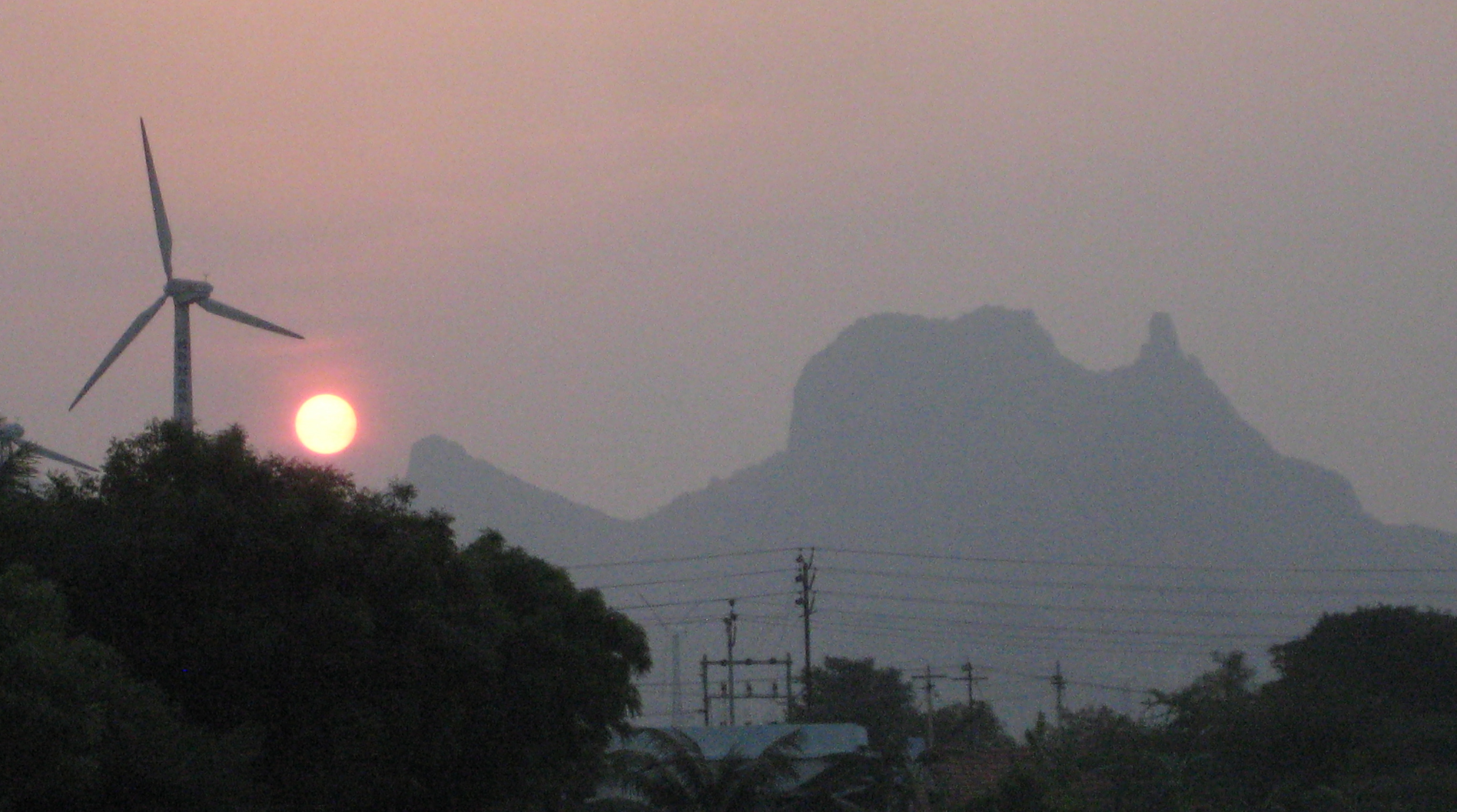
April 6th, 2010  At the southernmost tip of India lies the Muppandal Wind Farm, the biggest source of wind energy in India and one of the largest in Asia. I drove through it by accident a few days ago and and can report that Muppandal is as curious and multilayered as India itself. At the southernmost tip of India lies the Muppandal Wind Farm, the biggest source of wind energy in India and one of the largest in Asia. I drove through it by accident a few days ago and and can report that Muppandal is as curious and multilayered as India itself.
Muppandal pumps out 540 megawatts of electricity because of the strong, consistent winds that blow off the Arabian Sea and funnel through the Western Ghats (the lumpy, Dr. Suessian peaks in the background of the photo).
The turbines look strangely at home amid the coconut and banana groves, as if they were merely the region’s oversized new crop. The chaotic hodgepodge of turbines appears in batches over dozens of miles. Any one vista might encompass several different designs. India solicited models from all over the world, from the Netherlands’ blocky Vestas to Germany’s Enercon, with its distinctive teardrop-shaped nose.
A businessman I met explained that turbines in India are individually sponsored, which explains why corporate names and logos are painted on so many of the towers. A company “buys” the turbine, and in exchange the company gets a credit on its power bill equal to the turbine’s output.
Muppandal bears little resemblance to the wind farms I know in the U.S., with their tidy rows of identical turbines. But India seems to find its own way.
April 5th, 2010  I just returned from a visit to Chennai, one of the largest cities in Southern India, where my partner Anjali and I stayed with her family in a pretty nice apartment building. Besides eating some delicious dosai and uttapam, I came to understand one reason why India’s per-capita electricity consumption is 15 times less than that in the United States. I just returned from a visit to Chennai, one of the largest cities in Southern India, where my partner Anjali and I stayed with her family in a pretty nice apartment building. Besides eating some delicious dosai and uttapam, I came to understand one reason why India’s per-capita electricity consumption is 15 times less than that in the United States.
In India, every power outlet is governed by its own switch, and those switches are monitored with a careful eye. I was sternly instructed to turn switches off when I was done with them. If I vacated the bedroom without turning off the switch to the overhead light and the ceiling fan, I would get an immediate reprimand from the family cook. When I visited the aunt’s place across the hall and wanted to use the Internet, I had to start up the computer from dead because it had been switched to “Off” at the wall. No standby appliances vampiring electricity here.
This thrift extended even to the apartment gym, where I arrived with water bottle and towel to find the lights off and every cardio machine dark. To work out on the treadmill I switched its outlet on. When I finished I turned it off, as the sign next to the the machine instructed.
To contend with Chennai’s broiling heat, it isn’t as simple as pushing a thermostat button and pumping an entire big room or building full of cold air. Instead I turned on the A/C unit by the treadmill, and when I was done with the treadmill I switched it off. Then I headed to the dumbbell area and activated its resident A/C unit. None of this felt like any sort of imposition.
Somehow Indians have an instinct toward electricity conservation. Maybe it has to do with the country’s roots: Like many Indians, Anjali’s family is just three generations removed from its ancestral village, where one tended to the rice paddies and the bullock. Life was too hard to let anything go to waste.
Whatever the reason, it was refreshing to take a break from America’s thoughtless, wasteful use of power and to know that, halfway around the world, a billion people have found another way.
March 15th, 2010 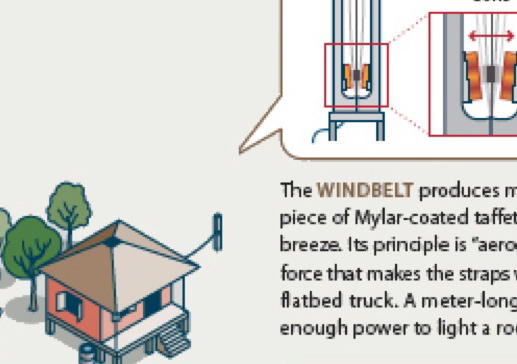 The Innovate column I write for Sierra magazine has one shortcoming: The word-count is too small for me to convey the wealth of useful resources I’ve found. Over the last few months, I blogged about the five technologies included in the March/April issue, which focused on what’s known as “Appropriate Technology.” When it comes to energy, this is a fancy word for cheap, durable energy sources for poor communities living off the grid. The Innovate column I write for Sierra magazine has one shortcoming: The word-count is too small for me to convey the wealth of useful resources I’ve found. Over the last few months, I blogged about the five technologies included in the March/April issue, which focused on what’s known as “Appropriate Technology.” When it comes to energy, this is a fancy word for cheap, durable energy sources for poor communities living off the grid.
Thermoacoustic Engine. The thermoacoustic engine is a technology that has some serious explaining to do. Many sources of natural energy, such as wind or solar or wave power, are fairly easy to get your mind around. But what the heck makes a thermoacoustic engine run? The short answer is waste heat, which our industrialized society (and even rural society) has plenty of.
Efficient Cookstoves: Waste heat in a poor, off-grid community comes from the cookstove that combusts wood, dung, or some other burnable to cook food for the family. There are millions such cookstoves in the world and most are ripe for serious design improvements. A few simple changes to a stove’s design can slash the amount of feed wood, keep children safer, eliminate soot in the hut (and wipe black carbon from the skies), and cook food faster.
Solar Refrigerator: Another head-scratcher. How is it possible that a refrigerator could get cold because it is out in the blazing sun? Students at Michigan State University figured out how, and are doing so with materials readily available in Guatemala.
 Windbelt: The windbelt fills a void our wind portfolio: It produces small doses of power very close to where it’s needed and can operate in winds that are strong or weak. It does this without lopping off the heads for birds, and requires almost no maintenance. Windbelt: The windbelt fills a void our wind portfolio: It produces small doses of power very close to where it’s needed and can operate in winds that are strong or weak. It does this without lopping off the heads for birds, and requires almost no maintenance.
Treadle Pump: When I saw my first video of the treadle pump, my first reaction was, “Of course!” A farmer who can’t afford diesel and isn’t on the electric grid could save hours every day with the help of this cardio machine made from steel or wood. An hour or more on the treadle pump can replace hours of labor for farmers in Asia, Africa and Latin America, and at a price they can actually handle.
March 13th, 2010  Photo by Nick Hobgood If there’s one thing I learned from reporting this month’s Innovate column, it’s this: The biggest beneficiaries of renewable energy will be the poor, rural farmers of the Third World. The billions of people who live off the grid in Africa, Asia and Latin America will use smaller and humbler technology than we will in the urban, modernized world. Yet its impact will be far greater.
In Europe, the U.S. and parts of Asia, the focus is on building massive solar installations and windfarms that are powerful enough to replace the carbon-spewing sources we already have, like coal-fired power plants, and that can feeds into the robust electricity grid we already own. Our power sources will change, but for the most part we’ll use those electrons for the same activities we do now. The developing world doesn’t resemble this equation at all. Entire regions have no money for projects this big, and no grid to speak of.
Traveling in rural Africa and Mexico, I’ve seen that the defining characteristic of the small backwater village is its lack of electricity. During the day a tinny radio powered by batteries plays at the grocery kiosk. At night the town shuts down, except in the orbit of the few businesses fortunate enough to have a kerosene lantern. A person is living a lifestyle of the rich and famous if he has a TV running off an old car battery. Though cellphones have become common, they’re difficult to charge and can’t provide nearly the connection to the world that an Internet-enabled laptop can.
For this month’s column, I looked at small yet cutting-edge technologies that could change this scenario. Some are novel ways of producing a few modest watts, enough to load a battery that can light a bulb in the hut at night so Mom or Dad can prepare for tomorrow’s harvest, and the kids can study. Just these few hours of productive time could spark dramatic changes in health, prosperity and educational attainment. As we learn to make power generators that are small, powerful and cheap, it will be possible for even poor villagers to have access to computers and the Internet. And with that, the village might achieve just enough prosperity and convenience that its residents don’t have to flee to the urban slums to make a living.
In my next post, I’ll explore what these technologies might look like.
March 11th, 2010  Look on page 69 of this month’s Sierra magazine and you’ll find Innovate, a column in which I explore new ideas in energy. Look on page 69 of this month’s Sierra magazine and you’ll find Innovate, a column in which I explore new ideas in energy.
I’m excited about this assignment because it lets me roam about at the beginning of our new era, the Renewables Age, and bend down to pick up the shiniest objects. The field is suffused with a sense of possibility. Seems like every week I hear about a new idea for capturing electricity from an orphan source, or harnessing it in a superior way. Trapping windpower (PDF) from passing subway trains! Making ice at night to cool buildings by day! Deriving fuel from our own sludge, or from carbon dioxide in the air, or from a glass of water!
Innovate is eye candy for techno-enviro geeks. The centerpiece is a large graphic about a technology, or a suite of technologies, that could solve one of our myriad energy conundrums. The trick for me as a journalist is to find the inventions and trends, and then work with a graphic artist to turn complex ideas into an illustration that can be understood at a glance. Finally, I do a profile of one of the pioneers of that exciting new field.
 Someday a decade or more from now, when the Renewable Age is fully upon us, we will do what humans do: We will glance back at promising technologies that sputtered out and chuckle in a knowing way; we will admire the victorious inventors, who will live in mansions and run businesses that have become boring and predictable; we will drive cars with a battery the size of a tea bag and a tank filled with gas made from old coffee grounds, but we will complain that it doesn’t have enough cupholders. Someday a decade or more from now, when the Renewable Age is fully upon us, we will do what humans do: We will glance back at promising technologies that sputtered out and chuckle in a knowing way; we will admire the victorious inventors, who will live in mansions and run businesses that have become boring and predictable; we will drive cars with a battery the size of a tea bag and a tank filled with gas made from old coffee grounds, but we will complain that it doesn’t have enough cupholders.
This is not the column for that day. This is the column for this day, when we don’t yet know who the winners or losers are, but can see with growing certainty that something fantastic is just around the corner.
|
|