Bubble, Bubble, Methane is Trouble: A vast storehouse of methane under the Arctic Ocean has perforated and is starting to leak, researchers disclosed. While scientists have long been preoccupied with methane release from thawing permafrost on mainland Siberia, the underwater stores in the adjoining East Siberian Arctic Shelf are much larger, and the release of even a small fraction could lead to a dramatic increase in global warming. Methane is a greenhouse gas at least 25 times more powerful than CO2.
Now a Word from Our Other Gases: It was a promising week in the world of fuels. A Colorado startup revealed a solar concentrator that can vaporize biomass and make high-yield synthetic fuels. British scientists explored enzymes in the gut of a boat-eating bug that could break down straw or waste wood. Meanwhile, a California newbie called Transonic Combustion claims to have invented a fuel-injection system that could boost mileage of plain old gas by 50 percent. The company registered 64 miles to the gallon in recent test drives.
And the Winners in the Common-Sense Category Are…: Rooftop solar water heaters are spreading like dandelion seeds in China and Europe; if worldwide growth projections hold true, in the next decade they could save the energy equivalent of 690 coal-fired power plants. Hurrah also for the efficient cookstove, a simple and inexpensive contraption that can stamp out soot, reduce the melting of glaciers, and help women and children live longer in the developing world.
Now Get Out of Here: With the Greek economy in meltdown, there’s never been a better time to buy an island. If it sinks underwater in a few years because of global warming, then make like the Maldives and build your own.
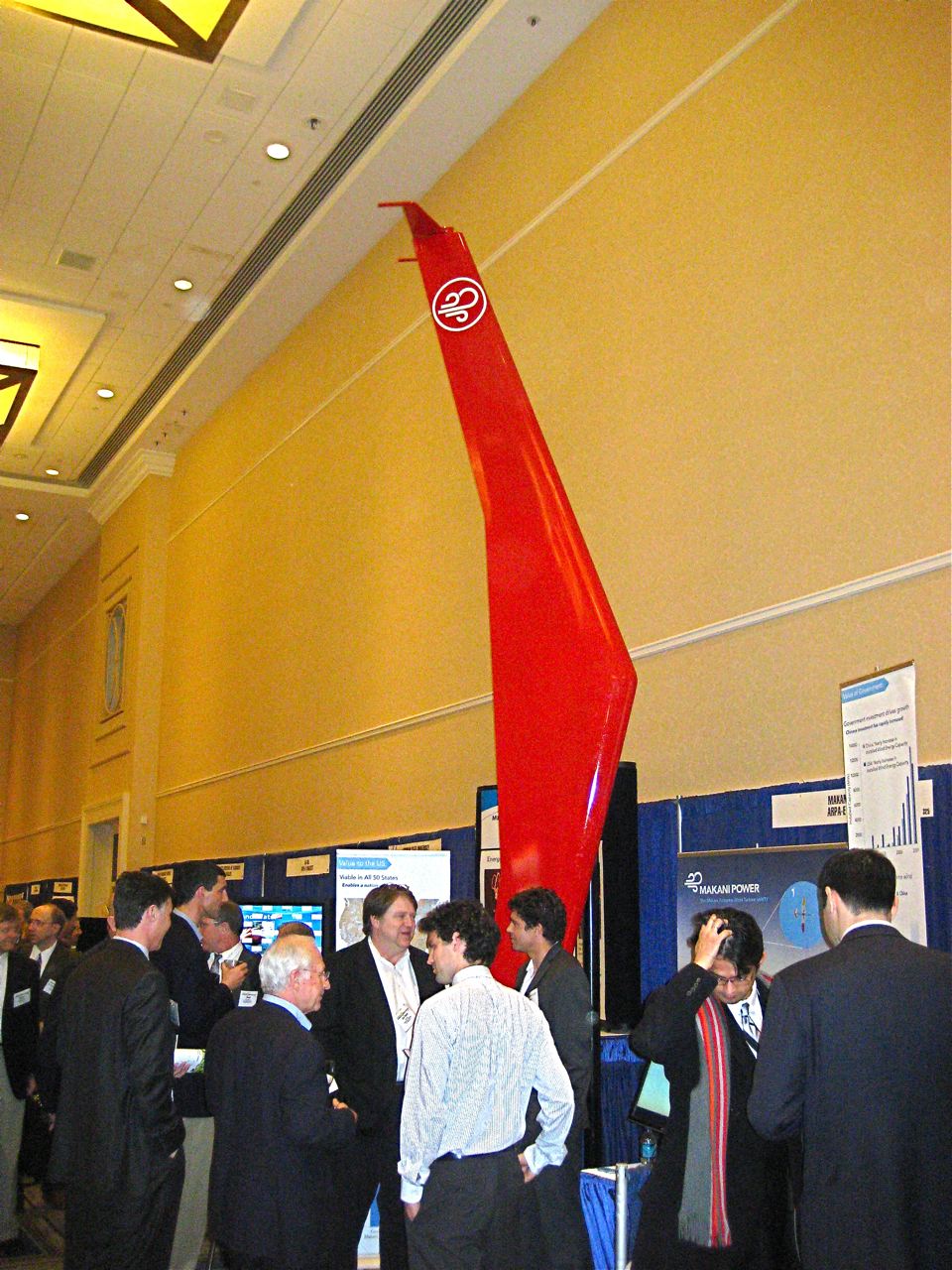
The Makani Power generator made a rare appearance at the ARPA-E conference this week.
The most surprising thing about the inaugural ARPA-E summit, held this week outside Washington D.C., is that the conference hall was full of losers. They were inventors, scientists and entrepreneurs who had applied for funding from the U.S. government’s exciting new energy-research organization but had been shot down. The Advanced Research Projects Agency – Energy received 3,500 proposals, but only accepted 37. That leaves room for some compelling also-rans.
As a consolation prize, some of the most credible finalists got booth space in the exhibit hall. The most visible were those with ambitious plans for “kite power” — harnessing the powerful and consistent winds that blow high off the Earth’s deck.
Kite energy is way out there, both physically and in the public mindset, and it can be a hard sell, even to an agency like ARPA-E that funds risky projects. Who wants to put their money on the line for a four-rotor helicopter the size of a 747 that’s suspended several kilometers in the air?
“We want a funding category and we want air space, so we can all play together,” said Len Shepard, CEO of Sky Windpower, creator of the giant helicopter-turbine.
Here’s a rundown of the models I saw:
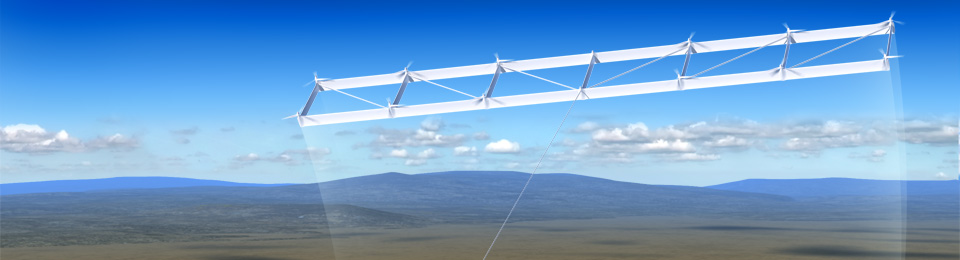
Joby Energy. A Joby wind installation would look like a giant white ladder turning circles in the sky.
At each rung of the ladder are two small propellers that generate power as the ladder tugs against the wind at 400 meters up.
Tethering the device is a cable that serves two power functions: sending generated electricity to the ground, and if the wind goes slack, returning power to the props to help the device make a safe, helicopter-style landing.
The Joby Energy design.
The Joby team, made up of former students from the Massachusetts Insitute of Technology and Stanford, are now assembling a 100 kilowatt (KW) model and are hoping to create a 300 KW one soon.
Makani Power. Early on, Makani got the ultimate imprimatur of approval: $10 million in seed money from Google, followed by another $5 million since. But their design has been a mystery. That cleared up a bit this week as Makani displayed a giant red fiberglass prototype at its booth at the ARPA-E conference.
Makani’s kitewing will zoom though the sky in circles with propellers attached, much like Joby’s design. Founder Corwin Hardham said the company plans to develop a 100 Kw model in the next year and a half, and a one-megawatt model the year after that.
An illustration of Sky Windpower's entry.
Sky Windpower. Unlike Joby or Makani, Sky Windpower’s approach is to launch a larger generator far higher in the sky — 6,000 to 27,000 feet up, said Shepard. Buffeted by winds of up to 300 miles an hour, it would stay in one place, more or less, governed by its tether and four rotors. Such high winds means the generator could be as large as a jet plane and could pump out 1 to 1.6 MW per unit.
The Unstoppable….Solar Lobby?!? A skirmish this week in Arizona revealed that the solar industry, while still adolescent, is developing some political brawn. A bill in the state legislature proposed expanding the definition of “renewable” to include nuclear power, a move that would have allowed the state’s lone nuclear plant to fulfill Arizona’s mandate to receive 15% of its electricity from renewables. Solar companies howled, including Suntech Power Holdings, which threatened to cancel its first U.S. factory in Arizona. Days later, the proposal was retired.
Walmart to Suppliers: Be Green or Else Walmart announced a goal of cutting 20 million metric tons of greenhouse gas emissions from its supply chain by the end of 2015. By using its unparalleled purchasing leverage, Walmart intends to force greener behavior from its vendors, like it or not. Suppliers may reduce carbon by focusing on raw materials, manufacturing, transportation, customer use, or end-of-life disposal.
If You Pollute It, We Will Come The Environmental Protection Agency said it would explore building renewable-energy projects on polluted industrial “brownfields” sites, many of which are well-supplied with power transmission to feed the grid. Also, Chevron announced plans to build a concentrating photovoltaic solar plant on the tailings of a molybdenum mine it owns in New Mexico.
Hummer R.I.P while Hybrids R-I-P As the Hummer died, hybrid and electric cars continued their confident merge onto U.S. highways. Toyota said it will sell a hybrid RAV4 by 2012. Not to be outdone, Volkswagen announced plans for a hybrid Jetta in 2012, a hybrid Passat and Golf in 2013, and that same year, its first all-electric models. Meanwhile, Tesla announced it would lease the Roadster for the not-inconsiderable sum of $1,658 per month.
March of the Penguins This week the Antarctic melted apace, as an enormous survey of Antarctic sealife showed that global warming is altering its ecology. In an unseemly bid for attention, the continent also calved an iceberg so large that it threatened to change world ocean currents.
A Dangerous Rise in Global Shrugging The Obama administration launched www.climate.gov as the go-to portal for all climate needs. Not that anyone age 18 to 35 cares; according to a new survey, when it comes to global warming, youngsters don’t really give a damn.
As Europe announced it would reach its goal of 20 percent of its energy from renewables by 2020, the U.S.’s climate soap opera entered a new chapter. President Obama converted his energy bill into a hybrid in hopes of driving it through Congress. To get the Senate to agree to a cap on emissions, he offered $36 billion in loan guarantees for nuclear-power plants and new leases for oil and gas drilling in the Gulf of Mexico. To further nudge coal states toward a carbon diet, he offered subsidies for the coal industry to capture and sequester carbon and to convert coal-burning plants to natural gas, despite the fact that Congress is investigating whether gas-drilling practices contaminate groundwater.
In another concession, the Environmental Protection Agency announced it would drag its feet in regulating carbon dioxide as a pollutant in order to mollify coal-state lawmakers. In a letter to reluctant Democratic senators, Administrator Lisa Jackson said the agency would pursue the biggest game 400 large emitters, mostly coal plants — in early 2011, followed by refineries and large factories in late 2011. Medium-sized factories might wait until 2016.
Bill Gates declared in a TED talk that his top priority is bringing the world’s CO2 emissions to zero. This revelation was a surprise, as to date the Gates Foundation has steered its formidable assets toward public health and poverty alleviation, or as Gates puts it, “vaccines and seeds.” But since global warming lurks as a threat that could dim hopes of fulfilling his other priorities, Daddy Warbucks is shuffling the deck.
Bloom Energy emerged from years of secrecy by pulling off not one but two publicity coups, first in the form of a glowing segment on “60 Minutes,” followed by a media opportunity starring Arnold Schwarzenegger and Colin Powell and drawing glowing comparisons to Google’s IPO. Only problem is there was no IPO, or even a product launch — just an unveiling of the Bloom Box, a $700,000 to $800,000 fuel cell now in use by companies such as eBay and Fedex. Bloom Founder K.R. Sridhar said the company hoped to create a compact unit that could satisfy a home’s energy needs for $3,00o, and that it would change the world. Didn’t they say that about the Segway?
A cadre of fast hybrids are headed to the Geneva Auto show, including the 400-horsepower plug-in hybrid Mercedes F800, a Porche 911 GT3 R hybrid that will hit the racetrack in May, and the Ferrari 599 GTB Hybrid, which boasts a pair of electric motors, a lithium-ion battery, and increased fuel efficiency that bumps from nine miles per gallon to — get ready — 12 miles per gallon.
The EPA announced the priorities for a $475 million plan to save the Great Lakes, including cleaning up pollution, fighting invasive species, cutting runoff and restoring wetlands. Meanwhile, Quiznos announced that if any of its paper cups blow into Lake Michigan, at least they’ll be compostable.
In other news, Boulder hit a rocky patch with its smart grid, and a utility discovers the key to making people turn down the thermostat is to employ rivalry and shame.
BrightSource Energy has trimmed its proposal for a solar-concentration plant in the Mojave Desert by 12 percent, in hopes the concession will mollify the project’s critics. The Brightsource installation has pit advocates of clean energy against those who fret about the future of the Mojave’s residents, like the desert tortoise and the Mojave milkweed. The new plan would drop the amount of electricity headed to Southern California from 440 megawatts to 392 MW.
Silicon Valley gained two solar companies and lost one in a busy week of consolidation for a young industry. SunPower, the San Jose firm that is one of the U.S.’s biggest solar panel makers, bought SunRay Renewable Energy of Italy for $277 million, acquiring projects now in the pipeline in six countries in Europe and the Middle East.
Calisolar of Sunnyvale absorbed Ontario’s 6N Silicon Inc., combining two solar-cell makers for expected heavy growth in North America. Also, Areva, a French nuclear-power concern, diversified into renewables as it purchased Ausra, a Mountain View-based maker of concentrated solar thermal equipment.
The hypermiling community moved into high (though very quiet) gear as Nissan announced that it will accept pre-orders for the Leaf, the first all-electric car by a major carmaker. Customers can register in April, and deliveries are expected in December.
At the Chicago Auto Show, Ford offered test drives of its Transit Connect Electric fleet vehicle and got a favorable review for its hybrid Focus. Meanwhile, at a press conference in Munich, Volkswagen made the latest of a series of contradictory announcements, this time saying its first entry in the hybrid category will be Touareg SUV.
Last week, as the media seemed ready to slice off Toyota’s head for selling cars with faulty brakes, Prius owners tapped their brake pedals and reacted with a shrug.
But the most exciting and weird news in cars came from where you’d least expect it: the half-jet, half-car Delta Wing, the crowdsourced Rally Fighter, and at last a price tag for the skateboard-car, the Trexa.
The U.S. Chamber of Commerce continued its stalwart denial of global warming as it petitioned a federal court to stop the Environmental Protection Agency from regulating carbon dioxide as a pollutant.
On one hand, solar, biomass, new vehicle technology and the smart grid all receive a boost of hundreds of millions of dollars under Obama’s plan. On the other, the president again suggested ending $36.5 billion in subsidies for oil and gas. Lest coal states and Republicans get too exercised, he also committed $545 million to carbon-capture technology and a whopping $36 billion in loan guarantees for new nuclear power plants, a move that drew howlsin some quarters.
Combined with a generous investment in biofuels, especially advanced ones, it appears the president is preparing to to herd resurgent Republicans and reluctant Democrats toward an energy bill this year.
A New York Times story detailed how thoroughly China is dominating the race toward renewables while the U.S. dithers. But the rising tide can cross the Pacific, as American Superconductors demonstrated when it won a $70 million contract to provide wind-turbine control systems to Shenyang Blower Works.
In a last-ditch effort to save climate legislation this year, a consortium of clean-energy groups met today in Washington and kicked off a week of intense planning and lobbying.
The notion of Clean Energy Week was born only a few weeks ago, when several groups realized they had planned events in the capital at the same time. Hasty organization didn’t prevent speakers at an opening press conference today from hammering on a consistent message: that the United States might gain 1.9 million jobs in the next decade if some version of a cap-and-trade bill is passed this year.
One participating group is the Coalition for the Green Bank, whose co-founder, Reed Hundt, said, “As the president made clear in his State of the Union address, a focus on green jobs is the immediate focus for the clean energy sector, and in fact by promoting the double whammy of clean energy generation and transmission along with energy efficiency, literally millions of fine new jobs can be created over the next several years.”
Organizers have high hopes for a “Business Fly-In” on Thursday, when 200 CEOs of clean-energy businesses arrive to meet with swing legislators and put a face on the possibility of jobs creation.
Other events include RETECH, a three-day conference between business, nonprofits and government on renewable energy.
Prospects for a climate bill retreated two weeks ago, when the Democratic Party lost its filibuster-proof majority in the Senate with the special election of Republican Scott Brown in Massachusetts.
However, President Obama’s repeated emphasis on clean energy and jobs in his State of the Union speech last week has invigorated advocates that an agreement might still be won.
I grew up listening to KQED, the public radio station for the San Francisco Bay Area, and I’m exhilarated to announce that I made it on the radio yesterday.
The piece, “Wilderness Calling,” is part of KQED’s Perspectives series, where regular people make their best case on a topic of the day. While some might question if I’m a regular person, I have formed an emphatic opinion about the growing use of cellphones in the great outdoors, based on a jarring experience I had in Yosemite National Park last summer. Listen to the whole thing below. (2 minutes 20 seconds)
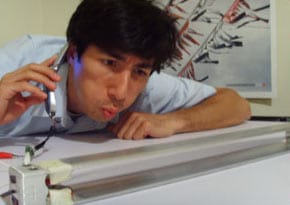
Why is it that many solar panels are the size of a hallway rug, while a typical wind turbine is the size of an office building?
There are many reasons, but one has to do with maintenance. A solar panel requires almost none: Install it and leave it alone for years. But a wind turbine is a finicky device with many moving parts, and the servicing makes a small turbine hardly worth the expense. I’ve always wondered whether we would ever learn to harvest wind on a smaller, simpler scale. Turns out we can.
The WindBelt was dreamed up by 28-year-old Bay Area inventor Shawn Frayne during a trip to Haiti as he tried to figure out how to deliver power to the energy-starved developing world. Frayne dispensed of the turbine altogether and explored a different aerodynamic phenomenon known as aeroelastic flutter. The marquee example of the principle is the so-funny-it’s-tragic collapse of the Tacoma Narrows bridge, aka “Galloping Gertie”:
Frayne asked himself: What if I induce those same forces, but on a small scale, and use that flutter to move small magnets and produce electricity? The result is wind power on a modest, rooftop scale. This video demonstrates it best:
The company Frayne created to improve and market the technology, Humdinger Energy, is marketing three sizes of Windbelts to serve different needs. Deploy a regiment of Windbelts in a windy area, and they could supply power equivalent to a large wind turbine, but without the noise or the rotors that kill birds.
Bunkherd Faphimal shows me a thing or two about Muay Thai kickboxing.
On the occasion of Christmas, I extend a thank you to some of the people who helped make 2009 active and memorable. Specifically, I’d like to acknowledge the dojos who offered their time and expertise for “Fighting to Keep Fit,” a story I wrote in the current issue of Men’s Journal.
Word counts are tight in magazines these days, and Men’s Journal didn’t have the space to acknowledge all of the gyms and masters who offered their time and facilities for this story.
Without further ado, I give the following dojos a respectful nod.
Krav Maga: special thanks to Idaho ATA Martial Arts in Boise, where I sweated through front kicks to a soundtrack of Metallica, and to the Academy of Self Defense in Santa Clara, CA, where Woody Mosqueda taught me how to defend against an attack with a bottle, and Everest Pepper showed me the fundamentals of stripping a man of his gun.
Woody Mosqueda winds up to clock me with a bottle.
Tae Kwon Do: A heartfelt thanks goes to Master Kim’s Martial Arts Academy in Sunnyvale, CA, and to Master Kim himself, whose most effective instruction was making me sit in his office for more than an hour as he explained, with great passion, how discipline and honor lie at the heart of martial arts.
Muay Thai Kickboxing: Thanks to Fairtex in San Francisco, where I learned to move on my toes, and to Fight and Fitness, also in San Francisco, where I enjoyed talking about the sport with Rocky at the front desk, and where Bunkherd Faphimal taught me a mean roundhouse kick though I couldn’t understand a word he said.
Karate: Thanks to Prodigy Martial Arts in Los Altos, CA, and especially to Dragon Bushido Dojo in Boise, ID, where Renshi Pon Inthathirath led me through my first kata and where I barked out one of those karate yells the way one is supposed to, from the diaphragm.
Mixed Martial Arts: The most eloquent, thoughtful explanation I ever got of mixed martial arts came from Alan Pagle at Modern Combatives in Berkeley, CA. Thanks also to Nakapan Phungepham at Beta Academy in Washington, D.C., for allowing me a week’s access to his classes in the church basement.
Eduardo Fraga squeezes me in a Mata Leon ("kill the lion"), cutting off the blood supply to my brain.
Brazilian Jiu Jitsu: Eduardo Fraga at Ralph Gracie Jiu Jitsu in Berkeley, CA explained and also demonstrated some of the geometrically challenging moves that make BJJ such a ruthlessly effective art, and also complied with my odd journalists’ request for three Mata Leon in a row. I think I’ve recovered by now, Eduardo!
 Bubble, Bubble, Methane is Trouble: A vast storehouse of methane under the Arctic Ocean has perforated and is starting to leak, researchers disclosed. While scientists have long been preoccupied with methane release from thawing permafrost on mainland Siberia, the underwater stores in the adjoining East Siberian Arctic Shelf are much larger, and the release of even a small fraction could lead to a dramatic increase in global warming. Methane is a greenhouse gas at least 25 times more powerful than CO2.
 Hurrah also for the efficient cookstove, a simple and inexpensive contraption that can stamp out soot, reduce the melting of glaciers, and help women and children live longer in the developing world.


 Hummer R.I.P while Hybrids R-I-P As the
  As Europe announced it would
  A
A  BrightSource Energy has trimmed its proposal for a
  President Obama turned his attention to energy this week, and in a rapid-fire series of announcements scrambled the prospects of the entire industry. Just days after