Check out the December/January issue of Men’s Journal for a story I wrote called “Fighting to Keep Fit.”
For this assignment, I got instruction in six combat-based martial arts to determine which best serves an individual’s fitness and sports goals. The six I chose were karate, Brazilian jiu jitsu, tae kwon do, muay Thai kickboxing, mixed martial arts, and krav maga. I drew on my fitness-training background to answer some questions that few have ever posed:
Which martial art helps drop the most pounds? Which is the best cross-training for a runner or cyclist? Which is best suited for a multi-tasker, or for a problem-solver?
I would tell you, but you’ll have a much more enjoyable and immersive experience by seeing it for yourself. Next time you’re at the bookstore or in the grocery line, look for it. It’s in the Mind & Body section on page 81.
Farmers in Bangladesh have long had an irrigation problem. Water is often plentiful in ponds or in the shallow water table underfoot, but getting that water onto the crops is no easy task. Diesel pumps are expensive, and there just aren’t enough hours in the day to fully water the land with a bucket.
A solution has appeared in the form of the treadle pump, a sort of Stairmaster that pumps water. The device takes water-carrying work away from a polluting machine and puts in the hands (or rather under the feet) of the farmer.
Invented by in 1981 by an aid worker, the treadle pump has sold more than 1.4 million units in Bangladesh, according to IDE (PDF file), with many more in use in India and Africa. They range in price from $20 to $100 and may be made of metal or bamboo.
Twenty hours a week on the water treadmill will irrigate a quarter-hectare field – enough to empower a farmer to grow an extra crop cycle each year, to make each crop more robust, and bring home more money for the family.
The solar refrigerator. The purple box at bottom is the cooler, the solar panel and activated carbon bed are on top, and the condenser is at center. Image courtesy Michigan State University.
The very idea of a solar refrigerator is a contradiction: Use the hot sun to keep things cold. How could such an oxymoron possibly work?
It would seem impossible if a team of undergraduates from Michigan State University hadn’t already built a prototype, out of cheap materials, in Guatemala.
The potential uses for a solar refrigerator are endless, from air-conditioning buildings to keeping a case of Sam Adams cold on a hot Fourth of July day. But its most immediate purpose is keeping vaccines viable for medical clinics in areas of Asia, Africa and Latin America that aren’t served by an electrical grid. The perfection of a solar fridge could significantly reduce disease in the rural developing world.
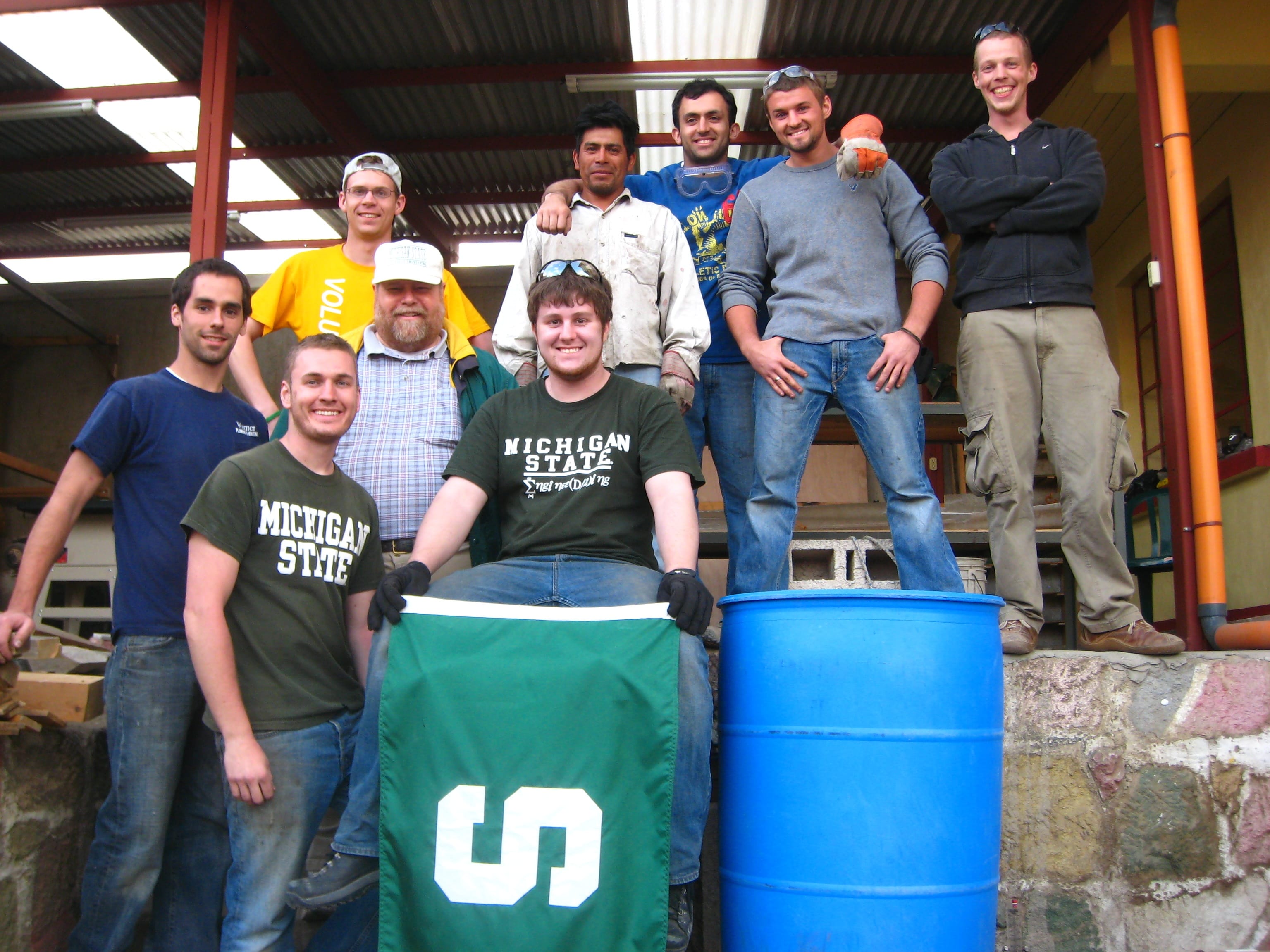
The Michigan State undergraduates who built one of the world's first solar fridges.
To get a solar fridge going, one needs a material that remains freezing cold even at room temperature. The Michigan State team chose ethanol, though methanol works too. Vacuum-sealed in pipes to low pressure, ethanol’s molecules slow and its temperature drops to about 35˚ F. The ethanol resides in the “evaporator,” a coil of copper tubes just inside the cooler. (Why is it called an “evaporator”? You’ll see in a minute).
By the end of the night, the cooler is 39˚ F, cold enough to keep its contents chilly even through a tropical day. As the ethanol has worked its cooling magic, it’s been doing something else: boiling at a furious rate. Ethanol in low pressure boils and turns into gas, just like that foggy liquid nitrogen you might have played with in science class.
Pipes direct that gaseous ethanol to the top of the box, where it drifts through a sandbox-like bed of powder at the top of the machine. The sand is activated carbon, aka charcoal. (John Barrie guesses that even charcoal from burnt coconut shells could serve this function.) The activated carbon traps the ethanol and holds it tight.
A solar refrigerator in action in Guatemala.
Then the hot sun rises. Sun rays strike the solar panel atop the machine. Directly beneath, the bed of activated carbon begins to heat up, and as it does, the ethanol vaporizes again. Only this time, the expanding gas raises the pressure in the pipes so the ethanol can turn back into liquid form. The ethanol gas fills the condenser, the matrix of pipes in the center of the drawing. The condenser has a large surface area that dissipates the sun’s heat and cools the ethanol back into liquid. As the day wears on, the ethanol trickles back down into the evaporator. By the time night falls, all the ethanol is pooled down in the evaporator, and the cycle can start again.
What if it’s cloudy? MSU professor Craig Somerton, who led the solar-fridge team, says that a fire set under the unit would keep it working.
While the sun-powered chiller is still a long way from reality, its promise is substantial. A well-calibrated solar refrigerator could go for years without maintenance, and most importantly, without ever being plugged into an electrical outlet. Click here to learn more and to find design drawings of the solar refrigerator.
In parts of India they’re called chulhas, in Malawi chitetezo mbaula, in Central America the Lorena, and in East Africa the jiko. The names and designs vary, but the principle is the same: a low-cost, efficient stove that replaces the open fire.
It’s hard to overstate the difference a better stove can make. In many parts of the world women cook over open fires in unventilated huts, filling the living space with smoke that stings the eyes and creates respiratory problems. Children burn themselves on the embers. An open fire requires lots of wood or other burnables, which means stripping the countryside in order to burn it.
An efficient cookstove requires a fraction of the wood, since it burns only exactly what is needed and sends heat directly to the pot. A flue routes the smoke outside, and the air receives less soot and carbon dioxide.
The building material is anything from clay to metal to concrete, and requires an exacting attention to design. To learn how it’s done, read this PDF.
Mt. Aconcagua and one of it's largest ice formations, the Polish Glacier.
Today I’m sad to learn that Mt. Aconcagua, a giant South American peak I attempted to climb several years ago, has become a collection point for the dangerous chemicals known as PCBs.
They found PCBs in every sample, with a lower concentration the higher they went. On average they found half a nanogram of PCBs per liter. This concentration doesn’t represent an immediate danger to climbers, they reported, but might have grim implications for wildlife, as well as the thousands of Argentineans and Chileans who rely on Aconcagua’s five glaciers for their drinking water.
Aconcagua’s toxic load is less than that found in the mountain ranges of the more industrialized Northern Hemisphere, such as the Italian Alps, where the concentration is four times greater.
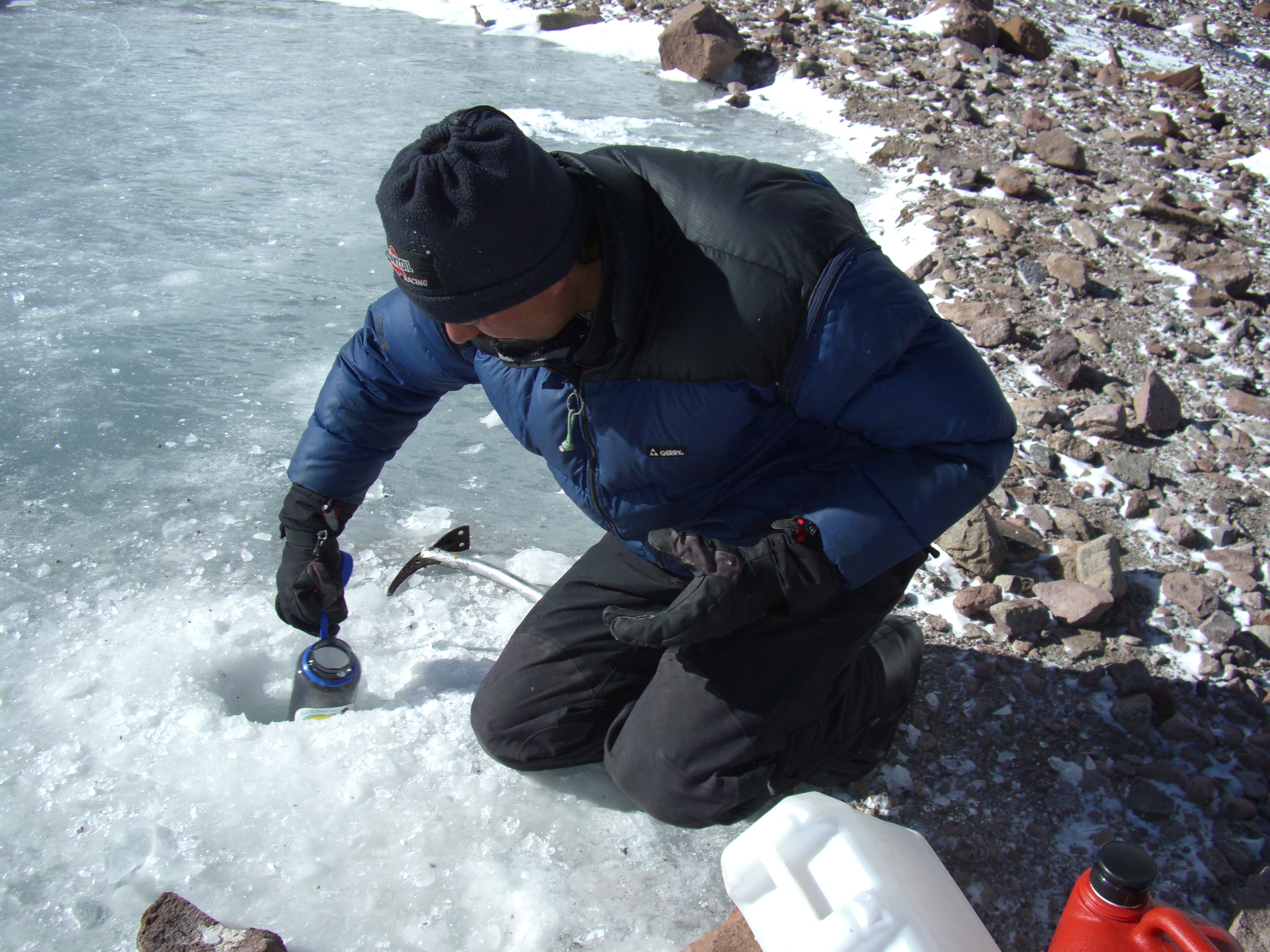
A guide draws water from an ice-covered glacial pond at 19,000 feet, during my climb up Aconcagua. Is this water tainted with carcinogens?
Still, it makes me take a cautious look back on the climb up Aconcagua, where I expected the danger to come from ice and storms, not chemicals that cause rashes, hair loss, cancer and impotence, as PCBs are suspected to do.
Despite being banned more than three decades ago, PCBs are still at large, afloat in the ocean, as I reported back in March, and now airborne on our tallest, wildest peaks.
The thermoacoustic engine is one of the weirdest forms of renewable energy I’ve heard of, and I had to have it explained to me several times before I started to get it. No description I read on the Internet made any sense. After consulting with John Barrie, an inventor who is designing a low-cost model for use in rural Guatemala, I created a description the rest of us could understand.
In short: The thermoacoustic engine uses heat to create sound, and sound to create electricity.
How’s that again? For the statement above to make sense, one has to understand the intimate relationship between sound and heat.
Imagine an impatient driver honking as you amble across the street. As the purple-faced motorist presses his horn, your innocent ears perceive the honk as a sound wave. What is a sound wave? Though we perceive it as sound, in reality it’s a wave of pressure. The crest of the wave compresses air molecules as it travels, while the trough of the wave is a little decompressed. That pressure wave enters your ear and strikes the tympanic membrane like a drumstick on a drum, making you turn and glance at the driver.
Now here’s where the heat comes in. The high and low-pressure parts of a sound wave actually have different temperatures, like the difference in mood between the angry driver and your cool self. The high-pressure part is hotter and the low pressure part is cooler. It’s this gap between hot and cold that makes a thermoacoustic engine work.
A typical thermoacoustic engine is a cylinder with a heat source warming up its middle. (Any of several heat sources will work: flame, an engine’s waste heat, or solar energy.) As the middle gets hot, the ends stay cool. Observe the flame at mid-cylinder in this video:
Pressure waves of heat and cold begin to bounce back and forth between the center and the ends. If the pipe is the right length and if the heat source is adequate, these chaotic waves fall into a steady rhythm known as a standing wave. Crucial to the engine is the “stack,” a perforated stopper that stands between the hot and cold parts like a cork with tiny holes in it. The stack serves two purposes. It’s an accelerator, causing air molecules to speed up as they move through the small openings. It also serves as insulator, to keep the hot side hot and the cool side cool.
At one end of the cylinder, the pressure waves create motion. Many thermoacoustic engines, also known as lamina flow engines, use the pressure waves to move a piston. That’s the design in this video:
Barrie’s design instead employs a magnet moving on a spring (like a drumstick on a drum). The magnet moves next to a copper coil, and the magnetic field between them creates electricity.
But wait – where does the sound come in? The sound is part and parcel of those pressure waves, though it doesn’t serve a useful purpose. In the same way that heat is a waste product of an internal-combustion engine, sound is a waste product of the thermoacoustic engine. Controlling that sound is part of the design challenge.
An engine could issue a whine of 135 to 180 decibels, which is louder than cozying up to a jackhammer. But if encased in a steel tube, it presents as a low hum, like the sound of a refrigerator running.
My lady Anjali and I just moved to Washington D.C. and I are trying to figuring out where to buy a house. Do we live in the suburbs, or in the District itself? We’re both children of the suburbs but are conducting our search from a sublet apartment in Adams Morgan, a hip neighborhood in the middle of the city.
As I walk around to its stores and restaurants, I ask myself: Could I see living in a big city, not as a lark, but forever?
The concentric squares and cul-de-sacs surrounding my childhood home in Sunnyvale, California.
The rectangular and diagonal grid around my apartment in Washington, D.C.
This is an unsettling question for a guy who grew up in the suburbs and just kind of assumed that, like it or not, back to the suburbs he would eventually return.
At the same time I’ve been reading about how to make suburbs a “greener” place to live. One way is to get people out of their cars. When city dwellers emigrated to the suburbs in the second half of the 20th Century, they gained a lawn but lost the ability to shop or worship or play without driving long distances. Now that we have all these suburbs, how can they be modified so the carbon-spewing car stays in the driveway, and the people walk to schools and shops?
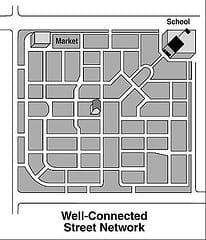
One of the writers I came across was F. Kaid Benfield, who explores how a neighborhood’s design influences whether people walk or drive. It’s not just a matter of exercise or personal virtue. Benfield did schematics of a cul-de-sac neighborhood and a traditional street grid.
Which do you think encourages a person to walk?
This got me thinking: How does the design of my neighborhood change the way I move through it? And if it’s important to me to be able to walk my community, how do the city and the suburb stack up?
I turned to Google Maps to find out. I asked for the route from my home to local landmarks, and set it to “Walking” rather than “By Car.” Of course Google doesn’t find a route as well as a local person might, but at least it gives a common reference point.
Here’s the route to the nearest high school:
The route from my childhood home to Fremont High School. Distance: 0.8 mile. Walk time: 15 minutes.
The route from my D.C. apartment to Cardozo High School. Distance: 0.5 mile. Walk time: Nine minutes.
Check out how many cul-de-sacs the suburban route has to go around!
Here’s the walking distance to the closest supermarket:
Distance: 0.9 mile. Walk time: 18 minutes.
Distance: 0.1 mile. Walk time: 2 minutes.
Everyone knows that in the suburbs, the store and the school are farther away. The surprising part is that those destinations are made even farther away by the suburbs’ design. No wonder the suburban streets are full of cars but empty of people!
Of course, walkability is only one part of the decision about where to spend my life. But I imagine a lot of people would like to have the spaciousness of the suburbs while still being able to walk to get a quart of milk. Doing so would involve some novel changes to the suburban landscape. We’d have to punch walking routes through the cul-de-sacs and change zoning laws so a subdivision could have its own mini-downtown, with a hardware store and market, and maybe a restaurant or two.
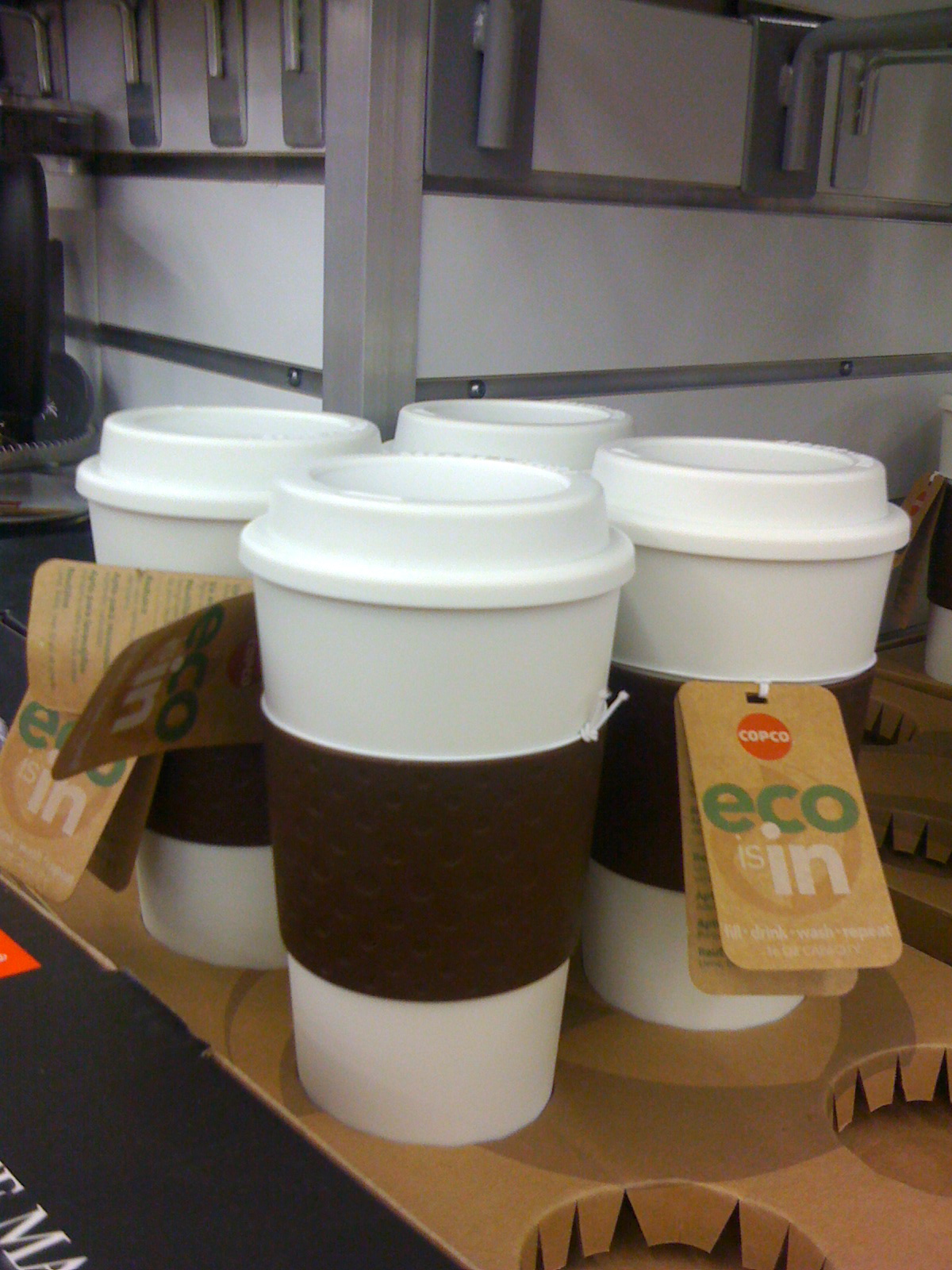
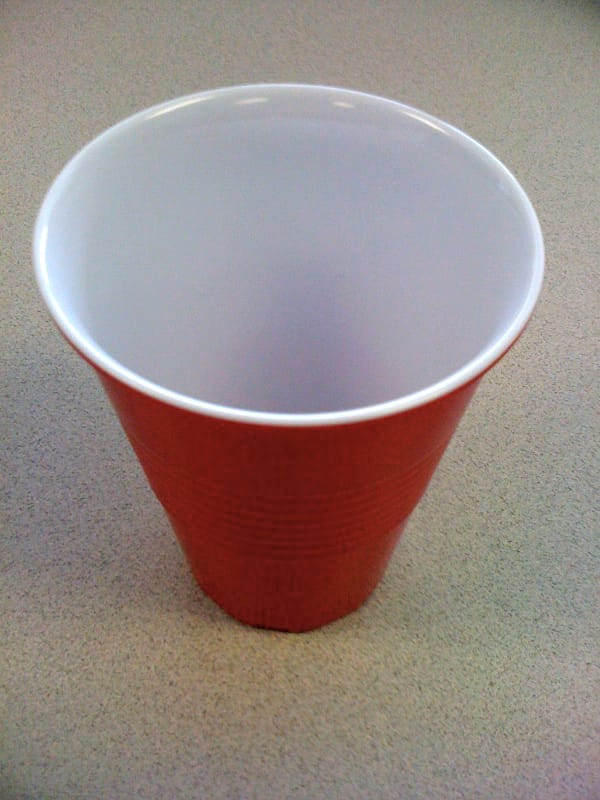
A few days ago at Bed Bath & Beyond, I was puzzled by something I saw by the checkout counter. It appeared to be a tall display of throwaway paper coffee cups. On closer inspection, they weren’t disposable; they were plastic commuter mugs made to look disposable.
Isn’t that weird?
Try to imagine a parallel from the world of products. It would be like a publisher printing a novel so its pages had the look and feel of newspaper. Or modeling a nice new house on a double-wide trailer home, with faux wood paneling and a cheap aluminum screen door. (If you can think of other examples, real or imaginary, let me know.)
Why would anyone make such a thing? Why would anyone buy it?
I asked the woman at the checkout counter whether people were buying. She nodded. “We had to put up another column of them just yesterday,” she said.
I circled back around to the display and held one. I have to admit it felt comfortingly familiar to handle, since as far as I can tell it’s a virtual copy of the Starbucks cup I have held in my hand hundreds of times. It even had a fake little insulating jacket.
The Eco-First Travel Mug, as its called, is made by Copco, a company that started making teapots in the 1960s and now is also a major purveyor of travel mugs. Someone at Copco must have gotten a raise for coming up with such a simple and brazen rip-off.
After all, Starbucks and its fellow coffee-sellers have already done the hard work of figuring out exactly what people want in a commuter cup. Teams of caffeinated specialists in Seattle engineered the cup bottom so it would fit any car cupholder, and designed the cup lip perfectly to the human lip, and gauged the insulating sleeve so it would fit for the best grip. No need to redesign what’s already been done.
Starbucks is trying to create an “Eco-Cup” of its own, having set a goal of a creating a recyclable cup by 2012 and making all of its cups (2.7 billion a year) recyclable by 2015. The company also encourages customers to bring their own mugs. Someone at Starbucks HQ is probably stomping mad that a competitor was the first to realize that the customer simply wants a Starbucks cup – made of plastic.
The surprising lesson I learn from the Eco-First cup is how deep and intimate our relationship is with throwaway food containers. I knew we used lots of disposables, but I didn’t know we loved them so much that the best way to make us leave them is to make a knockoff. A higher-quality knockoff. Trash has become the comforting staple of our lives.
I see a whole new generation of eco-products based on the trashy offenders of the past. Food clamshells with the smooth texture of Styrofoam. Water glasses with the waxy finish of Dixie cups.
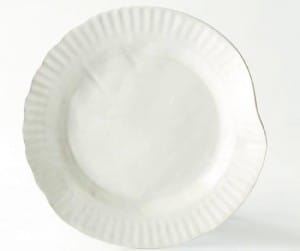
But wait, that day is already here. Someone has already figured out how to make the iconic red beer cup and the white paper plate – out of ceramics!
Special thanks to Mohi Kumar for helping to flesh out the ideas in this post.
Recently, the artist Chris Jordan flew to the Midway Islands to take photographs of dead albatrosses. Why travel so far to take pictures of such a small thing? Jordan wanted to make a point.
The photos he took reminded me of others you might recall. Remember how photos of baby seals were everywhere a few years back? Those furry white pups with glistening eyes didn’t just sell a lot of calendars. They catalyzed a public outcry that resulted in less seals being clubbed to death. Similarly, photos of the 1984-85 famine in Ethiopia led to a huge outpouring of aid.
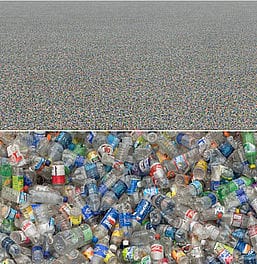
Jordan specializes in helping his viewers make sense of waste. Everyone has thrown away a plastic bottle. So what? I reconsidered my throwaway habits when I saw this piece by Jordan called “Plastic Bottles,” excerpted here:
And now Jordan has turned his camera on dead albatross chicks.
These pictures explain the Garbage Patch with heartrending simplicity. The Garbage Patch, in case you don’t know, is a giant area of floating litter in the middle of the Pacific Ocean. I know from personal experience that the Garbage Patch is difficult to explain.
It’s hard to get alarmed about the Garbage Patch because it’s hard to see.
The plastic doesn’t all bob together on the surface, like an oil slick. Instead it’s trillions of pieces spread over thousands of miles, only some of it on the surface. One can’t spot it from a satellite or a plane or a fast-moving ship.
So plastic doesn’t photograph well on the ocean, but it does from the belly of a baby albatross. Albatross parents fly for hundreds of miles to pluck food from the ocean to bring back to their young. These days, their baby food consists of lots of plastic, because the bright pieces of broken trash resemble food. These pieces of plastic block the youngsters’ guts and kill them while still on land.
Others have photographed these ex-albatrosses, but somehow Jordan is the first to capture the full pathos.
Pass these photos on, and help create a movement. See the whole photo series here.
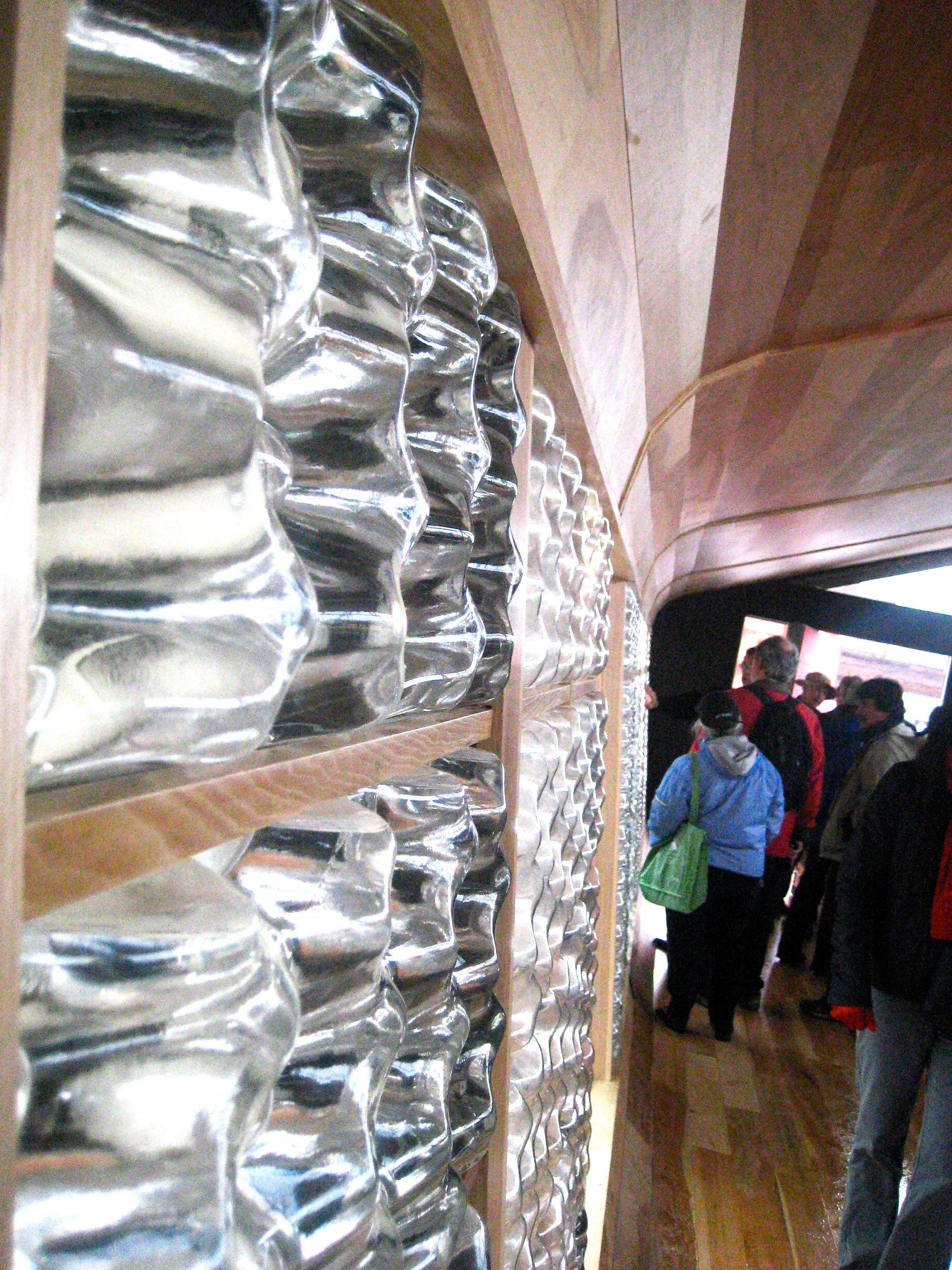
Near the Smithsonian building in Washington, D.C. stands a house with a wall of Coke-bottle plastic. Sandwiched between two layers of plastic is water. The wall’s surface conserves heat and also plays tricks with the light, so you can’t help but reach out and touch it.
On the deck of this house, a black kettle hangs twelve feet in the air. On sunny days it is filled with corn kernels. Below, two reflective circles bounce the sun’s rays onto the kettle. When the kettle gets hot enough the kernels pop and send popcorn tumbling down a tube and into a bowl, where they’re served to the crowds at the Solar Decathlon.
When I visited the University of Arizona’s decathlon project today, there was no sun. Clouds and drizzle filled the sky and temperatures hovered in the 40s. Only the feeblest solar energy fed the solar panels, as well as the sightseers, who despite being bundled in thick jackets and hats still stood in lines for half an hour or more to get a glimpse of the homes.
The Solar Decathlon brings 20 universities from around the U.S. and world to build mini-houses on the National Mall. They compete for the title of most energy-efficient house on the basis of ten criteria, including architecture, engineering, comfort and market viability. To win, a project needs to suck as much energy from the sun as possible – the design equivalent of lying on the beach in a bikini slathered in No. 2 Coppertone.
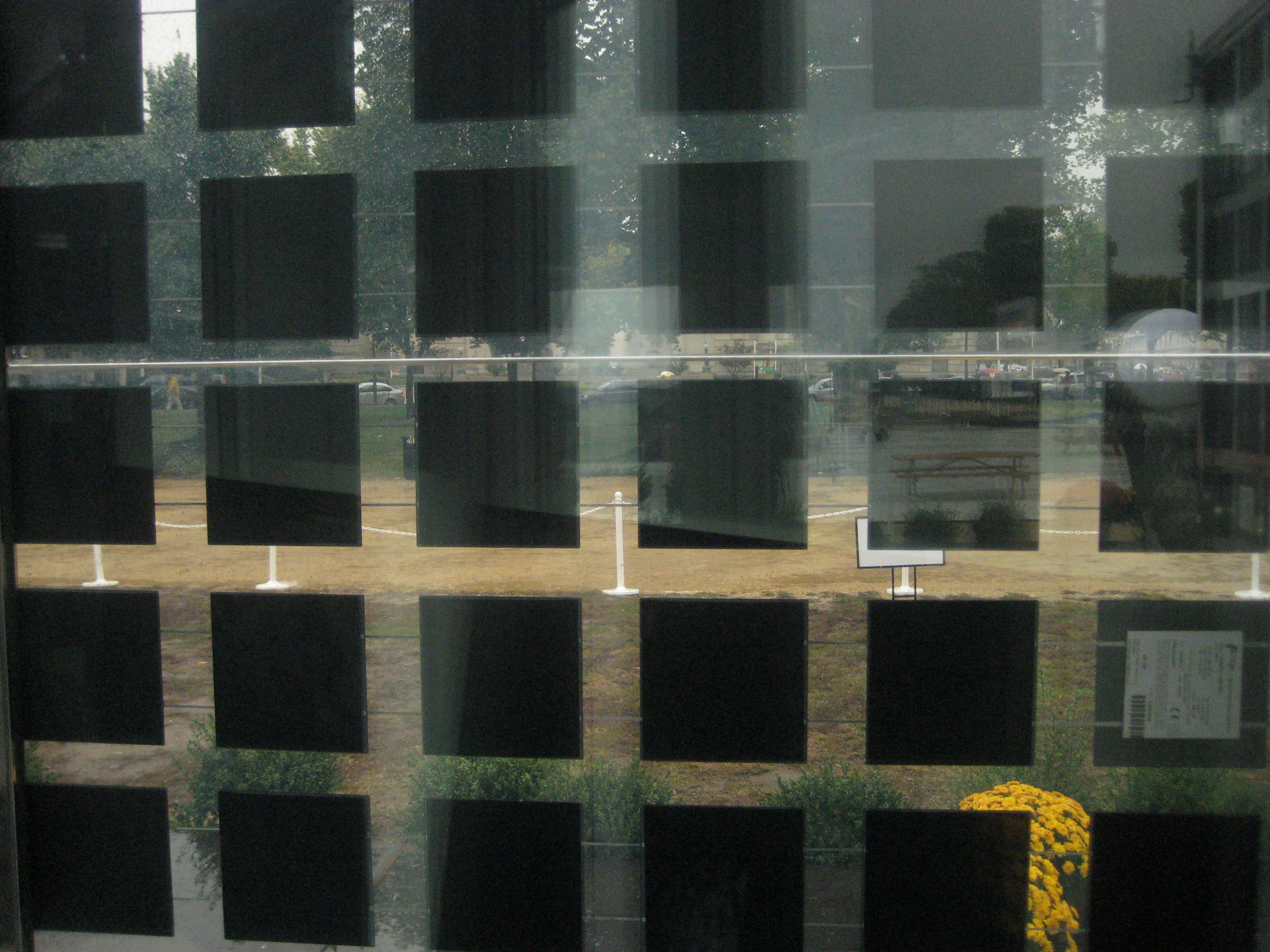
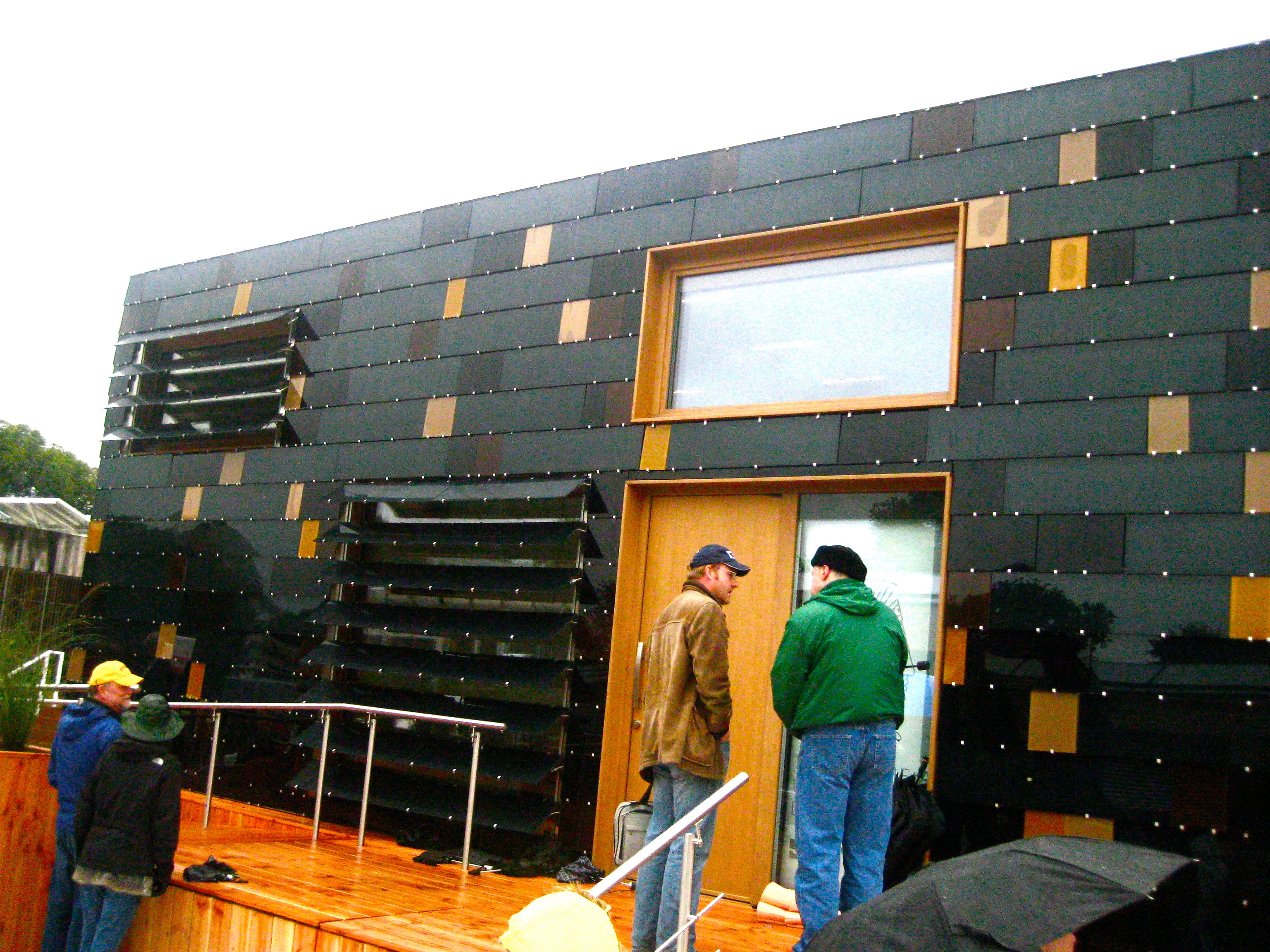
Students met this challenge in many ways. Team Spain embedded solar squares in glass walls and topped itself with a roof-size panel that rotated to face the sun’s rays. Team Germany sheathed its entire building in solar panels, all the way down to the window louvers.
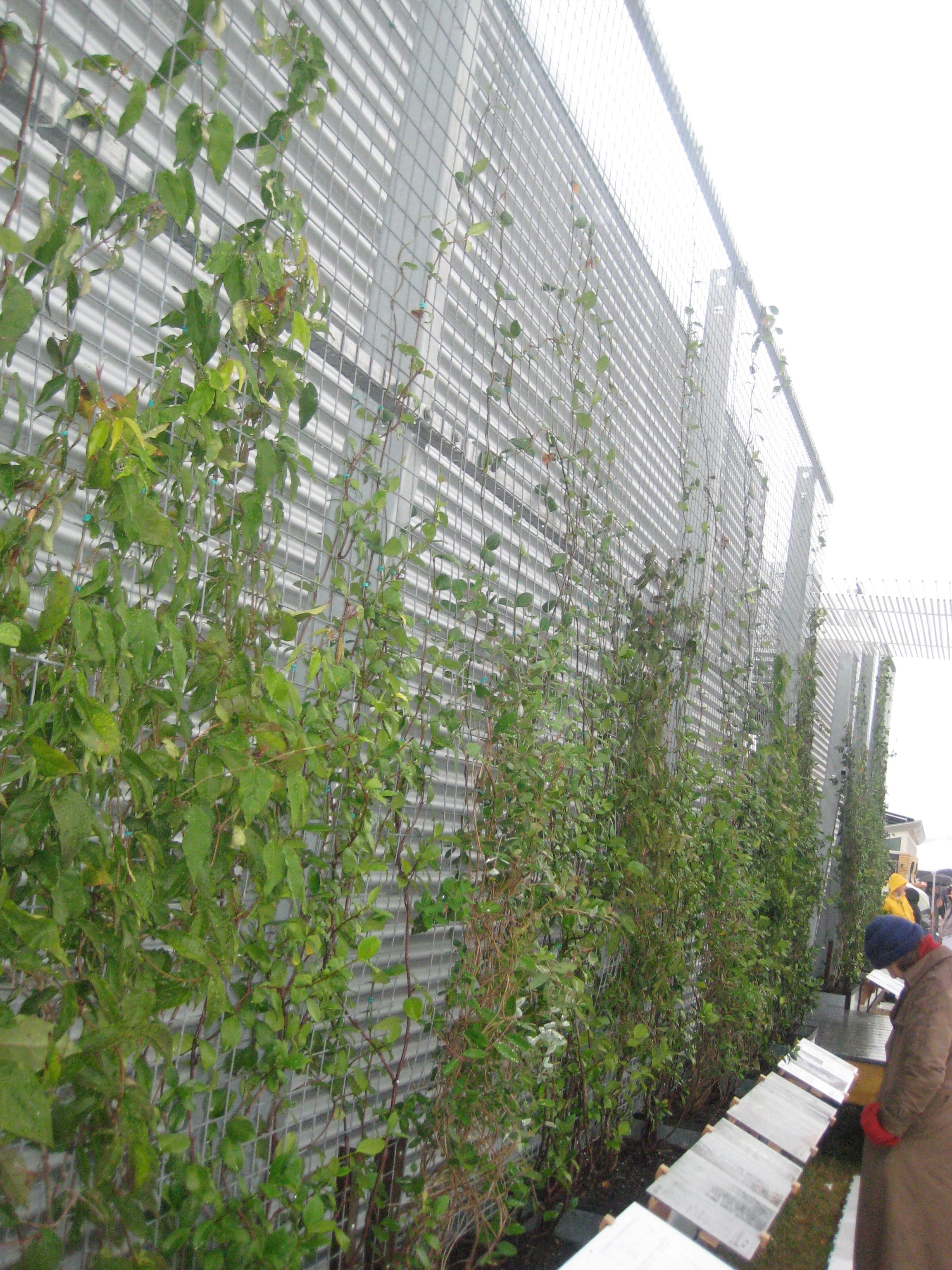
Plants climb the walls at Rice University's Zerow House.
Other projects put water coils under the floor and solar water heaters on the roof and rain-collection systems below the gutters. By investigating these ideas, one starts to look at walls, roof, floors and windows in a new way. They begin to look like a road crew lounging on their shovels. Get to work, you want to say.
One’s roof could be covered with solar panels, or skylights or grass or water tanks. The walls could be made of water or honeysuckle. The windows could open to let cool air in, or served by outdoor louvers to keep the heat out (and then covered with solar film, which worked beautifully for the Germans; they won the contest).
This is how people will look at their home surfaces in the future. The roof and walls will be crowded with energy-saving features, the way a TV remote is covered with buttons or a microchip is covered with circuits. You’ll look for ways to draw just a few more watts out of the sucker.
 Check out the December/January issue of Men’s Journal for a story I wrote called “Fighting to Keep Fit.”